
At this year’s Game Developers Conference, AI made headlines. Several talks revolved around the evolving tech, with developers discussing how it could be integrated into games. That was a controversial topic during the show, but one presentation seemed to wow attendees. Square Enix hosted a 30-minute live demo of an AI mystery game that showed how the tech could be a force for good, giving players more control over what they say and having NPCs that respond to prompts accordingly.
One month later, Square released that demo to the public for free. If you go to Steam right now, you can download The Portopia Serial Murder Case and try it for yourself. In fact, a lot of PC players already have … and the response hasn’t been too kind. As of the time of writing, the tech demo has a “Very Negative” rating with over 250 user reviews. While some of those could be reactionary review bombs from detractors of the tech, many appear to be legitimate criticisms calling out an incredibly limited experience.
“There might be some exciting tech behind the curtain but to end-users, it really just feels like a language engine from the late 90s,” one review reads. “It only responds to hyper-specific queries and doesn’t seem even half as flexible as they’re pretending it is.”
They’re not wrong. The educational project isn’t exactly a strong first look for the potential marriage of gaming and AI. The Portopia Serial Murder Case is an odd tech demo that seems to make the problems it aims to solve much worse. Despite that, I’m not ready to write off Square Enix’s efforts entirely based on the experiment, as I can see some areas where the tech could be useful in the long run.
Unnatural language processing
The Portopia Serial Murder Case acts as a modern remake of an old Japanese visual novel first released in 1983. The intent here seems clear: show how far video game tech has come by contrasting a restrictive, old adventure game with a new version supported by AI. In a manual bundled with the download, Square Enix gives some context as to what the project is trying to show off.
“At the time of the game’s original release, most adventure games were played using a ‘command input’ system, where the player was asked to type in text to decide the actions of their character,” it reads. “Free text input systems like these allowed players to feel a great deal of freedom. However, they did come with one common source of frustration: players knowing what action they wanted to perform but being unable to do so because they could not find the right wording.”
The introduction goes on to explain that those restrictions came down to the title’s Natural Language Processing (NLP), which was limited at the time. The new project acts as a showcase of how much that’s changed in 40 years as Square Enix shows off the improved NLP it’s currently working with. Unfortunately, the tech demo doesn’t currently impress in the way it’s meant to.
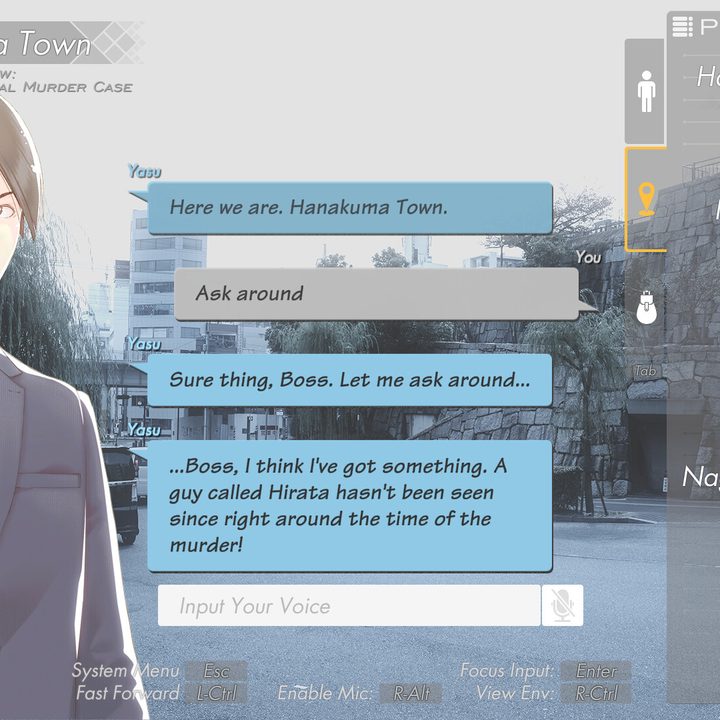
When I open the game, I’m thrown into a basic visual novel. I’m a detective investigating various locations across Japan trying to solve a murder by finding clues and interrogating suspects. My assumption going into it was that I’d be able to type just about anything into the text box and get some kind of relevant response. I immediately learned that wasn’t the case. Rather than functioning like ChatGPT, it feels like I’m trying to hold a conversation with Siri. Anything the game deems random gets me some boilerplate line to the tune of “Let’s not talk about that right now.” Instead, I need to figure out a pretty specific set of commands to make anything happen. If I want to ask strangers on a busy street for information, I need to write “ask around.” If I try to go off script, I won’t get the desired response. I experience a similar issue in interrogations, where forgetting to include a “the” in a command can leave the game confused.
After 30 minutes, I’d barely gotten anywhere. Nothing I was typing ended in an answer and I mostly found myself repeating the same few phrases over and over to move the story along. I’d begin to progress the more I picked up on recognized phrase templates like “look at …” but I became skeptical that Square Enix has actually solved the problem it set out to fix. My investigation felt every bit as unnatural and frustrating as classic text adventure games.
Part of the confusion I experienced seemingly comes down to a big tech omission. Square Enix noted that it had to remove the demo’s Natural Language Generation tool for now, citing the current risk of “unethical replies.” That aspect is what made the demo such an impressive showcase at GDC, so its absence here is a little confusing. What exactly are users seeing here that wasn’t already shown in games like AI Dungeon years ago?
Speech-to-text
Things would get a little more interesting when I’d enable voice commands in the main menu. With the tap of a button, I could speak prompts into my microphone and see them instantly translated into text and responded to accordingly. The mystery began to move a little more naturally at that point, as I hopped around town picking up shining clues and calling phone numbers by reading them out loud. It’s undoubtedly impressive to see spoken words clearly recognized in the game, going further than Dead Island 2’s recent Alexa integration.
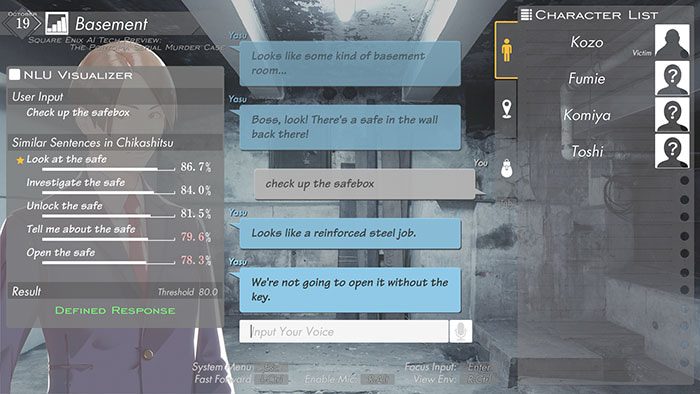
Still, that part of the demo is frustrating in its own right. Certain names would get mangled by the text-to-speech tool when I tried to speak them, forcing me to say them again and again until the computer wrote them outright. It flashed me back to the days of playing Brain Age on my Nintendo DS and struggling to get the word “blue” to register.
Though it’s positioned as an educational tool and a piece of software training, I’m not exactly sure what I’m supposed to take away from The Portopia Serial Murder Case. Simplistic language commands and repetitive, canned responses from NPCs don’t really make a case for how Square Enix’s Natural Language Processing or Understanding models can be used to improve a game like this. It’s not even clear how AI is being leveraged here — that much is clear from the Steam user reviews confused about how to interact with the game successfully.
Even so, it’s nice to see Square Enix being so transparent with its tech experiments and giving anyone the ability to play with its work-in-progress tools. This implementation is far from impressive, but I’m curious about what the publisher is attempting to solve. I’d love to play a mystery game where I can say anything I want into a microphone and have NPCs not only understand it, but respond in a relevant way (so long as scripted lines are left to human writers). That’s clearly not what anyone’s experiencing here, but hopefully, this is a necessary first step toward achieving that dream.


