
What I’ve always appreciated about the SteamWorld series is its unwillingness to settle. Rather than taking one successful idea and running it into the ground, almost every game runs in an entirely different direction. SteamWorld Dig is a modern twist on Dig Dug, SteamWorld Heist is a stylish turn-based strategy game, and SteamWorld Quest: Hand of Gilgamech goes truly left field with a card-based mecha-fantasy RPG. Though what makes all these games work is that they’re all equally well-thought-out and fun, too.
SteamWorld Build looks to continue that tradition. The latest installment in the ever-changing series is a city-builder that has players creating a thriving town around a train station. Though in classic SteamWorld fashion, it doesn’t just stop there. During a demo at this year’s Game Developers Conference, I quickly learned that the full game goes much deeper than “steampunk SimCity.” The full release draws inspiration from several previous installments to create a complex genre hybrid that pulls in everything from strategy to city management to tower defense. It’s the kind of complicated balancing act that only SteamWorld can really pull off.
Under the surface
When my demo begins, I think I have a full grasp of what’s happening in SteamWorld Build pretty quickly. I start by building a stretch of road branching off a train station and placing some buildings alongside it. Residencies give me access to workers who can, in turn, build structures like sawmills and cactus farms to harvest resources. Those resources go back into town building as I create even more structures and fulfill worker demands to keep everyone happy. Simple, right?
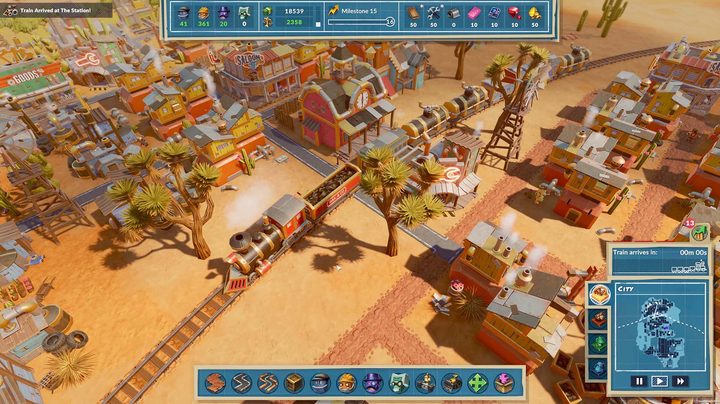
When my demoist launches me further into the game, I realize there’s a lot more happening under the surface – quite literally. In addition to managing a functional city, I also need to maintain several mines underground to dig up more resources and rocket ship parts to fulfill the story’s ultimate end goal. That’s where I start to feel the clever ways Build integrates ideas from other SteamWorld games. Underground gameplay initially has me building miners and commanding them to pickaxe through clods of dirt and rock to find more resources. It’s basically SteamWorld Dig but reimagined as a top-down strategy game.
Just as I’m getting the hang of that, I’m sent even farther forward in the game, where things are notably more complex. Now I’m managing a second underground mine below the first one, constructing support pillars to avoid cave-ins. I also bump into monster hives down here, which constantly churn out bugs that can destroy my carefully engineered operation. To combat them, I can build stationary weapons that’ll auto-attack any creatures, as well as equip combat units with some tools. It’s a tower-defense game within a city-builder, calling back to the series’ very first entry on Nintendo DS.
With each step forward, I get to see how much deeper the city-building goes. By that third jump, I have the option to construct a staggering amount of buildings. An “aristocrat” menu, for instance, allows me to create a plastic plant using rubbery mushrooms that I’ve harvested underground. Each business can be customized with different perks too, increasing their efficiency as I work to create a city that essentially functions like a well-oiled machine while I toil in the mines.
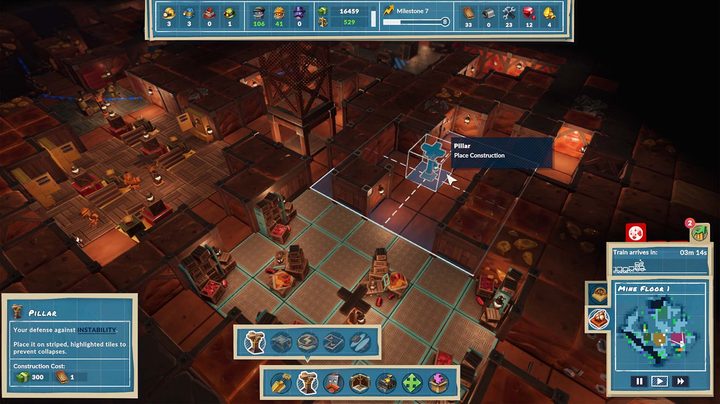
By the end, I’m a little taken aback by how seemingly complex it all gets. The final game will have players managing four layers altogether and I was left wondering how difficult that juggling act would get by the end. Fortunately, SteamWorld Build has a lot of helpful quality-of-life tools to keep management, well, manageable. A menu lays out all of my different structures and tells me exactly which ones are operating well and which need to be addressed to restore balance. If I need to construct a new building that requires several different resources, I see exactly what’s needed and can click on each to craft them on the fly. All of that should hopefully make the multi-tasking operation a lot easier to parse as players work through it at a more steady pace.
While I like what I’ve seen so far, I’m eager to get into that more natural flow. I’m intrigued by some of the high-level play I saw late in the demo, but I want to see how easy it is to work up to that skill level on a casual playthrough. The real test will be its ability to keep me up to speed as the complexity mounts. If it can pull that off, I imagine SteamWorld Build will be another hit for gaming’s most consistent series.


