City-building games usually all follow the same visual pattern. You start in a large open area, rife with nature. Sometimes it’s a desert or a forest, or just rolling plains with some scattered trees. Either way, that’s all covered up by concrete, towering buildings, and stressed-out workers by the end of the game.
That’s what makes Terra Nil, the latest game from Broforce developer Free Lives and Devolver Digital, such a standout. It has been advertised as a reverse city-builder, something that subverts the entire genre and flips it on its head. After spending some time with the game during a hands-on preview as part of Devolver Digital’s E3 showcase, I can certainly attest to that. However, Terra Nil also capitalizes on its relaxing nature, proving to be a much more complex puzzler than it lets on.
Reclaiming nature
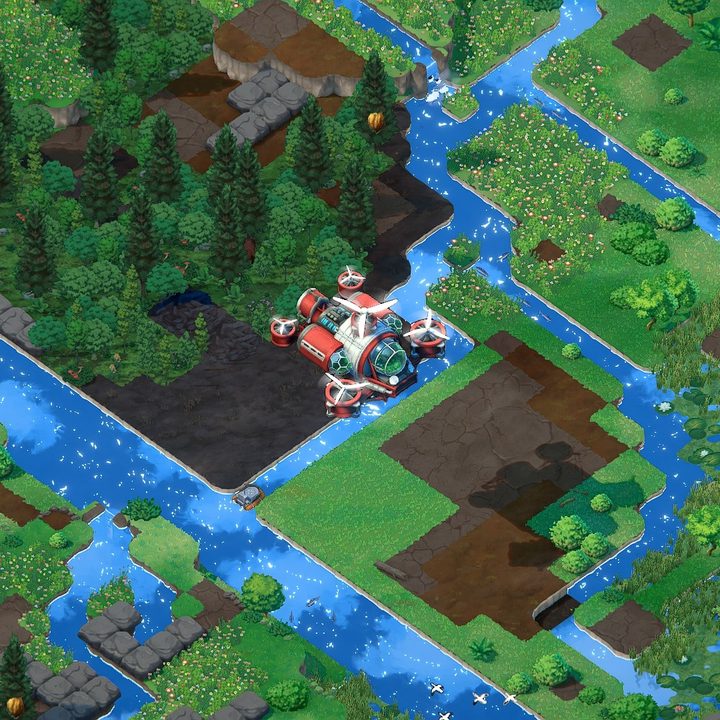
Rather than starting with a lush area full of nature and life, each procedurally generated map in Terra Nil is a complete wasteland. It’s gray, full of dead trees, rocks, and dried-up riverbeds. Your main job is to fill this wasteland with nature and then leave without a trace, the only thing left behind being a verdant field of life.
To that end, each game is split into three phases. The first has you place down buildings that detoxify the land and water it so grass can grow and trees can spring to life. Additional buildings let you fill dried rivers with fresh water, perfect for fish to call home again. While this process is pretty and you’ll want to just make the entire map green, it’s important to keep in mind that this is still a management game.
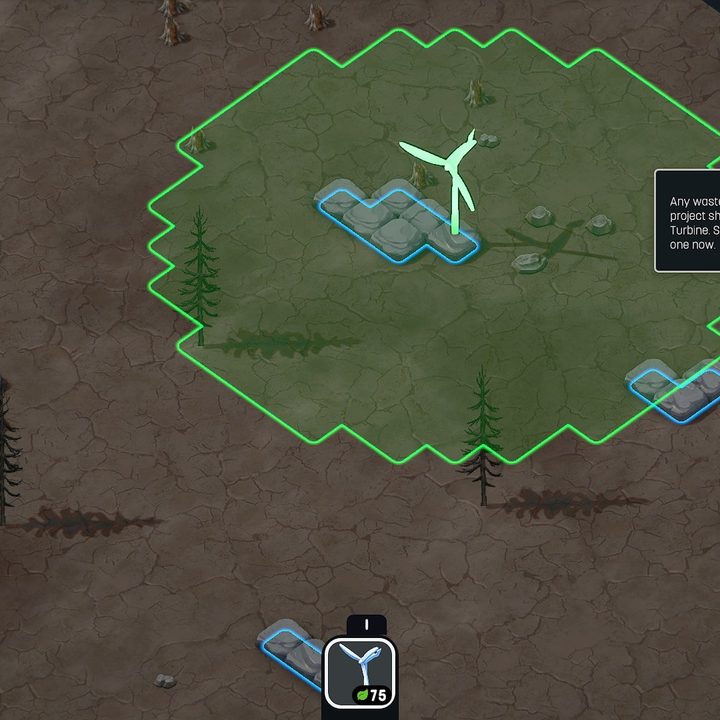
Your main resource is, essentially, greenery. You start with a set amount and spend some to build buildings. Of course, some buildings sprout more greenery, giving you more to build with. However, it’s easy to get distracted with building and not plan out how to eventually deconstruct everything, something that comes into play during the game’s third phase.
The second is less about building and more about diversifying. Nature can’t just be one thing; it needs balance. With some extra buildings, players can take the land that they’ve already reclaimed and turn it into something else. Areas around rivers can become wetlands, plains can become home to bees and beautiful wildflowers.
Terra Nil starts looking its best here, and it’s because of the player’s actions. After you diversify large areas, animals start showing up. The game’s empty skies are filled with birds and deer populate meadows. They don’t show up immediately, either; the first time you notice animals grazing or moving around the map, you’ll probably be surprised. It’s a nice surprise though, like a flower popping up through cracks in concrete. The game’s animals aren’t the best looking, and they certainly don’t have the flashiest animations, but it’s still a joy to watch them because you’re responsible for them being there.
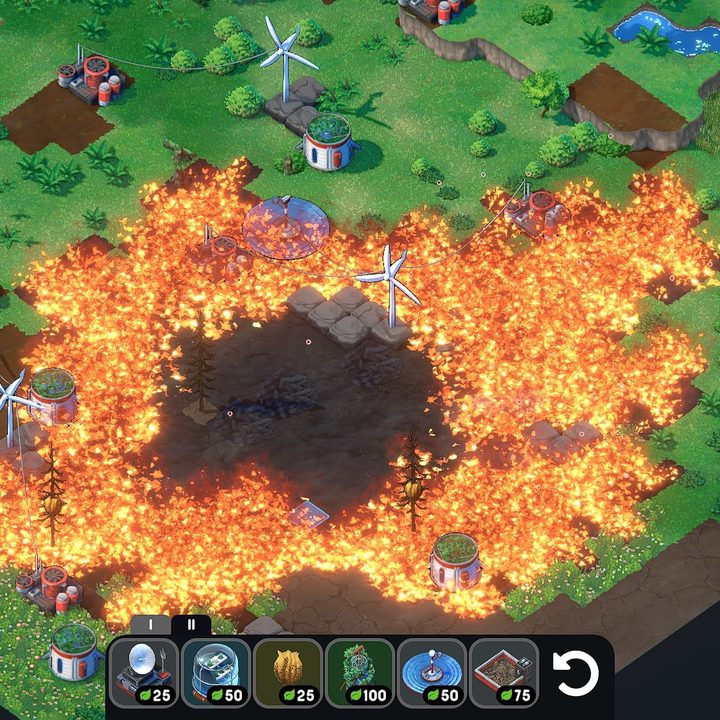
Having bears appear in Terra Nil means you need to grow a forest, which requires you to burn down an area of your reclaimed land. For trees to grow, they need rich, nutrient-filled ash, and you can only get that by setting fire to a large swathe of your area.
That’s not to say you’re forced to burn down the entire map. Players are granted plenty of options to modify the terrain. An excavator, for instance, draws a long line through the earth, making new paths for rivers to flow down. Likewise, calcifiers can be placed in rivers to sprout out tall rocks, perfect for placing wind turbines on to power your other buildings. But like everything else you build, eventually, those buildings have to get taken down.
Terra Nil‘s final stage is all about leaving nothing behind, which usually carries a negative connotation. Here, it just means you’re taking all traces of civilization out of an area. I know that still sounds bad, but in this context, it’s actually a good thing. You start by building a large airship, and then a small boat. The boat will then travel around to ports you’ve placed, which are filled with building materials first held in silos.
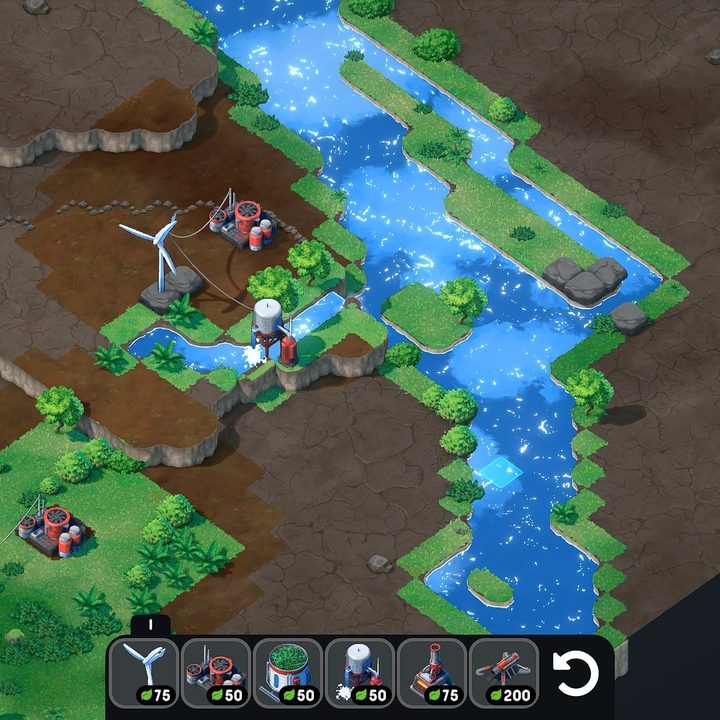
This is when Terra Nil‘s simplicity will likely betray you, as it did me. My first time playing the game, I wanted to cover the map in grass and different biomes, without knowing that I would eventually have to pack up and dismantle all my buildings. As such, I placed a fair number of them far away from water. That meant there was no way for the boat to collect materials from those buildings. They were stuck out there, and without all of them gone, you can’t finish a level. I ended up having to restart because I ran out of resources trying to dismantle a few lone buildings.
While that experience was frustrating, it taught me the mindfulness that comes with Terra Nil and how this game purposefully forces a player to balance everything. The entire map can’t be lush with greenery because you won’t be able to collect every building at the end. Paths to building clusters have to be made with excavators so they can eventually be dismantled and the map left without a structure in sight.
I’m left curious about what else Terra Nil has in store. After playing through its first map, I feel like I’ve pretty much experienced all it has to offer. While the game hinted that there was an entire world full of wastelands to reclaim, the question of what additional challenges will be levied against a player remains. After all, a majority of the difficulties that come from a city-building game start with a player decision. Without that, it’s not clear how levels throughout Terra Nil will push players to build better, smarter swaths of nature.
Terra Nil doesn’t have a release date just yet, and will only be available on PC when it launches. If you’re interested in what Terra Nil has to offer, you can check out the game’s page on Steam.