
“The Crush House turns reality TV into the funniest puzzle game you'll ever play.”
- Clever reality TV premise
- Sharp social satire
- Hilarious writing
- Ingenious audience puzzling
- Interchangeable characters
- Limited simulation
- Some disjointed gameplay hooks
“Why you can trust Digital Trends – We have a 20-year history of testing, reviewing, and rating products, services and apps to help you make a sound buying decision. Find out more about how we test and score products.“
Oh my God, did you catch the season finale of The Crush House? I totally did not expect Milo and Emile to hook up, but I’m here for it! I need to check their Instagrams to figure out if they’re still dating now. I just love that Gunther ended up alone, though. He’s such a freak. And Joyumi’s karaoke performance? So. Awkward. Who acts like that!?
If you’ve ever watched a reality TV show, you’re probably all too familiar with this kind of conversation. While the format became a phenomenon in the 2000s thanks to shows like Joe Millionaire and Survivor, it’s grown into an empire in the age of streaming services. Platforms like Netflix have capitalized on the sick appeal of reality TV by putting out trashy shows that raise the bar for what’s even ethical. It’s an infectious spectator sport that has a way of turning civilized people into proud brats.
With The Crush House, developer Nerial explores that dynamic in its unique reality TV simulator. Players aren’t just voyeurs who hate watching a slimy reality show; they need to satisfy those very people’s overbearing demands as the show’s sole cameraperson. It’s an ingenious concept delivered through hysterical writing and a one-of-a-kind first-person puzzle system. As sharp as it is, however, The Crush House’s limitations and at times disjointed gameplay show why it’s so difficult to truly replicate the complex appeal of trash TV.
1999’s hottest simulation
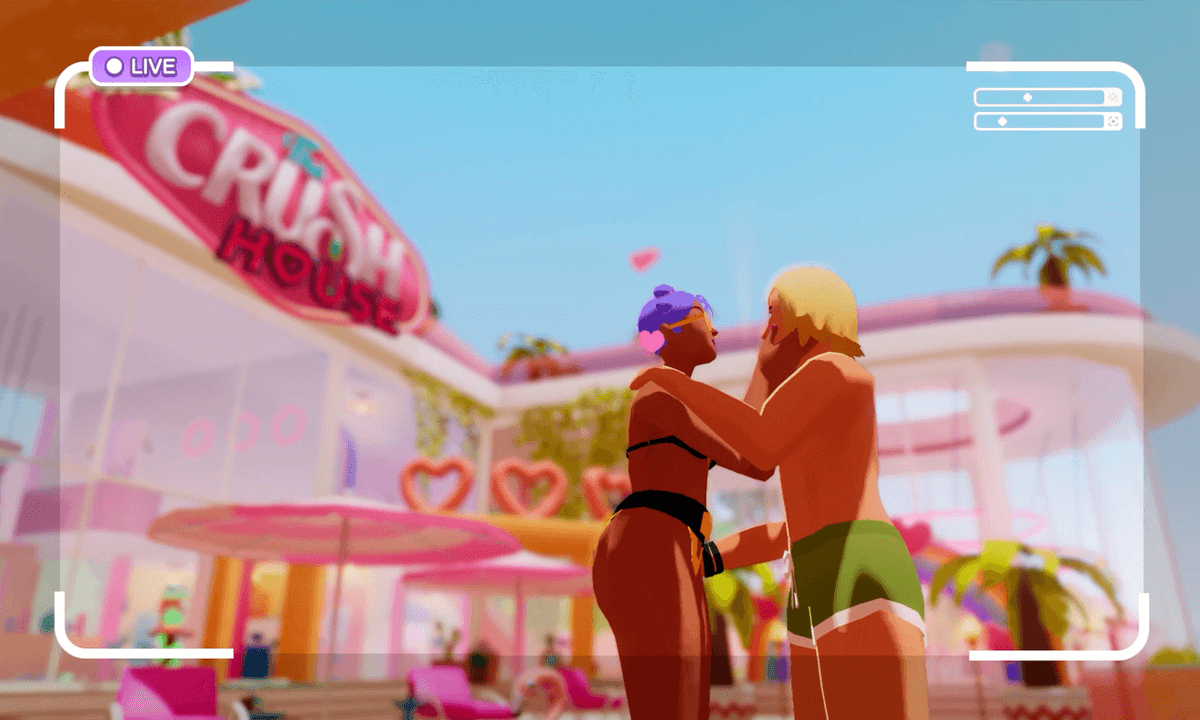
In The Crush House, players take on the role of the sole producer on 1999’s hottest reality TV show. It’s your typical slice of slop: four hot strangers spend a week together in a Malibu mansion complete with a pool (there’s always a pool!). The goal is to film all the drama as it unfolds, selectively recording the simulated show from a first-person perspective, and capturing moments that fulfill the wishes of an eccentric audience that comments live via stream. It’s like being dropped into The Sims, as smooching and slap fights play out. The difference is that players aren’t gods controlling it all; they’re observers there to watch on like kids at a zoo.
I easily found myself picking favorites and making enemies …
The actual simulation aspect gets the job done to a point, but it can only go so far in what’s a sleeker representation of reality TV. At the start of each five-day season, players start by picking four singles from a list of characters, each one with their own traits. Each bachelor plays on a different trope. Joyumi is a rich “girlboss,” while Gunther is a loudmouth internet troll. Put them together and sparks are sure to fly. I easily found myself picking favorites and making enemies among the cast of well-written characters, replicating the harmless mean streak I acquire whenever I begin a new reality show.
A season of The Crush House occurs over five in-game days, during which characters shuffle around the mansion grounds and act out scenes. It’s an impressive system that makes the fictional Crush House feel like a real show at times. In my first season, I watch with glee as my cast members fight, make up, and smooch. The deeper I get, the more mechanical it begins to feel. Kissing and fighting are the primary verbs for any cast. Even if I’m casting the ultra-shy Milo, he’ll eventually get into a screaming match with another cast member and confidently hook up with someone else. That can make characters feel a bit like interchangeable pawns, even if they do have distinct personality traits that set them apart.
There’s some truth to that; reality TV is built on archetypes and familiar drama. Whenever I watch a new season of Love is Blind, I quickly identify which singles are bound to be troublemakers, who is going to be the “hero” of the season, and which couples are doomed to fail. Despite being presented as real people in real situations, they can feel like puppets dancing for a camera that warps the truth. The Crush House smartly plays with that in its overarching meta mystery that addresses why the show feels so cyclical and why its cast members sometimes feel like malleable goo that’s been birthed out of an executive’s filing cabinet.
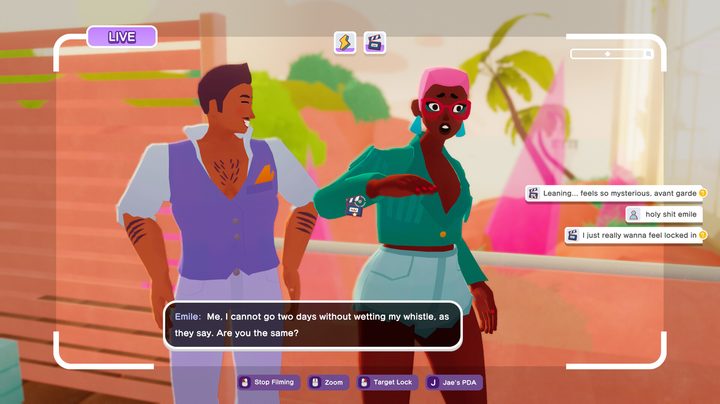
While that makes for some sharp satire, the flashes of humanity that make reality TV truly engaging are only briefly reflected in a comparatively narrow simulation. Those moments are relegated to each cast member’s own sidequest, which tasks players with breaking the show’s firm “don’t talk to talent” rule to fulfill a request for them. Milo, for instance, grew up as a sheltered kid. He wants to be filmed kissing someone, getting in a fight, and making friends to show the world that he’s a normal person. It’s a fleeting moment of sincerity amid the machinery that briefly connects me to these characters before they’re back to shuffling through familiar scenes.
Reality TV is a complex thrill. It’s repulsive, delightful, predictable, unpredictable, artificial, and sincere all in one. The Crush House touches on all of those ideas in a smartly constructed system, but a computer can only capture a uniquely fascinating snippet of human culture so effectively.
Puzzling audiences
While The Crush House has some shortcomings as a simulation, it excels as a comedic puzzle game that’s unlike anything I’ve played. Each day, a set of audiences tune in that each want to see different things that they hint at via a sidebar chat. Butt guys are there to see butts. Plumbers demand to see sinks and toilets, all while they comment on the mansion’s pipework. Libertarians are just straight-up trolls who rant about Ron Paul and how much they hate “the welfare state,” apropos of nothing. The Crush House’s best moments don’t happen in the simulated show, but in that ever-present side chat that accurately captures how annoying and needy TV viewers are.
The real game is about serving those conflicting needs by finding ways to fulfill as many of those needs as possible in each shot. When I click my mouse, I raise my camera and start broadcasting. If there’s something in frame that an audience segment likes, an emoji pops up and starts filling their satisfaction box. Some tasks are easy to fulfill. I can quickly rack up favor from foot fetishists by keeping shoes in the shot, while film school students are suckers for Dutch angles and impractically extreme close-ups. Others are more complex and I need to use comedic hints in the chat to decode four different ways I can satisfy them. With some experimenting, I learn that geriatrics want to see characters sitting (they spam chat with worries about the cast member’s backs whenever they’re standing).
A sharp social satire wrapped up in one of the funniest puzzle games I’ve ever played.
That playful hook turns into a fun and hectic juggling act once six or more audiences are in the mix. To optimize my ratings, I always want to try to satisfy at least three audiences in each shot. That triggers “on fire” status that makes their approval go up faster. Sometimes I find myself standing on a karaoke stage, filming a couple making out at a Dutch angle with the pool and some garden gnomes in the background. The chat explodes as a flood of emojis on-screen show me that musicians, film students, artists, plumbers, and more are all pleased with what they’re seeing. It’s a euphoric moment, one that I imagine a Netflix executive must feel whenever their perfectly engineered show is landing with their intended audience demographics exactly as planned.
Anytime I’m not filming, I’m running ads that give me cash I can spend on new house props between days. That doubles as both a needed progression hook, as the house gains more features that help broaden the simulation, and an additional puzzle layer. Is my cast failing to play to viewers in terms sexy moments? I can install a pool shower that can lead to some steamy moments. Or I could choose to load up my backyard with lawn decorations, making it the perfect space to rack up points no matter what I’m shooting. The more strategic I am about my purchases, the more I feel like I’m prepared for any amalgamation of weirdos.
Of course, that can go south too. Sometimes I get a shuffle of conflicting demands that aren’t easy to play to all at once. That might mean that I need to step away from the cast altogether and simply film the tiki torch-lit balcony for a while so my audience of lighthouse enthusiasts and arsonists can enjoy the show. There’s some funny push and pull there, but it can be frustrating considering that a failed day’s only real consequence is annoyance. The show gets “canceled,” but the day just starts again after that. By the later seasons, where I’m juggling eight audience segments at once, I’m barely paying attention to the simulation at all. I’m more so just repeating random shots and ignoring the show altogether.
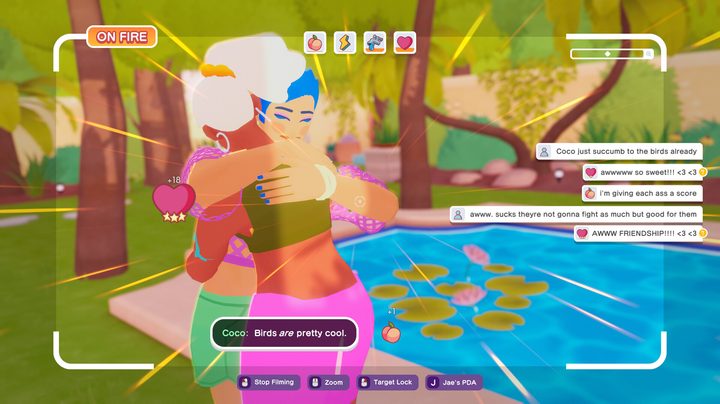
Those moments eventually reveal a breakdown in The Crush House’s busy premise. While there’s a show going on with character stories I want to follow, that sometimes feels secondary to everything else happening on-screen. Ultimately, my focus has to be on pleasing the audience each day at all costs and completing character quests, which are necessary to actually progress the overarching mystery. Even when I’m trying to follow a scene, the hilarious commentary on the side competes for my attention. And when my audience demands are fulfilled for the day, I’m incentivized to stop filming altogether to rack up cash. The enticing simulation gives way to a progression metagame that becomes repetitive.
As is the case with an actual reality show, I’m left grappling with conflicting feelings when I roll credits on The Crush House. It’s a sharp social satire wrapped up in one of the funniest puzzle games I’ve ever played, but the mechanical simulation leaves me wanting more. As I sit down to map out my criticisms, that’s when it hits me: I’m an emoji in my own audience segment. Maybe The Crush House would playfully nickname me a “snob,” one who keeps saying the term “high-concept” in the chat at random intervals. Maybe the things I’d want to see would clash with an audience hungry for this sleeker design that’s still perfectly functional and creative. The Crush House serves as a reminder that you can’t please everybody, or else you’ll end up in the backyard filming lawn gnomes.
The Crush House was tested on PC and Steam Deck OLED.


