Can a TV replace your video game console?
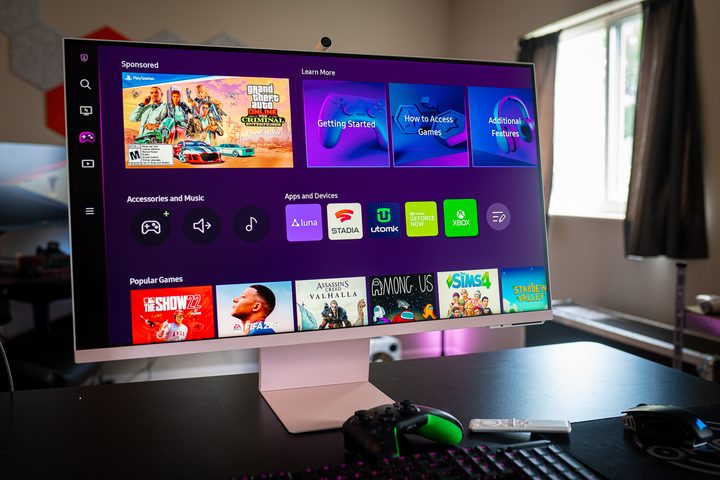
That’s a question Samsung has flirted with for over the past two years. It started with the reveal of Samsung Gaming Hub, a handy smart TV widget that brought several cloud streaming apps together. With it, anyone with a recent Samsung TV could instantly cloud stream games from Amazon Luna, GeForce Now, and, crucially, Xbox Game Pass. Samsung is even doubling down this year with the introduction of exclusive games that can be played with nothing more than a TV and phone. There’s a very real world in which someone could not own a single console and still have access to an enormous library of games.
But how viable is that? Can you really lead a full gaming life entirely through your TV? After years of curiosity, I finally gave that a try for myself. I bought a Samsung TV for my new home office and quickly immersed myself in the Gaming Hub ecosystem. Though there’s no chance it’ll change my gaming setup long term, I’m starting to see where the extra flexibility could weave into my routines — even if it’s not always the ideal way to play.
Gaming on a TV
My experiment would begin when I moved into a new railroad-style apartment and converted a narrow middle room into a home office. I decided that I’d want to move all of my gaming consoles into that room so it would be easier to jump over to them during the workday, leaving an Xbox Series S on my living room TV as a streaming app box. To complete my office setup, I’d need a new TV. After kicking around some options, I decided to go with a 55-inch 2022 Samsung TV primarily so I could have access to Gaming Hub.
After getting it set up and poking around the app, I decided to take a week to try to live in Samsung’s gaming ecosystem. Rather than hooking up my consoles, I’d exclusively do my home gaming through what was available through Gaming Hub (I’d still use my Steam Deck and Switch for portable play as my TV couldn’t replace those experiences). The first step of my journey was easy enough: I’d dig out my Amazon Luna controller and pair it exclusively to my TV. That would be the only bit of setup I’d need to do.
Before actually using it, I’d take a pit stop into Gaming Hub’s catalog of phone-controlled games. While most games available on the platform are equivalent to simple distractions you’d find on an airplane, the bulk of my playtime there would be spent trying out the more ambitious Rivals Arena. The deck-building fighting game is Samsung’s first big “exclusive” meant to show off how the company is elevating the idea of a free TV game.
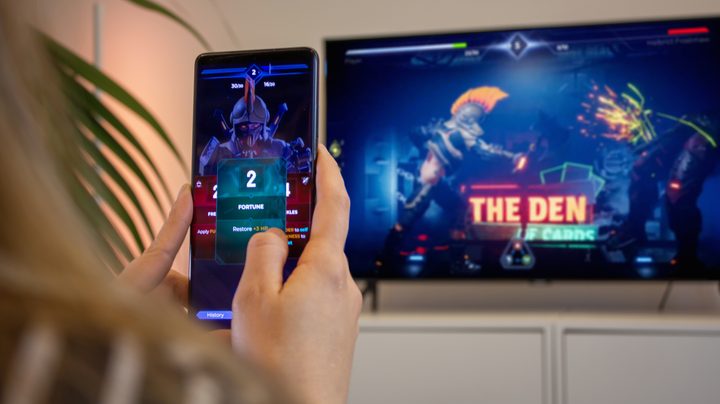
It’s not going to win any awards. As two hulking characters with health bars appear on screen, my AI opponent and I both select a card to play each turn. There are three primary colors of cards, and they interact in a “rock, paper, scissors” fashion. While there’s some strategy to making a deck built around inflicting status effects, it’s mostly a mindless game of chance. There’s more effort here than I’d expect from something like this, though. The 3D character models are detailed, even if they don’t move too much. There are free loot box equivalents, quests to check off, costumes to unlock, and even multiplayer support. I don’t feel compelled to play it beyond my curious first look, but I can feel where a developer could make something engaging enough for the platform if Samsung is serious about pushing the idea further.
After messing with that, it was on to the next course. I’d log into my Xbox Game Pass account and start firing up some games like I would on a console. I’d dive into some go-tos to start, like A Little to the Left so I could do some daily puzzles. Even with some occasional slowness when using Gaming Hub’s interface, I mostly found it seamless to boot up a game and have it immediately work with my Luna controller. So far, so good.
It’s one thing to toy around with a smattering of games, though. To really get a feel for it, I’d need to really play a full game through the service. As it turned out, horror game Still Wakes the Deep had just been added to Xbox Game Pass as I was in the process of setting up my TV. Considering its sleek run time, it was the perfect game to test out end-to-end over a few sessions. I never downloaded it to my Xbox; I would only stream it.
If you’re familiar with cloud gaming, you already know the caveats here. Personal internet speed will also make or break the experience. I’m located in New York with a solid (though not top of the line) Verizon Fios connection. As such, I got a fairly smooth experience over the four-hour runtime. I did hit the occasional stutter, but latency felt surprisingly low. I was able to get through some tense chase scenes with ease, though granted it’s a mechanically simplified game. The main deal-breaker I experienced boiled down to image quality. It’s a very dark game, and those deep blacks do not translate well over cloud streaming. Splotchy shadows tempted me to just download it on my Series X and switch over, but I resisted for the sake of the experiment.
After trying out a few different games over a week, it became clear that this wasn’t the way I’d really want to play normally. That said, the different use cases started to become clearer to me the longer the week went on. On one cheat evening, I wanted to hang out with my girlfriend in the living room while getting another half-hour of Still Wakes the Deep in. To do that, I’d fire up the Series S in that room and continue cloud streaming it, picking up exactly where I’d left off using the Gaming Hub in my office.
That’s where I see the potential power in what Samsung is going for. It’s not a replacement for a real gaming device, but it’s a useful ecosystem for households with multiple TVs. I think about the layout of my parents’ home. They have their main TV in the living room, one in the dining room area so they can have it on while eating, and a small screen in their bedroom. In a setup like that, I can see where it would make sense to connect some game consoles in the living room, but use some Gaming Hub-enabled TVs in other rooms for some added flexibility. That cuts out the cost of having to buy a second set of systems.
My small experiment modeled the viability of that option, the main caveat being that cloud streaming still isn’t entirely reliable. Even with fast internet, you’re going to lose some image quality and deal with hiccups. But the next time I have to download a 100GB megagame that I only intend to check out casually via Game Pass? I might just give my Xbox’s hard drive a break and let my TV do the heavy lifting.