

One of the major narratives going into Amazon’s Device and Services event — something you’d read leading up to the event, and something I even heard as we waited in line to get in — was, of course, artificial intelligence. Would AI make its way into Alexa and Amazon at large?
Of course, it would. And, of course, it’s been here the whole time. And, of course, it will be here going forward.
At this point, AI is as much a marketing buzzword as it is actually a thing, just like the early days of 5G. But when everything is soaked in AI, how do you use it to stand out?
Have you heard the good word?
Mentions of AI saturated nearly everything that Amazon announced this week.
It was in the headline for the press release on all the new Fire TV fare, in the first sentence of the body, and peppered into the subheadings. You had to wait all of two paragraphs before hitting AI in the press release for the new Echo Show 8, the new Echo Hub, and the new Echo Frames. “These new Echo devices give customers more ways to experience the world’s best personal AI — and the growing generative AI capabilities that will be coming to Alexa soon — at home and on the go.”
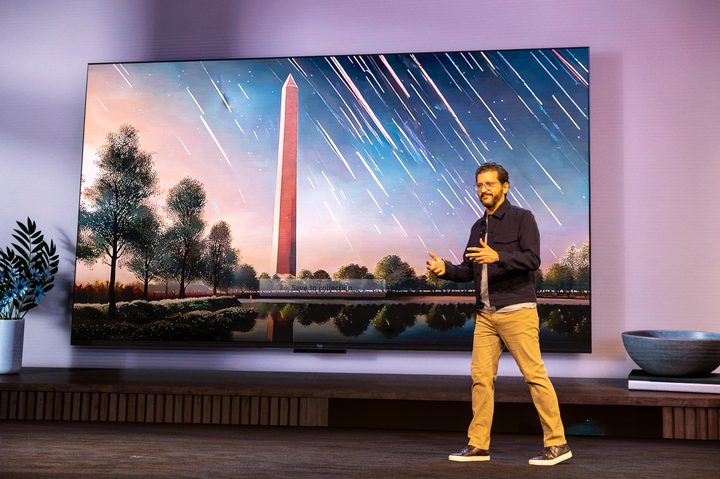
And we had plenty of examples of it during Amazon’s 90-minute presentation featuring all of the aforementioned products. AI was quickly out of the mouth of Dave Limp, the outgoing vice president of devices and services for Amazon. We heard more from the likes of Rohit Prasad, senior vice president and head scientist, artificial intelligence. And from Heather Zorn, vice president for Alexa, And from Daniel Rausch, vice president of Alexa and Fire TV.

So, yes: AI was everywhere this week for Amazon. It’s not just embedded in the foundation of Alexa going forward, it might be the foundation. It’s hard to overemphasize its importance.
Here’s the problem: If everything has AI, is it really a feature that sells devices and entices you to use services? And just like the 5G Wars that came before, is Amazon’s AI really going to be that much better than Google’s? Or Apple’s? Or Microsoft’s?
You’re not going to see a “Now with more AI!” sticker on your new Echo Dot or Fire TV Soundbar (at least I hope not). It might be more akin to the old “Intel Inside” badges, but it’s more fundamental than that. Intel was the engine. AI and large language models and datasets are the new fuel. Carmakers might proudly badge a car with “V8,” but nobody’s putting a “Gasoline” sticker on there.
Chances are, what will continue to sell Amazon products is price, more than anything ($600 consumer-grade routers, excluded). You’re going to expect your $50 or $60 Fire TV Stick to have AI, because it will. You’re going to expect your Echo speaker to have AI, because they will too, going all the way back to the very first Echo all those years ago. And AI will be in devices that look cooler than they are useful. If today’s AI-studded Microsoft Surface event was any indication, that’s just the way things are headed.

AI is table stakes at this point. The ante isn’t all that high yet, and it’s going to get more expensive — and important — over time in terms of what it can do for us as consumers, what it’ll do for companies, and just how the hell all our data (both disaggregated and en masse) will be handled.
That’s true for everyone. And this week, it was especially true for Amazon.


