

“Audeze’s brazenly advanced EL-8 come dangerously close to the performance you’d expect from headphones costing upward of $1,000.”
- Fluid, effortless clarity across the spectrum
- Brilliantly-detailed instrumental separation
- First-rate dynamic expression
- High performance level from low-powered devices
- Closed-back model offers less intimate performance
- A bit bulky for travel
“Why you can trust Digital Trends – We have a 20-year history of testing, reviewing, and rating products, services and apps to help you make a sound buying decision. Find out more about how we test and score products.“
There’s a line from Quentin Tarantino’s indelible hybrid-samurai flick, Kill Bill, about swordmaker Hattori Hanzo’s impeccable craftsmanship: “If you’re gonna compare a Hanzo sword … you compare it to every other sword ever made … that wasn’t made by Hattori Hanzo.”
Ever since Audeze jumped onto the scene with its planar magnetic headphones — which trade more commonly used dynamic drivers for a thin membrane — we’ve thought of the brand as the Hanzo of headphones. Everything Audeze makes, from the LCD-2 to the LCD-3 (aka, “the voice of god” headphones) and LCD-4, is a sterling example of sonic brilliance — a classic unto itself.
Needless to say, we were pretty excited when we got a chance to be one of the first to review Audeze’s latest, the EL-8. Available in both open and closed-back versions, the EL-8 are the company’s most portable and affordable planar magnetic headphones yet, and represent a turn of sorts for the company. With competitors like Oppo turning out their own portable planar cans, Audeze surely wanted a piece of the action. To do this, Audeze designed the EL-8 so that the body could be almost totally cast, making them easier (and cheaper) to produce than the company’s storied hand-made models. The cans have a number of other new features as well, and at $700, manage to deliver the sort of audiophile bliss others charge several hundred dollars more for.
What’s in the box
The price-conscious EL-8 don’t offer the same luxurious unboxing experience that comes with Audeze’s flagship LCD-3 ($2,000), which come sequestered in a lacquered wooden case lined with sumptuous silk fit for a crown, or other packaging masterpieces like Klipsch’s Heritage HP-3. Instead, the EL-8 arrive in a chic black package that reflects the same minimalist style as the headphones themselves. Opening a magnetic lid reveals the EL-8 face down in hard foam, lanky oval earpieces connected with a stout arched band, and emitting that new headphone smell: A tempting mixture of soft leather and die-cast metal.

Tucked into the backside of the lid is a compartment loaded with accessories, including a felt tote bag, gold-plated quarter-inch adapter, some promotional material, and a flat detachable cable with proprietary stereo connectors that are somewhat reminiscent of Apple’s Lightning jack.
Features and design
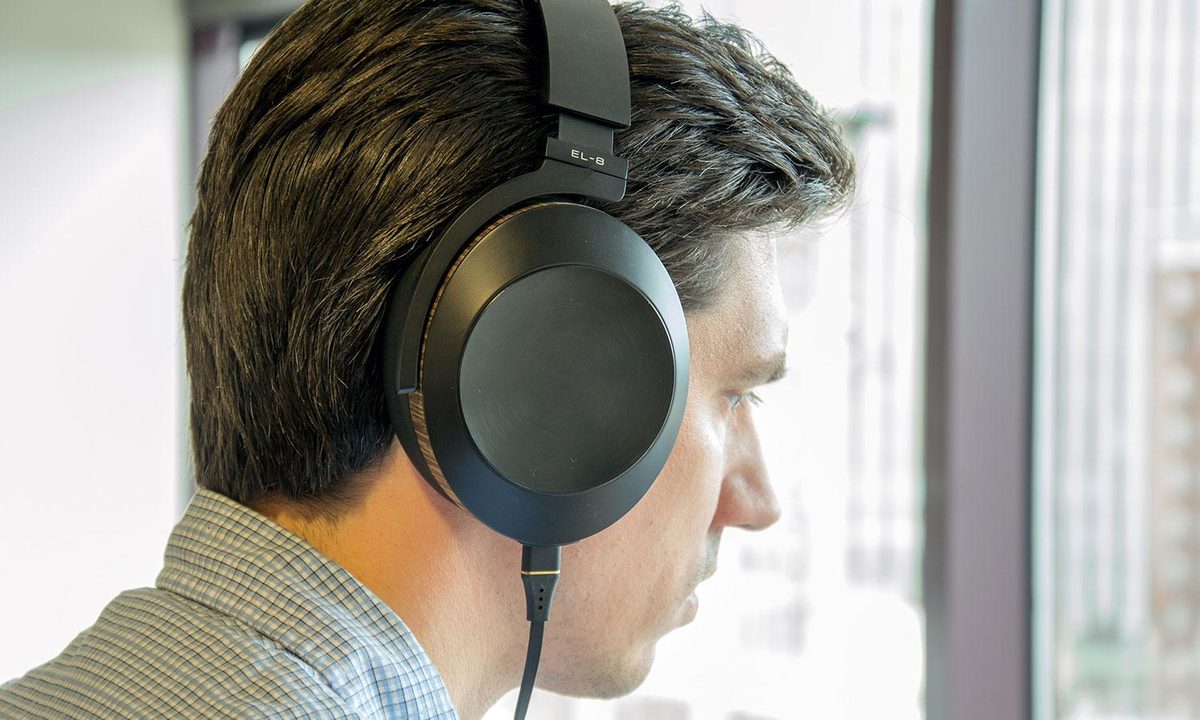
While much more conducive to a road trip than Audeze’s LCD-3, which we described in our review as “a stationary listening apparatus,” the EL-8 are still a formidable piece of hardware. Unlike Oppo’s $400 PM-3, which could easily pass for a traditional pair of over-ears thanks to smaller drivers, the EL-8’s bold size and stature will no doubt draw some looks — there’s more tricked out Humvee than Porsche in this robust frame. Still, while relatively heavy — and a bit bulky for travel — the EL-8 are a handsome pair of cans, skillfully designed for utility and comfort, with subtle touches of flash on the exterior to foreshadow what’s nestled inside.
The EL-8’s aesthetic is more military Humvee than Porsche.
Die-cast earcups stretch from above the ear almost down to the jawline, encircled by a thin strip of wood veneer along the edge. Those lanky cups are affixed to a single bracket by a ball joint that offers some leeway for fit, while the bracket itself rotates on the vertical axis, allowing the cups to lay flat in both directions. The vented plates on the open-back model carve out a subtle “A” for Audeze in the center, while the closed-back model flosses a solid plate of shimmering concentric circles instead.
On the interior of the cups are the angled pillows cloaked in soft leather that all Audeze models wear, matched by an ample cushion of padding at the top of the headband, which is suspended on an adjustable elastic band. The top pad handles a good bit of the cans’ stout 460 gram (just over a pound) load.
A peek inside the earcups reveals a chrome-colored plate behind slotted metal bars, reminiscent of the ribbon tweeters you’ll find in high-end tower speakers; and inside lies the magic. Planar magnetic drivers are so named because the membrane is excited by magnetic force — but the EL-8’s is no ordinary planar magnet. Audeze has designed a patent-pending “Fluxor magnetic structure” for the cans that transfers more energy on the driver-facing side than the backside. This makes the magnets much more efficient, and therefore easier to drive with low-power sources like a computer or smartphone.


The EL-8 are also fitted with Audeze’s Fazor technology, described as “acoustical elements” positioned on each side of the magnet that “enhance transparency by influencing sound waves generated by large planar diaphragms.” The system is essentially designed to create a clearer stereo image, lower distortion, and prevent sound waves from cancelling each other out (called phasing). And from experience, we’d have to say it works pretty damn well.
By the numbers, the EL-8 reproduce a claimed frequency response of 10Hz-50kHz. As mentioned above, the Fluxor magnets allow the large 100mm drivers to be driven easily, reducing their impedance to just 30 ohms (by contrast, the LCD-3 have a 110 ohm impedance). Still, as you might guess, the EL-8 sound their best when handled by some sort of dedicated headphone amp, be it a little USB-powered number, or a premium rig like our Oppo HA-1. The open-back model offer a claimed sensitivity of 102dB/1mW, while the closed-back design is slightly less sensitive at 100dB/1mW, marking the only rated difference between the cans on paper.
The EL-8’s single included cable is over 6 feet long, and designed for tangle-free listening. The proprietary flat-jack connection in use means you won’t have the luxury of swapping out the cable if something goes wrong.
Comfort
As mentioned, the EL-8 are pretty heavy when you compare them to run-of-the-mill headphone fare, and, as we experienced at CES, they also have a pretty mean grip, providing some firm clamping force out of the box. This was an issue Audeze promised to fix for its production cans, and luckily, the grip relaxed after a day or two of wear. We’re not sure whether the pads adjusted to our face, or we simply adjusted to them, but in short order both the open-back and closed-back models settled in to offer a very comfy ride for hours at a time.
Audio performance
There are hours upon hours of eloquent beauty to discover in the depths of your music collection when listening through the EL-8. But, not surprisingly, they don’t offer quite the same transcendent, almost other-worldly experience the LCD-3 do when it comes to simple sonic happenings like the woody thump of a hand slapping a guitar, or the buzzing textures of breath passing over the reed on a bass clarinet. To truly appreciate them in all their planar magnetic glory, the EL-8 require a bit more of a lean-in listening session.
The EL-8 require a bit more of a lean-in listening session than pricier planar cans.
Still, that’s really getting picky when you consider all these headphones can do at their (relatively) manageable price point, outperforming the darker-colored Oppo PM-3 below them, and working their way towards cans at the $1,000 mark. The planar drivers react with super-human speed when delivering rippling transients from the fastest electronic synthesizers and snare snaps you can throw their way, yet they also manage to boast glistening extension in the treble, a smooth and silky midrange, and rigid (if not slightly resigned) power in the bass.
There’s an effortless, almost sumptuous way the EL-8 approach their revelation of detail, whether it’s the rotation between a crash cymbal to a ride in a drummer’s frenetic tirade, the dynamic ballooning of breath in a vocal track, or the ghostly tail of reverb echoing in an otherwise barren right channel. This is especially true in the open-back model, which offers a more intimate performance than the closed-back option – it’s almost like taking a step closer to the music, or if you like, opening a window to better drink in a clear blue sky. In exchange, of course, the closed-back EL-8 offer much more privacy from exterior interruptions, and shield those around you from hearing your little concert for one. In any event, both headphones really start singing when given the challenge of dense, multi-layered productions from perfectionists like Peter Gabriel, Radiohead, Muse, and Depeche Mode.


We were brought back to Audeze’s description of the Fazor technology’s aim for utter transparency when spelunking the depths of our most complex samples. The EL-8 proved almost startling in their clarity, which is luminous and pristine, without ever becoming abrasive — especially impressive in the handling of higher instruments and percussive effects. One striking example came from the weird little track Fitter Happier from Radiohead’s OK Computer. We’d never before heard the radio sample in the right channel so brazenly, as a voice from the 1950s repeats: “Section 917 may have been hit.” What?! A similarly odd sonic moment of clarity happened during Kid A when we accidentally discovered nearly every lyric from the mumbling Thom Yorke’s affected vocal.
There’s an effortless, almost sumptuous way the EL-8 approach their revelation of detail
A tour of Peter Gabriel’s Up brilliantly exposed the EL-8’s penchant for near-perfect instrumental separation. As is Gabriel’s style, the album must’ve taken several years to produce, painting layer upon layer of sound, with more tracks than most CPUs can process. Yet the EL-8 parsed every strand in perfect separation, from the terse release of two doubled guitars in the intro of Sky Blue to the detailed forging of the oddly-colored crash cymbal in Burn You Up, Burn You Down that only occurs twice in the song. You can almost see the exact design of the cymbal as it rings above the fray.
Frankly, even when it comes to the basic elements of recording, the EL-8 dig deep enough to be distracting for daily listening, i.e. do not listen while operating heavy machinery. We’ve got to stop somewhere, so we’ll end with some praise of the EL-8’s rich dynamic expression. Whether it’s vocal inflection, the dying sustain of a single electric guitar string, or the full swell of a chorus of strings, the trait was second only to the EL-8’s pure clarity on our list of favorites. But, we also love the uber-quick transient response … and the granular detail of guitar tones … and … fine, let’s just say these are very good headphones, OK?
Conclusion
Highs
- Fluid, effortless clarity across the spectrum
- Brilliantly-detailed instrumental separation
- First-rate dynamic expression
- High performance level from low-powered devices
Lows
- Closed-back model offers less intimate performance
- A bit bulky for travel


