

Whether purchasing a new television for your main home theater or simply upgrading an existing smaller television in the bedroom or office, there are definitely specific platforms that are better than others when it comes to your cord cutting lifestyle. While set-top boxes like the Roku 2 or the Apple TV can provide an inexpensive way to update older standard definition and high definition televisions to watch streaming video, the recent rash of smart televisions can simply cut out that step thanks to internal software that’s capable of accessing video applications such as Netflix, Hulu Plus and Amazon Instant Video. Some smart TVs also provide direct access to streaming video and audio feeds over the Web rather than having to pass through a secondary device like a set-top box or gaming console.
However, not all high definition televisions are ideal for cord cutters. Factors that are important to consider first in your decision include:
• Available streaming video applications in the Smart TV interface
• Wi-Fi capabilities (if the television isn’t near your home’s router)
• Processor power
• User interface and navigation
• Number of HDMI and USB connections
• Mobile device interactivity
• Universal searching capabilities
Continuing the purchase decision process, you can start considering traditional factors like picture quality, resolution, screen size, sound quality, other types of inputs beyond HDMI and remote capabilities. The ability to play 3D movies may also be an important factor for you, but be aware that streaming video services are just starting to provide 3D versions of movies. For instance, Netflix is slowly rolling out 3D support on a handful of LG televisions as well as the Sony PlayStation 3. More devices could be added to that list dependent on the popularity of the 3D films offered on the Netflix service.
In order to help you find the best televisions for a cord cutter, here’s a roundup of the best Smart TV platforms on the market:
LG
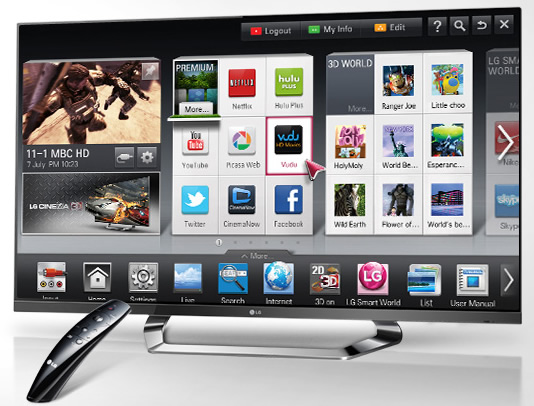 Offering an ideal menu layout for browsing content in addition to a remote with motion pointer capabilities for fast content selection, LG’s line of smart televisions feels superior to competitors specifically due to the slick, simple user interface. This is ideal for families as it’s definitely the simplest interface to learn and operate on a daily basis.
The television comes loaded with the standard set of popular streaming video applications such as Netfix, Hulu Plus, Amazon Instant Video, YouTube and Vudu. Other popular apps include Pandora, MoG, Facebook, Twitter and Skype. Regarding sports, major league baseball fans can use the MLB.TV app.
Regarding mobile interactivity, LG television owners can use the Smart Share function to send the content from a device like a smartphone or tablet and display it on the television screen. In addition, Smart Share allows users to view video, music or photo content stored on any desktop or laptop computer on the home’s network. Content appears on the television screen in thumbnail form and can be selected with the remote control.
 The Smart Share feature is also compatible with any USB device, such as a flash drive or external hard drive, that’s connected to the television. Taking network accessibility a step further, users can also install the Plex Media Server application in order to watch Web content that may not be offered through traditional apps on the television.
LG models that utilize a dual-core processor include the LM8600, LM9600 and the G2 series available in 47-inch and 55-inch sizes. All of these models offer built-in Wi-Fi as well as 3D capabilities, four HDMI inputs and three USB inputs. On the LM8600 and LM9600 sets, LG has included a voice search feature that will allow users to state their search request similar to Siri on the iPhone.
Users can also download a mobile application on their smartphone or tablet in order to type search queries with a keyboard or control the television with a touchscreen version of the remote control. For a smaller television with smart TV capabilities, check out the 42-inch LM6200 series. You won’t get the dual-core processor with the LM6200, but you will be able to access the Smart TV applications using the built-in Wi-Fi functionality.
Samsung
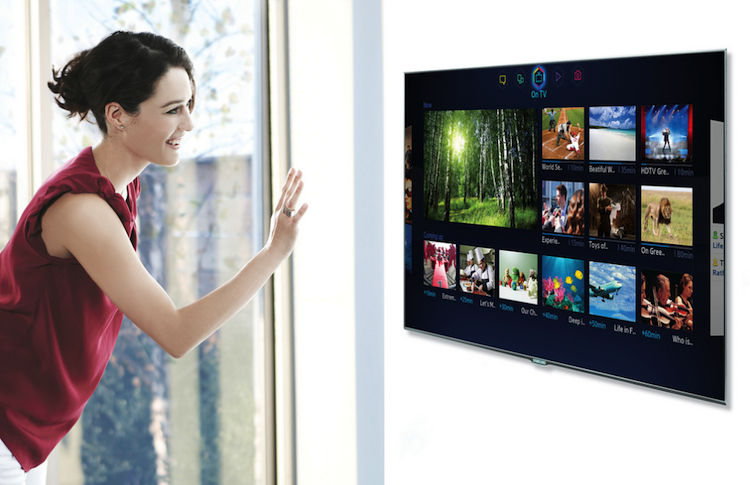 While the menu system isn’t as user friendly as the LG models, Samsung’s Smart TV interface looks fantastic and provides a significant amount of features that can be useful to cord cutters.
There’s a large selection of useful apps on the Samsung Smart TV platform, easily competing with the library of applications on Roku 2 devices. Beyond the standard array of YouTube, Netflix, Hulu Plus, Vudu and Amazon Instant Video applications, users can try out Vimeo, Ted Talks, Redux and other niche applications.
Samsung’s universal search feature also feels superior to both Smart TV and set-top box rivals. For instance, if the user was searching for Mission Impossible: Ghost Protocol, they would get results from subscription services like Netflix as well as rental and purchase prices from services like Vudu, CinemaNow and Samsung’s first party Media Hub. In addition to listing prices and video quality, the user can view detailed information about the film as well as the trailer and user ratings of the content.
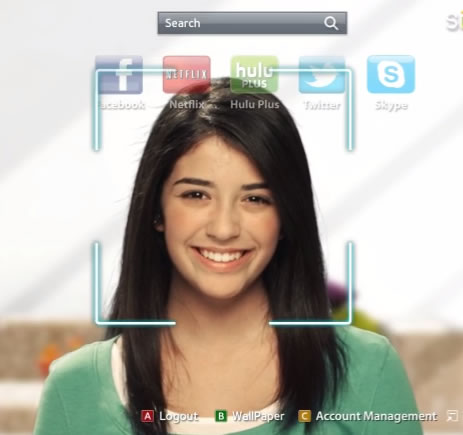 Interestingly, Samsung has included a feature on its high-end sets that worka similarly to the Xbox 360 Kinect. Using face recognition, the camera built into the set automatically recognizes the user and logs them into a home page profile with specific applications.
This is ideal for family situations where several people use the television and prefer different apps. For instance, Dad may want to want Netflix when he sits down in front of the TV while the kids would rather log into Facebook. The Samsung sets also offer gesture control and voice control for users that want to forgo the traditional remote.
Samsung models that offer a dual-core processor include the ES7100, ES7500, ES8000 and the ES9000. However, only the latter three include the built-in camera, automatic Smart TV interaction and a smart touch remote. Regarding sizes, Samsung offers panels in 46-inch, 55-inch, 60-inch, 65-inch and 75 inches. All panels comes with three HDMI ports and three USB ports. For a smaller model, check out the 40-inch ES6100 or the 32-inch ES6500. Both come with Smart TV functionality, but the latter also offers 3D capability.
Panasonic
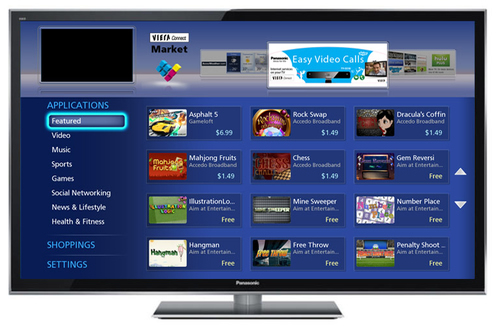 The speed of Panasonic’s user interface has greatly improved over the past year, but the interface isn’t as polished as Samsung’s or LG’s. In regards to video applications, Panasonic supports Netflix, Hulu Plus, Amazon Instant Video, Vudu, Vimeo and YouTube.
Similar to other smart TV platforms, Panasonic has a bevy of other applications for social networking, news, fitness, music and games. Navigating through the large library of applications can be somewhat cumbersome due to the grid design. However, the universal search function can be extremely helpful in locating specific content across a variety of video services.
Panasonic has added a “Swipe & Share” feature that allows users to send videos, photos or music to the television by swiping towards the TV using a mobile device like a smartphone or tablet. In addition, users can use a compatible mobile device and the Remote Play app to browse content without disturbing the video that’s currently playing on the screen. Panasonic’s Smart televisions are also DLNA-compatible allowing users to access content on other computers within the home’s network.
Panasonic doesn’t specify which models use a dual-processor, however the higher-end models come with a feature called “Web Smoother” that’s designed to reduce motion blur in videos streaming off the Web. Those models include the DT50 and WT50 in 47-inch and 55-inch sizes. All models come with four HDMI inputs, three USB ports, a SD card slot, built-in Wi-Fi and 3D capabilities. For a smaller panel size, check out the 42-inch ET5 with built-in Wi-Fi or the Wi-Fi ready 42-inch E50.
Sony
 For anyone already invested in content on the PlayStation 3, it will be relatively simple to jump into the Sony Entertainment Network on Sony’s Smart TV line. However, the user interface has more in common with Microsoft’s Metro design on Windows 8 devices.
The thumbnails are simple to navigate and users can specifically mark certain apps as favorites in order to gain quicker access after turning on the television. My only complaint is that launching applications or accessing the application store can be sluggish at times, depending on the television model.
Regarding video applications, Sony includes support for Netflix, Hulu Plus, Amazon Instant Video, YouTube and Crackle. For premium purchases, users are directed to the Sony Entertainment Network in order to rent or purchase movies, music and television shows. Sony has included an interesting “Wi-Fi Direct” mode that doesn’t require users to connect to a router or access point. Users can send photos or videos from a smartphone, tablet, laptop or another Wi-Fi enabled device directly to the television, ideal for guests that want to show off interesting content. This feature would definitely come in handy at parties.
Similar to Panasonic, Sony doesn’t specify which models use a dual-processor, but it’s likely that the panels that utilize the X-Reality and X-Reality Pro picture engines require more processing power than other models. Those models include the HX750, HX850 and HX950 with panel sizes in the 46-inch, 55-inch and 65-inch range. All of those series offer 3D functionality, built-in Wi-Fi, four HDMI inputs, two USB inputs and are compatible with the Media Remote application for a smartphone or tablet. For a smaller Sony panel that offers Smart TV functionality, check out the 40-inch EX640 which comes with a Wi-Fi adapter.
Which model is right for me?
As time goes on, the availability of different streaming video applications will be less important when it comes to a Smart TV purchase decision. As the majority of manufacturers are working to support all popular applications, the differentiating factor going forward will be how easily that content is accessed through the user interface and the success of universal search functions. The speed of launching applications and the accessibility to mobile devices will also be of rising importance as new versions of hardware are launched throughout the year. However, many of the models listed above fit that criteria already and can help support your cord cutting lifestyle right now. Overall, Samsung and LG panels are currently the most well rounded choices in the Smart TV space.


