
You don’t need a dozen speakers to enjoy Dolby Atmos Music anymore. It’s now something anyone with an iPhone, an Apple Music subscription, and a set of headphones can hear. In the not-too-distant future, Android users will be able to get in on the Atmos action, too.
But does Dolby Atmos Music actually sound better? Given Apple’s spin, plus my own experiences listening to Atmos Music via Tidal on my home theater system, my expectations were very high for Dolby Atmos via headphones.
“Spatial is an immersive experience with sound moving around you in different directions,” said Zane Lowe, Apple Music’s co-head of artist relations and radio host, as he launched into a pseudo-sales pitch for the new immersive format. “So, it’s not even just about the way it’s going to end up sounding,” Lowe said, ”it’s very much how songs are going to feel.”
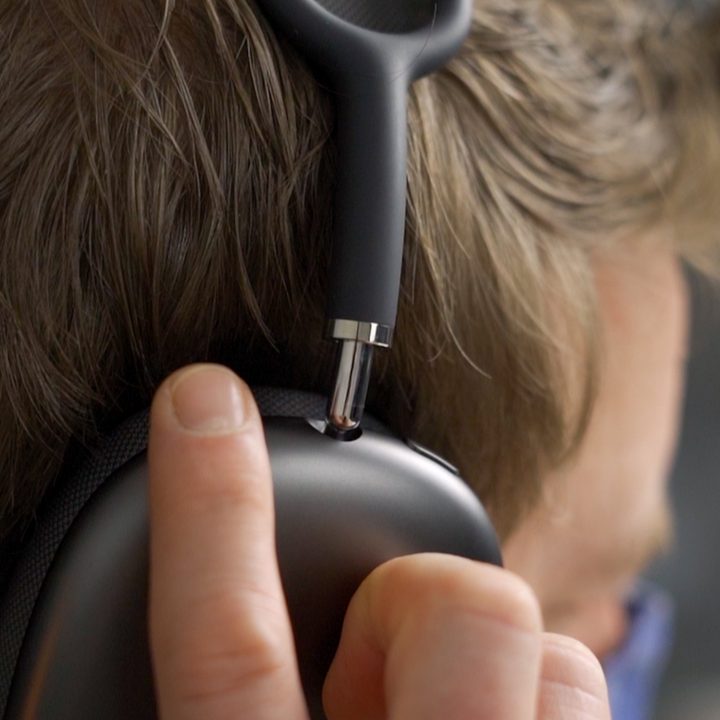
Armed with a loaner pair of $549 AirPods Max and my iPhone 11, I dove right into spatial audio on Apple Music, starting with Lowe’s referenced tracks, Lady Gaga’s Rain On Me, and Kanye West’s Black Skinhead.
Bigger spaces

One thing cannot be denied: Dolby Atmos Music (which for the purpose of this review I will use interchangeably with “spatial audio”) creates a much larger sense of space. Atmos tracks feel like you’re sitting in a studio with the band, with the musicians spread out around you.
But because that effect is being simulated through two fairly standard speakers attached to your head, there’s a price to be paid for that extra sense of space: You lose some dynamic range and volume dips quite dramatically.
It’s almost as if you sat between two closely spaced speakers and then someone moved the speakers 20 feet away, but didn’t increase the volume to compensate for the extra distance. You get an airy, open sound, with an increased sense of where the music is physically coming from, but at the same time, the intensity decreases, as does the intimacy.
More movement, less emotion
In listening to Rain On Me and Black Skinhead, the bass notes spread out, creating a deep pool of low-end warmth in my chest. The vocals, however, felt distant, as did much of the instrumentation. In Black Skinhead, the shouts and screams Kanye uses to punctuate his lyrics echo off an invisible back wall and ceiling, something you wouldn’t normally hear in a stereo mix. Curious to know what the original version sounded like, I switched over to Tidal and ran the track again.
This time, the whole song was in my face. Those screams were no longer echoes, they were tangible and inescapable. Kanye’s voice took on a new urgency while the drums hit hard from the left side, and I was suddenly aware of my heart rate increasing. If that’s not an emotional response, I don’t know what is.
With Gaga’s Rain On Me, a song that was clearly meant to get people on their feet and dancing, the Dolby Atmos version felt robbed of much of the energy that the stereo mix possesses. The extra space generated by the spatial audio effect seemed to dilute rather than enhance the harmonies that Lady Gaga and Ariana Grande start to layer as the track hits the midway point.
I repeated this A/B comparison on various other tracks that I’m more familiar with, like Red Rider’s Lunatic Fringe, The Weeknd’s Blinding Lights, and The Beatles’ Here Comes The Sun, and listened with the AirPods Pro and Sennheiser’s HD 560S. Each time, I appreciated the big-room effect of Dolby Atmos, with its ultra-deep soundstage, but I also noted that the traditional stereo mixes had more power, more clarity, and for me, more emotional punch.
A brighter future?
Hollywood sound mixers have been working with Dolby Atmos for years, and the results can be stunning with the right equipment. But the format is still very new for musicians. I have a feeling Lowe is correct when he said, “Eventually there will be new artists who are born into spatial, just like I was born in stereo. Artists in the future might never even think about making a stereo record — because all they’ve ever known is spatial.”
When that starts to happen, we should start getting “spatial-first” tracks that have been conceived from the beginning to take advantage of the greater immersion that formats like Dolby Atmos makes possible.


