

“Why spend more when the Air Pro 3 offer so much for so little?”
- Very comfortable
- Big, dynamic sound
- Customizable controls
- Bluetooth Multipoint
- Great battery life
- No wear sensors
- So-so noise canceling
- Imprecise touch controls

“Why you can trust Digital Trends – We have a 20-year history of testing, reviewing, and rating products, services and apps to help you make a sound buying decision. Find out more about how we test and score products.“
Earfun’s latest wireless earbuds, the $80 Earfun Air Pro 3, prove yet again that you don’t have to spend Apple amounts of money for a great noise-canceling wireless audio experience.
Packed with features — some of which are so leading edge you can’t use them yet — and great sound quality, you’ve got to get out a microscope to find a reason not to buy them if you’re looking to spend less than $100. Here’s why I like them so much.
If it ain’t broke …
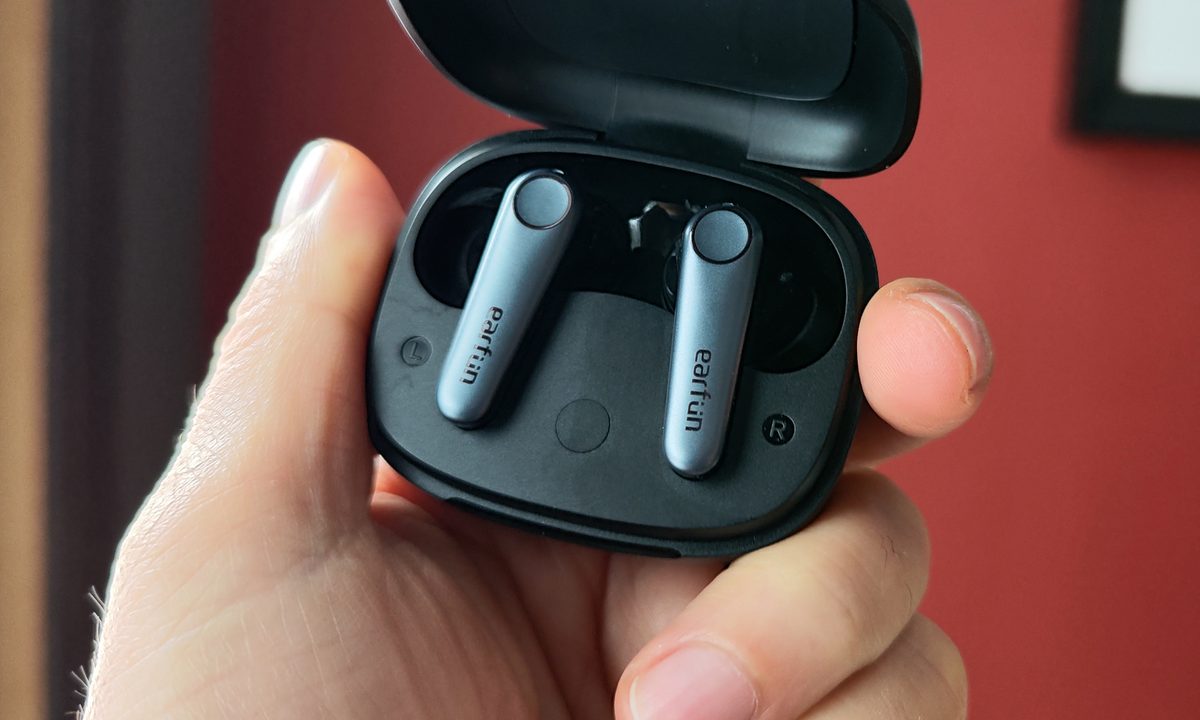
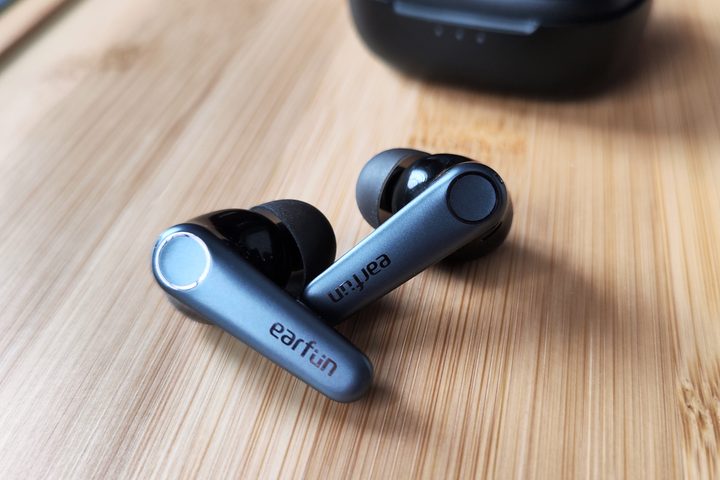
Design-wise, Earfun takes an if-it-ain’t-broke approach to the Air Pro 3, with a stem-based shape that looks a lot like the company’s previous Air/Air Pro models. This time, however, the earbuds have an even more refined silhouette, with an elegant silver-blue top cap that helps alleviate the monotony of the all-black plastic look we usually see on these products.
They continue another Earfun tradition too: they’re super comfortable. Stem-based buds don’t always score highly when it comes to keeping them locked in place, but I had no issues with the Air Pro 3 popping out of place, especially once I bumped up to the largest size of eartips (there are four sizes to choose from). Their IPX5 water-resistance rating shouldn’t be tested in showers or pools, but you’ve got no reason to fear heavy sweat or rain as long as you wipe them clean before putting them away.
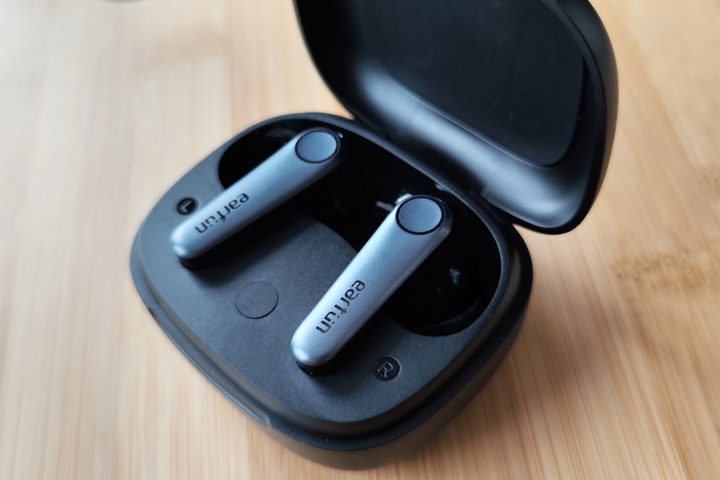
Earfun sticks them in a simple, wirelessly charging case that sports a wide opening and a lid that opens (and stays open) with ease. It may not be as small as flip-top charging cases (e.g., AirPods), but if you’ve ever fumbled with getting buds in and out of those designs, the Air Pro 3 case will make you wonder if size really matters.
Fans of big, bold sound are going to love the Air Pro 3.
Touch controls can be a bit hit-and-miss, and there were times when my taps weren’t always recognized. I chalk this up to the relatively small target area (the little circles at the tops of the stems). On the other hand, Earfun’s recently released app for iOS and Android lets you choose what each tap gesture does, so if you find a single tap easier to perform than multiple taps, you can assign your most-used functions accordingly. There are a total of eight, and they can be used to control any function you like — even volume and changing the earbuds to their low-latency game mode.
There are only two missing features: the buds don’t have wear sensors, so you’ll have to pause the music manually, and you can’t choose to toggle between just active noise canceling (ANC) and transparency modes (you have to rotate through the “off” mode too).
Dazzling Bluetooth
When it comes to Air Pro 3’s Bluetooth specs, prepare to be dazzled. Earfun claims these are the first wireless earbuds priced under $100 to support the new Bluetooth LE Audio standard. along with its new LC3 codec. They’re also ready to support the soon-to-be-released Auracast feature that essentially turns your compatible phone into a Bluetooth radio station that can broadcast to anyone within Bluetooth range. Throw in Qualcomm’s aptX Adaptive codec for up to 24-bit/48kHz (lossy) hi-res audio, and Bluetooth Multipoint for dual simultaneous connections, and there’s nothing left to wish for.
I found them easy to pair, Multipoint worked like a charm, and they gave me a very acceptable wireless range both indoors and outdoors.


Fans of big, bold sound are going to love the Air Pro 3. Earfun has tuned these buds with a bass-forward, punchy signature that’s especially well-suited to modern music trends. It’s a more assertive sound than the company’s previous models, so you may find yourself reaching for the Earfun app’s built-in EQ adjustments if it proves too much. Out of the box, the EQ feels hot right across the frequencies, something that’s bound to make audiophiles flinch. But judicious use of the six-band equalizer can help settle things down. Once I got things dialed in, the Air Pro 3 proved to be a very enjoyable listen with a generous soundstage and plenty of detail.
If you want something with a more neutral sound for this price, check out the very good Jabra Elite 3.
I noticed a slight difference when switching between AAC on an iPhone and aptX Adaptive on a Xiaomi 12 Pro (the Xiaomi offered a bit more nuance), but I really had to focus to hear it — iPhone users have no reason to feel left out.

ANC at a nice price
As with many earbuds these days, the Air Pro 3 have ANC, which is a nice addition, especially when you consider their sub-$100 price. But don’t expect anything like the kind of silence you’ll get from more expensive models. ANC mode definitely reduces external noise, but it tends to do most of the work in the lower frequencies. It;s not bad for blocking out some of the droning sound of a fan, or airplane engines, but it won’t do much to prevent voices or the barking of dogs from being heard. Still, if your goal is to be able to hear your podcasts while walking busy streets (without cranking the volume to dangerous levels), it will definitely help.
Transparency mode is similar — it’s enough to help you stay aware of sounds that might be potential threats (traffic, etc.), but you may find that conversations are still much easier if you just remove the buds altogether.
I’ve always found Earfun earbuds surprisingly good for call quality, and the Air Pro 3 are no exception. The mics have excellent pickup and produce a very clear reproduction of your voice, even in conditions that have challenged more expensive products. Still, your best bet is to find a quiet spot for your calls — the noise-canceling algorithms are good, but not great.


Excellent value
Battery life on the Air Pro 3 is another bright spot. Earfun claims you’ll get nine hours per charge and 45 hours total playtime with the charging case if you keep ANC disabled, and 7/37 if you keep it turned on. In reality, expect a little less than this, particularly if you listen above 50% volume level. Regardless, these are excellent numbers that will keep your tunes going for much longer than other ANC earbuds. It takes an hour to fully charge the buds in the case, which is the equivalent of about 1.5 hours of playtime for a 10-minute charge (ANC off).
If any of this sounds familiar, you may have noticed that the Air Pro 3, both in their features and price, are incredibly close to the $80 Soundcore Life P3. However, the Life P3 are now almost two years old and, even though they’re still a solid choice, the Air Pro 3 offer better battery life and call quality, as well as features like Multipoint.
Once again, Earfun has proven that a fat wallet is not a prerequisite for a great set of daily-wear wireless earbuds. The Air Pro 3 are extremely comfortable, they come with features that are useful right now, as well as a few that will prove handy in the future (like Auracast), and they deliver a dynamic sound that competes with models that cost a good deal more. That’s a lot to like in a set of budget-friendly buds.


