
You finally got past the digital transition, upgraded yourself to a new HDTV, maybe even sprang for a Blu-ray player. You can now sit back and enjoy your 21st century HDTV for years to come, right?
Well, not so fast.
Panasonic has officially announced it will unveil the first workable, full 1080p, 3D HDTV system for the home sometime next year.
Yes, you will need a new Blu-ray player. Yes, you will need a new HDTV that can display both 2D and 3D. And, yes, you will need to wear glasses. Panasonic will likely launch its 3D Blu-ray camcorders in 2011. And, yes, new 3D HDTVs and 3D Blu-ray players will carry a “substantial premium” in price, according the Panasonic’s North America executive VP, Bob Perry.
Panasonic insists its 3D system won’t provoke a 3D format war ala Blu-ray and HD-DVD. While no other Blu-ray or HDTV maker has publicly supported Panasonic’s system, “they support it in private,” Perry reported. “I’m not aware of any manufacturer or studio that says they don’t support it.”
“This is the new frontier – to make TV more realistic, to simulate what you see in nature,” Perry explained. “We think consumers will adopt it like they adopted HDTV. This will be the way we watch TV. In three to five years, 50 percent of all HDTVs will be 3D.”
3D Details
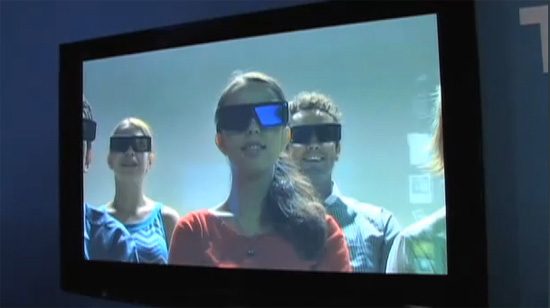
Panasonic’s 3D system is stereoscopic, but not anaglyph – the type that uses the familiar red-and-green glasses, or the polarized system used in movie theaters. Instead, Panasonic’s system is all electronic. New dual-scan, dual-drive HDTVs display alternating full 1080p frames that you watch in 3D through battery-powered “active shutter” dark glasses. The glasses receive 120 Hz control signals from a series of emitters built into the 3D HDTV.
According to Panasonic, the 3V CR2024 battery in the glasses will last for 250 hours of viewing – around two months of watching around 3-4 hours a day. The glasses turn themselves off automatically when they don’t detect signal from the emitters. Glasses will be manufactured and sold by a number of manufacturers.
Because they have a native refresh rate of 600Hz, new 3D HDTVs will be plasmas, the only technology with a fast enough refresh time to accurately display the alternating full 1080p HDTV frames. LCDs running at 240Hz will work “well enough,” according to Perry, and may come later.
Both the new 3D HDTVs and 3D Blu-ray players require the new HDMI 1.4 specification, designed to handle dual 1080p streams.
3D Content
Perry believes right now there could be 50 titles available. By launch, Perry expects there to be at least 100 3D Blu-ray titles.
While details are still being worked out, Perry projects that 3D Blu-ray titles will be released as two-disc sets, one disc with standard 2D content, the second with the 3D version.
Perry also believes there will be substantial 3D broadcast content. Both Panasonic and Sony are producing 3D broadcast cameras. Sony shot and broadcast last January’s FedEx Bowl BCS National Championship Game between the Florida Gators and Oklahoma Sooners using Sony’s 3ality Digital image-capture technology to an invited audience at a specially equipped Las Vegas theater.
Perry also believes there will be 3D content offered via 1080p IPTV services, such as Panasonic partner VUDU, which want to differentiate themselves from cable and satellite.
How’s it look?
We saw a nine-minute demo of the 3D system at Panasonic’s Secaucus headquarters last week, a follow-up to a demo we saw in Panasonic’s booth at CES earlier this year. Unlike other non-1080p 3D demos we’ve seen, the Panasonic 3D is smooth, seamless and natural. In short, it looks as close to real life as we’ve seen from a television.
Thousands of synchronized performers from the Beijing opening ceremonies looked extra threatening with added depth perception highlighting row after row after row of them. Scenes from Pixar’s Up! looked as sumptuous as they did in the theater. We felt right in the middle of the 3D Olympic sporting events.
Best of all, we didn’t find ourselves constantly trying to refocus as the images moved from foreground, and so avoided the usual 3D headache. Of course, it was only a nine-minute demo.
The glasses – which are almost goggles – fit over existing eyeglasses and felt light and comfortable. But they are essentially sunglasses. While the 3D effect can be experienced in a light room, a lot is lost in a well-lit room. Like regular plasma, the effect persists off-angle viewing. The demo was shown on one of Panasonic’s largest plasma sets; we think you’ll want at least a 65-inch set to really feel the full effect.

Aside from HDTV overload and cost, the question remains: Do you want to want to wear battery-powered sunglasses to watch TV? “Glasses will add to the virility of the American male,” Perry joked. The real answer depends on how compelling full-HD 3D will be.
So, joking aside, are we ready for yet another TV transition?


