There’s never been more demand for an awesome pair of fully wireless (AKA “true wireless”) earbuds. Ever since Apple “bravely” removed the headphone jack, (and others followed suit) we’ve essentially been coerced into finding a convenient, dongle-free means of blasting our favorite tunes.
Unfortunately, the vast majority of true wireless in-ears — including those offered by Apple itself — leave a lot to be desired. From awkward form factors and annoying controls to clunky cases and terrible battery life, the first few generations of true wireless earbuds have far too often missed the mark.
So, listen up, manufacturers! Below are the seven things we need to see from the next generation of true wireless headphones.
Comfort first
It seems like an obvious point, but any decent pair of true wireless earbuds should be comfortable. This is not the time for designers to go buck wild with jagged edges and dramatic design cues. The ear is full of curvy lines, and great silicone (and even memory foam) eartips have been around for decades. We need true wireless earbuds to provide a soft and ergonomic fit, with good passive noise isolation (we’re looking at you there, Apple).
Truth be told, most of us don’t even really care if true wireless buds are on the bulbous side — like Sony’s WF-SP700N or Bose’s Soundsport Free – as long as they’re comfortable. We’d rather look like we’re on a conference call about to dump some Enron stock than have achy ears after an hour or two of listening.
A decent battery
Yes, battery technology is a problem when it comes to the tiny form factors required by true wireless headphones. Yet, we’ve had flagship offerings that have 5-6 hours of listening time for over a year now. Quite frankly, anything less is a disappointment, and we see far too many true wireless earbuds with 3.5 hours of battery life or less.
The good news is, Qualcomm has come out with a new, significantly more efficient Bluetooth chip for the next generation of true wireless models which claims to double the current offerings. Until then, though, anything below 5 hours is gonna be a no from us, dawg.
Sweat-proofing is a must
The primary reason wireless in-ears are convenient is because we can take them anywhere and wear them while doing anything. That means we’re going to work out in them, get drenched by rain on occasion, or accidentally get splashed while poolside. All true wireless earbuds going forward should be waterproof (and, preferably, dust-proof too).
Turn down the bass
Of course we want true wireless in-ears to sound good, but few of us are buying Bluetooth headphones for their fidelity. That’s what wired-in headphones are for. We’re not sure where the confusion came from here, but heftier bass response is not a solution for mediocre sound. We don’t need every song to blast low end like it was made for the dance floor in Miami. Sometimes, people listen to jazz or acoustic music.
True wireless earbuds should have an accessible sound signature. We don’t need the sound signature to go overboard. Just give us something that sounds decent and — better yet – includes some effective EQ settings.
A case for every pocket
To make up for mediocre battery life in the headphones themselves, manufacturers often include cases that charge the earbuds, which is definitely helpful. However, some manufacturers offer headphone cases that have battery packs seemingly large enough to jump-start a small car. That’s cool in theory, but it’s often super impractical during everyday life.

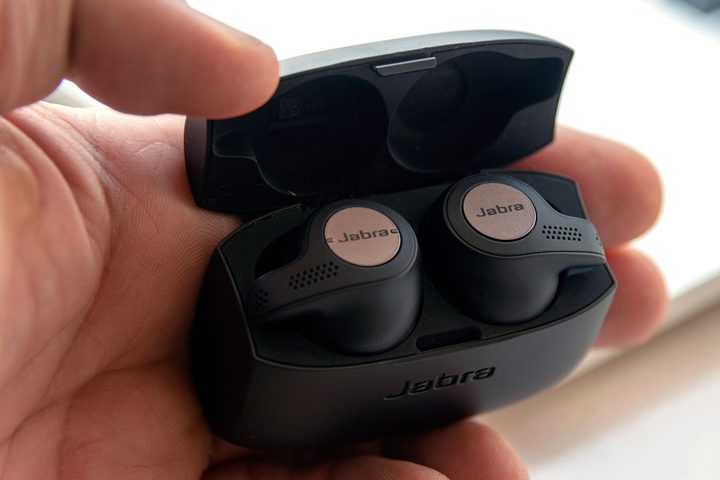
At least half of the population doesn’t carry a purse, backpack, or fanny pack with us everywhere we go. That means, one way or another, true wireless earbud cases are going to be stuffed in our pockets. As a rule, a charging case for true wireless headphones should fit in a normal women’s pocket. If it fits into a pair of women’s American Apparels, it should work for everyone. Make it so.
Cut the flash
We’re buying what is essentially a tool here, not a pair of earrings.
We really don’t care (ok, ok, within reason) what they look like – Apple’s golf tee-shaped AirPods has proven that. They don’t need to be the sleekest earbuds ever or look like tiny bullets that are going to shoot into our skull. They just need to not look stupid.
Make them in white. Make them in black. Heck, make them clear or in skin tones. We don’t care. Just don’t make them in neon yellow, orange, or with some crazy logo on the outside. These are headphones. We just want headphones.
Simple control
After testing dozens of pairs of true wireless headphones we’ve realized that, while basic controls would seem to be an easy feature set to design, they apparently are not.
We’ll start simply: Please stop putting touch controls on true wireless in-ears. It seems like almost every we get an itch, need to adjust a pair of true wireless earbuds with touch controls, or just accidentally put our hand up by our ear, we raise or lower the volume, play or pause the music, or switch songs.

What we want are buttons. Decent, easy to find, don’t-jostle-the-headphones-or-pinch-us, buttons. Like two or three of them, total. Maybe a volume rocker on one side and a multi-function button on the other. Don’t go crazy. Make them easy to find. Make them easy to press. Make them work in the simplest, most logical fashion.