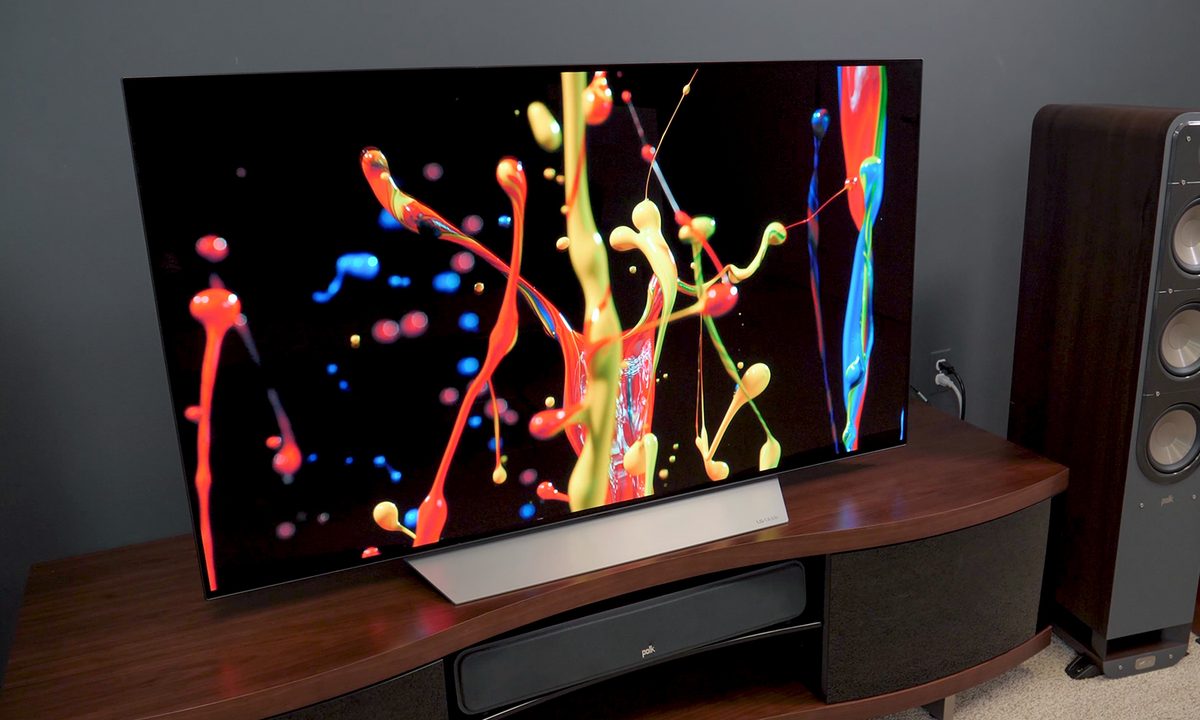

“Simply put, you can’t buy a better TV in 2017 than LG’s C7 OLED.”
- Best picture quality ever
- Outstanding HDR performance
- A joy to use
- Beautifully designed
- OLED remains expensive
“Why you can trust Digital Trends – We have a 20-year history of testing, reviewing, and rating products, services and apps to help you make a sound buying decision. Find out more about how we test and score products.“
After stacking 26 televisions up against each other in a dizzying series of side-by-side comparisons over the course of three months, we have determined that the LG C7 OLED TV is the best TV you can buy in 2017, and indeed also one of the best tech products you buy in 2017. In this LG C7 OLED review, we’ll explain why the C7 earns our affection over the less expensive LG B7 OLED as well as other competitive models such as Sony’s A1E OLED and Samsung’s Q9F QLED TV. We’ve also got some illuminating comments on what LG did to make its 2017 OLED TVs significantly better than its 2016 models.
Out of the box
We’ve unboxed about 10 LG OLED TVs at this point, but the experience is just as exciting today as it was a few years ago. It’s hard not to gasp when removing the protective foam from the top of the television, as a profile thinner than an iPhone is revealed. Even when you know the TV is going to be thin, something about seeing it and touching it really hammers home the wonders of engineering that made the LG C7 OLED TV possible.


The brushed metallic stand LG designed for the C7 is simple, classy, and most importantly, it’s narrow enough that the TV can fit on any TV stand 24 inches or wider, making it an option for those with smaller entertainment centers.
What’s more, the TV stand is one piece, making installation a breeze. Just attach it to the back of the television and secure with four Philips-head screws.
When you see it, it will ruin you for any other TV.
Easy setup continues thanks to LG’s exceptionally user-friendly WebOS interface. Plug the TV into a wall outlet, hit the power button on the included Magic Motion remote, and WebOS will take you through a brief, animated setup wizard wherein you’ll first connect to your Wi-Fi router (provided the TV is not wired via Ethernet cable). Once connected to the internet, the TV will offer to scan for over-the-air (OTA) TV signals if an antenna is connected. If you are instead connected to a cable box or satellite receiver, WebOs will gather information on your location and service provider to integrate the remote control and programming guide for easier access to live TV.
It’s a good idea at this point to re-label inputs to match your connected devices – cable box, Blu-ray player, game console, etc. – so you’re not guessing what’s connected to HDMI 1,2,3, and 4.
Once inputs are relabeled, you may want to organize the ribbon of tiles that appear at the bottom of your screen so that they sit in the order of most frequently accessed. We like grouping our streaming apps like Netflix, Hulu, Amazon Video, and Plex fits, with our Xbox One S, TV tuner, and Ultra HD Blu-ray player just after, for example.
Finally, we suggest adjusting the LG C7 OLED’s picture preset to either ISF Expert Bright Room or ISF Expert Dark Room mode – in fact, you may find yourself switching back and forth between these depending on the time of day you are watching. Either of these presets will offer the best out-of-box contrast and color, and as a bonus, the motion smoothing that introduces so-called “soap opera effect” is turned off by default in these modes. However, note that when the TV enters HDR mode, you’ll need to go into the picture settings and turn off TruMotion. If you find that the TV seems to judder or flicker a bit too much during slow panning shots, you can turn the setting on, reduce Dejudder to zero, and play around with the de-blur setting to help smooth things out. Even cranking up the de-blur setting will introduce any noticeable “soap opera effect,” and, according to my colleague David Katzmaier at CNET, a de-blur setting of 10 resulted in his LG C7 OLED sample achieving a maximum motion resolution of 600 lines.
If you’d like to see us unboxing setting up this TV for yourself, click on the video below.
Another very important note: We highly recommend turning off the Energy Savings mode. If you don’t, you’ll notice the picture won’t get very bright. LG has this turned on by default now due to heat the industry has received about Energy Star ratings and how they line up with TV performance with out-of-box settings.
Picture performance
LG’s C7 OLED produces the best picture quality we’ve ever seen in a consumer-grade display — just as good as the stunning “Wallpaper” W7 OLED. It offers perfect black levels, outstanding contrast – especially for HDR content — excellent out-of-box color, zero motion blur, and incredible depth and texture. The LG C7 is drop-dead gorgeous and when you see it, it will ruin you for any other TV.

For 2017, LG improved peak brightness by about 20 percent, improved the lowest part of the black range, adding more subtle gradients for better shadow detail, changed the anti-reflective screen coating so that the display looks deep black when turned off (instead of casting a purple hue as LG’s OLEDs have in prior years), and reduced input lag down to about 21ms. On their own, these aren’t groundbreaking improvements, but together, they make a significant difference – enough that we would pass up a good deal on a 2016 OLED for the 2017 version.
You simply can’t get a better picture anywhere else.
You can however get picture quality that is just as good as the LG C7 OLED. All of LG’s OLED TVs use the same panel and processing chips, so the picture quality is essentially the same across the board. We could not see any distinguishable differences between the LG C7 OLED and the LG E7 OLED in a side-by-side comparison. Furthermore, in a battle between the LG E7 OLED and Sony A1E OLED, the picture quality differences were negligible, and where differences did exist, we would never say one was better than the other, just different.
So why is the LG C7 OLED our pick for best TV of 2017? It comes down to design and price. The C7 is simply a more attractive TV than the marginally less expensive LG B7 OLED, and it is significantly less expensive than the E7 OLED and Sony A1E OLED – by about $800 for each size variant now that the 55-inch C7 is running about $1700. We just can’t call the “picture on glass” design and soundbar found on the E7 OLED substantial enough upgrades to justify such a big bump in price.
Audio performance
The LG C7 OLED TV doesn’t sound half bad! If that doesn’t sound like a ringing endorsement, consider that most ultra-thin TVs sound downright deplorable. The C7 has enough oomph to stand on its own – it even fakes Dolby Atmos to a certain degree – but this TV deserves at least good soundbar, or better yet, a full-on home theater surround sound system.
Ease of use
With the exception of Samsung TV armed with Tizen OS, you will not find an easier to use TV than those featuring LG’s WebOS. What puts LG slightly ahead of its competition is the inclusion of the Magic Motion remote, which gives users the option of pointing and clicking their way through menus like they might with a Nintendo Wii controller, or clicking and scrolling. We think the Magic Motion remote is the best solution to lengthy and time-consuming username, password, and other types of text entry.
WebOS is so simple, even the most technically challenged folks can figure it out. What’s more, WebOS has a very solid voice search feature, making content you want to watch easy to find. Finally, WebOS is well optimized for streaming HDR content from apps like Netflix and Amazon Video as well as 4K UHD Blu-ray, and you’ll know you are getting HDR or Dolby Vision because WebOS proudly presents corresponding graphics any time HDR content is detected.
Warranty information
The LG C7 OLED comes with a 1-year warranty covering parts and labor. You can get more information about the warranty on this television here.
Our Take
Subtle improvements LG made to its OLED line for 2017 were significant enough to get us just that much more excited for OLED TVs, and the LG C7 OLED is the best choice of the crop. Simply put, you can’t buy a better TV in 2017.
Is there a better alternative?
No. This is the best TV you can buy. If you want really great picture quality and an equally pleasant user experience for a lot less money, you should consider the TCL P-Series TV.
How long will it last?
With support for every kind of HDR format available now, and the ability to support more in the future, this TV is as future-proofed as any TV you can buy. Furthermore, it feels like it is built very well, and built-in image retention abatement measures should ensure that this TV will last well past the 100,000 hours to half brightness that it is rated for.
Should you buy it?
Yes. If you can afford the premium price, you should absolutely get this TV. You’ll love it for years to come and have the peace of mind knowing you got the best TV money could buy.
Update: Added links to DT’s Best Products of 2017 and Best Home Theater Products of 2017 as well as a link to our W7 OLED review, and adjusted pricing to reflect LG’s recent price reductions on the 55- and 65-inch models of this OLED TV series.