
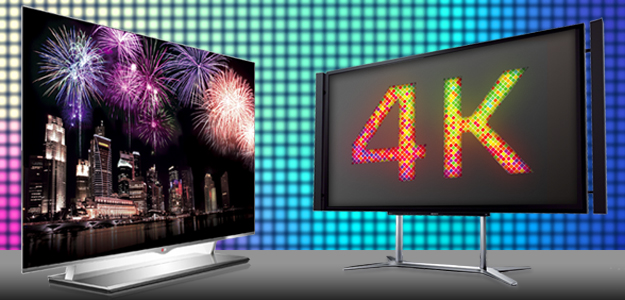
The eye-popping detail of 4K resolution may be hogging headlines due to a recent renaming to “Ultra HD,” but another TV technology also has the potential to upend the status quo – and both will be dueling for your dollars in 2013. OLED (Organic Light Emitting Diode) TVs made a major showing at CES earlier this year, but engineers have struggled to take the tech – which works well on smaller mobile screens – and implement it at the kinds of sizes that often inhabit people’s living rooms or home theaters. At CES, both Samsung and LG had OLED TVs to show off, albeit with onlookers held back at a healthy distance. But LG later showcased its fully assembled, 55-inch OLED TV prototype in Monaco, allowing us to land hands all over it – and it knocked our socks clean off.
Now, before we could even get them back on again, comes a report from NPD DisplaySearch indicating manufacturers plan to commercialize OLED technology before the end of the year. We knew that consumer-ready OLED tech was on its way, but we weren’t confident we’d see it before it was time to sing “Auld Lang Syne.” Before you get too jazzed, keep in mind that only about 500 units will ship before 2013, and virtually all of them will be used for retail demonstrations. Furthermore, manufacturers are only estimating about 3 percent market penetration by 2016.
This a quite the blip for OLED, considering that it had been flying firmly under the radar. Of late, the national media’s coverage of TV tech has been devoted to the 4K versus Ultra HD naming controversy, and now that we’re finally hearing about OLED again, we have a plethora of questions: Can it challenge Ultra HD? Will we see the prices over $10,000 that have been bandied about come back down to Earth a bit?
The question that really has our circuits buzzing, however, is whether or not we’ll see an Ultra HD OLED display. Is the world even ready for that? It would be like the television equivalent of crossing the streams. Before we get too excited, let’s put the unlikely hypotheticals aside for a bit and get back to the facts.
Here’s how we see it: Right now, Ultra HD just isn’t ready for prime time, but it would seem that OLED is. And even if Ultra HD were a bit more practical, OLED – in our estimation – is a giant step up visually from every other TV tech out there. Its contrast capabilities are out of this universe, and its black levels simply unparalleled; pure and simple, it’s a visual tour de force. Combine that with the ultra-ultra-thin 1mm bezel on the 55-inch LG model we saw, and you get deeply immersive optical effects that just aren’t possible on any other TV. Perhaps this recent news signals a need for the industry to shift gears in its reporting on the future of television.
Why isn’t Ultra HD ready for prime time? Well, the native content isn’t ready to be delivered at the consumer level yet, and there are plenty of indications that it won’t be for some time. According to a report by Advanced Television, DirecTV is all-in on the format, but admits it won’t be viable until around 2016. In other words, some of the first real Ultra HD broadcast content we see could conceivably be the states lighting up red or blue in the next US presidential election. In the case of OLED, however, we have a revolutionary way of delivering existing content. And it’s breathtaking in plain-old, boring 1080p HD.
One thing Ultra HD does have going for it, however, is that it’s built for gargantuan sizes, while OLED is still struggling to reach standard sizes. Still, though man-cave denizens get giddier as TVs grow larger, we have to ask ourselves: How big is too big? Too much of a good thing is always possible, and mammoth screens can only expand so far before becoming obtrusive and dominating whatever room they happen to be in. Size matters, but to a point.
To be honest, what we’re anticipating here is a good old fashioned format war. It’s exciting, the competition drives innovation, and, well, it gives us something to gab about. But, if that kind of conflict does come to fruition, both the industry and the consumer also run the risk of losing. The HD-DVD vs. Blu-ray debacle in its day stymied consumer adoption, and as a result, Blu-ray has had a tough fight finding its way into consumer’s living rooms. If we had to place a bet, though, our money just might be on OLED.


