
Like many tech companies, Sonos knows it must do better when it comes to the climate and it has come to the conclusion that in order to make a significant impact on its carbon footprint, it will have to find ways to stop its family of wireless speakers and components from using so much electricity.
This realization is spelled out in the company’s first climate action plan, which it will use as a road map to achieve carbon neutrality by 2030 and then net zero by 2040. The plan joins Sonos’ first product sustainability program, which it also unveiled as part of its 2021 Listen Better Report, which provides an overview of its Environmental, Social, and Governance (ESG) efforts.
Related:
Both the climate action plan and the product sustainability program are geared toward increasing the company’s product sustainability while decreasing its total contribution to global carbon emissions.
“With our Climate Action Plan, we’re entering a new phase in our commitment to environmental responsibility,” Sonos CEO Patrick Spence said in a press release. “We are invigorated by the challenge to innovate and create better solutions for our customers and for the planet.”

The reason Sonos is now laser-focused on the question of power is that more than 75% of its carbon emissions can be attributed to the energy consumed during its products’ lifecycle. In other words, Sonos can make big improvements in its supply chain, the materials it uses, and its product packaging — all of which are under active review — but these won’t have as big an impact on its carbon bottom-line as figuring out ways to make its new and existing products more energy efficient.
It’s a problem that feels deceptively simple. Sonos says that in 2019, the average idle power consumption of its products (the power used when the speakers aren’t actually playing music) was 3.83 watts per hour. That seems like a small amount, but it’s a continuous, 24/7 drain that only stops when you unplug the product from the wall. Multiplied over all of the Sonos products out in the wild, and it’s easy to imagine a much, much bigger number for total energy consumed.
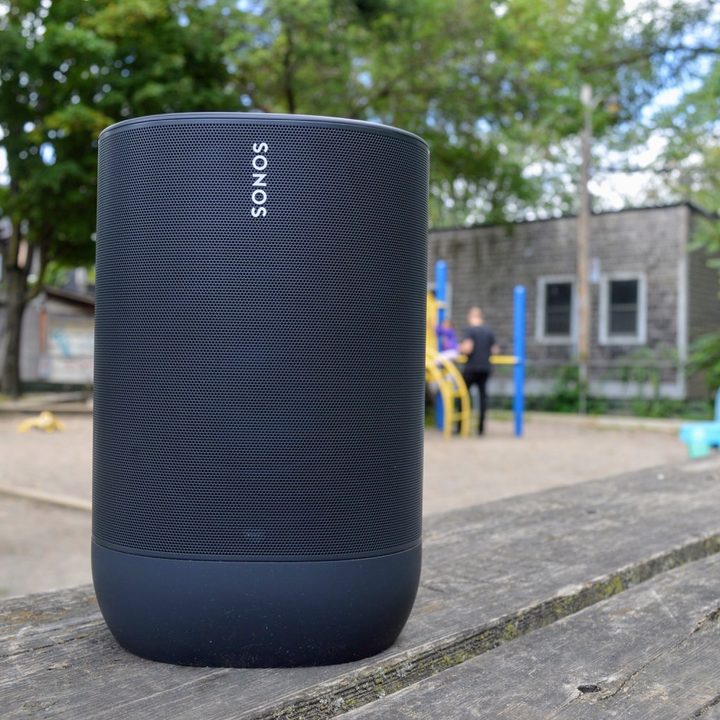
To address this challenge, Sonos says it is applying lessons learned from one of its newest products, the portable, rechargeable Sonos Roam. The Roam’s idle state consumes only 1 watt per hour and it has an even lower-power sleep state that consumes a scant 0.1 watts. It achieves these numbers despite still offering advanced functionality like smart speaker voice commands and Apple’s AirPlay 2 wireless streaming protocol.
The goal, according to Sonos, is to design new products that replicate this energy efficiency while providing smaller efficiency gains to existing equipment using software updates. Ultimately, it expects to get to an average idle power consumption of less than 2 watts per hour — something it believes it can do with its portable speakers within 24 months.
At the same time, the company is looking at a variety of ways to make its new products more environmentally friendly from a materials point of view. By 2023 it says it will eliminate the use of virgin plastics, replacing them with post-consumer recycled (PCR) plastics. It will change the design of the products to replace adhesives with fasteners so that they can be easily disassembled and recycled when they reach the end of their useful lives, but also to make them easier to repair when they can be fixed. By 2025, it aims to have packaging made with 100% responsibly sourced paper, and on the rare occasions when it needs to use plastic, it will use PCR plastics.
All of these efforts are aimed at reducing what Sonos’s contributes to the carbon problem, which it calculated was 1,231,430 metric tons of carbon dioxide equivalent in 2020 (about the same as 267,528 passenger vehicles driven for one year). But since it’s essentially impossible for industrial activity to produce zero emissions, the other side of the climate coin is to buy carbon offsets through investments in specific environmental projects.
For 2022, the biggest of these investments will be a partnership with SeaTrees by Sustainable Surf which will run a marine ecosystem project in the Southern Cardamom Watershed in Cambodia. And while offsets are a good way for a company to get to carbon neutrality — something Sonos says will happen by 2030 — getting to net zero is considerably harder.
Net zero means that a company actually removes the same amount of greenhouse gasses (or more) from the environment than it emits. But carbon capture technologies are in their infancy, with few offering the same potential as natural options (like trees) it’s not yet clear what mix of capture activities will get Sonos to its 2040 net zero goal. Apple, by contrast, claims it has already achieved carbon neutrality and has set 2030 as its goal for net zero.
Still, the scope of Sonos’ climate vision is encouraging and we’ll need many more companies to embrace a similar level of carbon accounting and alleviation on an even more aggressive time scale if we’re to make any headway toward the UN climate change COP26 goal of getting the planet to net zero by 2050.


