
How do you design with someone else when you can barely speak to each other?
“We don’t share a language in the traditional sense, but we meet all the time and we go see environments, stores, we take walks together,” explains storied designer Yves Behar. “We communicate by drawing, essentially the design language — drawing and interactions with each other’s teams.”
Behar, is practically a household name, or as close as the technology world is to one. He’s the designer behind One Laptop per Child, the Jawbone headset, head of the dynamic industrial design firm fuseproject, and responsible for who knows what exactly for Apple when he worked at Frog Design way back when. His latest project is a collaboration with electronics giant Samsung on a new television, unveiled earlier this week at the 2015 International Consumer Electronics Show in Las Vegas.
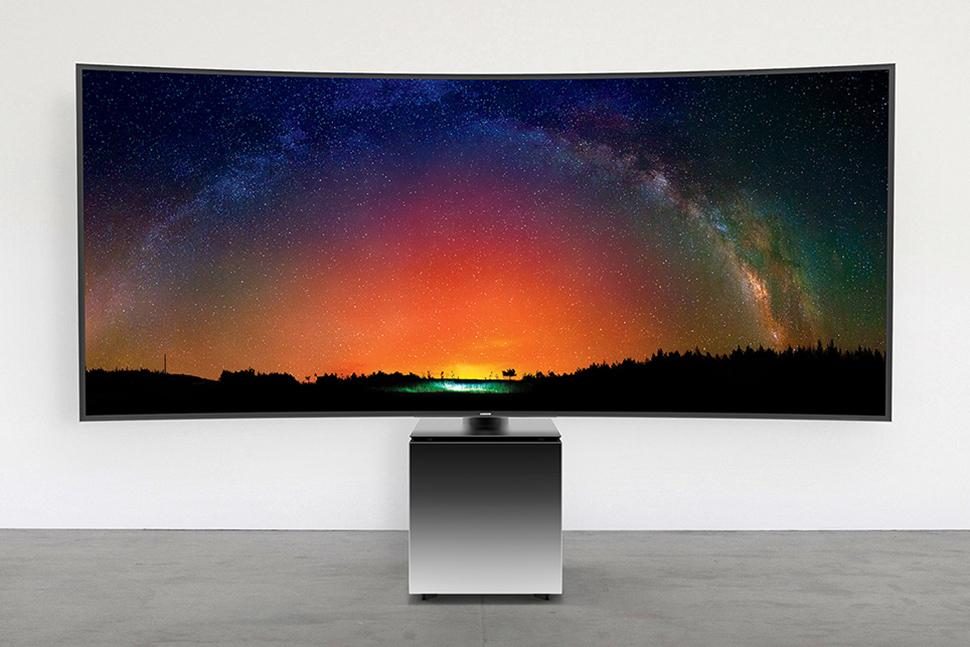
The Samsung S9W Curved TV pushes standard TV design in several ways.
And here’s the challenge: Behar is Swiss but speaks fluent English. Yun-je Kang, Senior Vice President of the Visual Display Design Group, understands English well but is far from a native speaker. It sounds limiting, but the pair seem to have hit it off.
“Yves is a great design partner,” Kang told me through a translator. “We have a great relationship … we are not simply sharing this product, we are sharing ideas. It wasn’t simply a process of giving Yves an assignment, and having a shallow collaboration, it was really about exchanging thoughts, our design identities, infusing Samsung and Yves perspectives. It was a truly collaborative experience.”
It sure sounds limiting, but it seems to have worked: the Samsung S9W Curved TV pushes standard TV design in several ways. It features a curved, 82-inch 4K screen much clearly wider than most, thanks to a 21×9 aspect ratio that perfectly matches the dimensions of film. (Yep, that means ordinary TV, which is shot in 16×9, will have the black bars that movies will lack.) The S9W rests upon a gallery-like cube like “a classical sculpture on a plinth.” The top of the cube, which is made from stainless steel in the current version, opens when turned on to reveal inner lights and the TV’s sound system. (The S9W is not currently for sale, and pricing has not been announced.)


The TV’s design is meant to pick up touches of the unexpected; moments, details, materials, that add an element of surprise, Behar explains on the website for his company, fuseproject. The cube can be made of many unexpected materials, and a black gradient at the top makes the frame look as though it floats over and fades into the plinth.
It’s a far cry from the TVs of yesterday, monstrous CRTs that were heavier than Heavy D (some weighing more than D even with the Boyz). Behar knows all about it.
“I had to move things out of an old house about a couple of weeks ago, and there was one of these 10- or 12-year-old TVs that was somewhere in the basement. And that thing must have been like 200 something pounds,” he said with a laugh. “It was as deep as it was wide. I had almost forgotten how massive and clunky these objects were.”
“The choices that the design team makes affects directly the features and capabilities of the product.”
It’s not just televisions that have evolved, of course. At the turn of the millennium, technology design was often intended to make electronics and especially computers look friendly and accessible. Think about the egg-shaped iMac from 1998, for example, a product wildly different than today’s computers. It was wonderful at the time, but today, it looks … well, a little silly.
“There were a lot of cartoonish designs,” Behar admits, “and you’re right, it was to make computers mostly and consumer electronics more approachable. But what makes them more approachable today is the fact that they integrate better, into your life, into your home environment, and the fact that they respond better – they start to respond to human behavior in ways that require less work on the part of the viewer or of the user.”
Kang speaks to his translator and the coterie of Korean executives surrounding us for a few minutes. I pick out three words in English: “minimal design” and “collaboration.”
“I’ve been with Samsung as a designer for quite some time, so I can say personally that I’ve been with the company since the years when it was not so advanced in terms of design. And I’ve seen how the company has really evolved into a design-centric company,” he said.
“In 2006 – about nine years ago I think — we launched the Bordeaux TV and it was very well received by consumers. Since then we’ve really strived to lead the trends in terms of TV design. If you look at how it’s evolved, it started from the TV being very matte and black, and went to being more glossy. We led the way in making TVs something very beautiful and elegant, as opposed to a bulky box.”
The S9W is the latest evolution of the TV, the pair argue, an effort not to make electronics friendly or cartoony or stark or sleek but integrated, part of the room. And Samsung may be one of the world’s best companies when it comes to the circuits and components that make up tech, but that’s not enough anymore.
“Technology is a set of bits and pieces. And you can be the best at the bits and pieces, but how you put them together, the choices you make … and the choices that the design team makes affects directly the features and capabilities of the product.”
“I’ve always believed design is the perfect alloy for technology,” Behar continued. “Technology in itself isn’t the answer, it’s how it’s applied, how it’s adapted, how it’s made relevant to the consumer. Design really is that translation.”


