During its Sustainable with Google event on Tuesday, the company announced a range of improvements across its product portfolio that are aimed at helping users make more sustainable decisions. Updates and projects aim to lower carbon emissions by steering people toward more environmentally friendly travel choices, greener products, and more accurate information around climate change.
Besides consumer products, Google took the opportunity at the event to toot its own horn about a previous commitment to having net-zero data centers by 2030. The company says it is leveraging the “cleanest cloud in the industry” for partners like Whirlpool, Etsy, HSBC, Unilever, and Salesforce. More news on that front is expected next week at its annual cloud conference. Here’s everything announced at Sustainable with Google 2021.
Nest offers carbon offsets

Nest Renew is a new service that adjusts owners’ home heating and cooling to use more sustainable power sources. Since output from sources like solar and wind vary greatly, it’s possible to make small changes in the thermostat to take advantage of an abundance of clean energy or to respond to a dip in its availability.
Electrical providers try to incentivize behavior to align with those variations by offering time-of-use rates. It’s not entirely practical to be hanging out at your thermostat to make tweaks, but letting Nest adjust it automatically is potentially a great solution. Ideally, these changes are small enough to not make a material difference in household comfort.
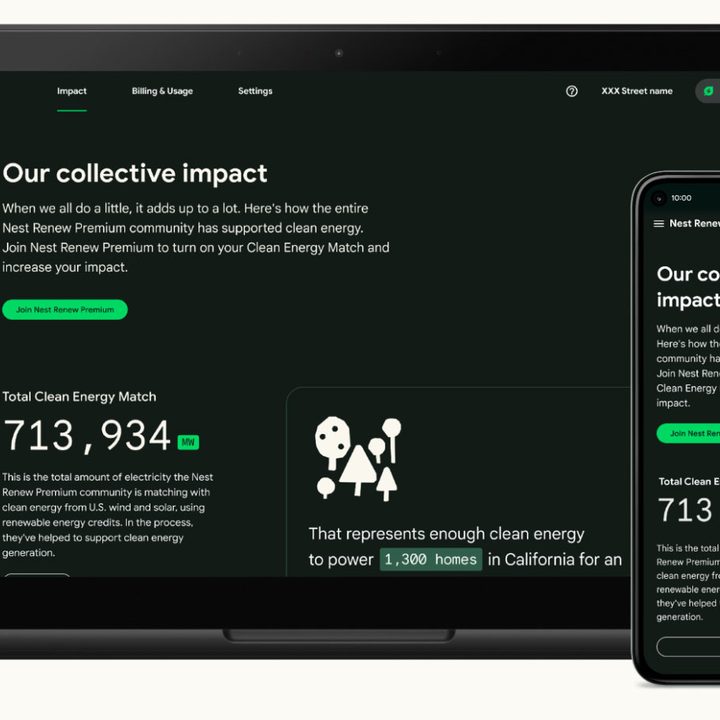
Nest has awarded users with a leaf when they’re saving energy, and Renew will dole out a few more. They include occasional challenges to earn bonus leaves, such as committing to running a load of laundry with cold water to save on power. These can be cashed in for votes on how Nest uses funds in its Energy Impact Program, which makes donations to a bunch of environmental nonprofits like GRID Alternatives and Elevate.
Though Nest Renew is a free program, Google is also offering Renew Premium. For $10 a month, it’ll match your estimated fossil fuel power usage with renewable energy credits. It’s perhaps best to look at this as a carbon offset subscription. The first partner on this front is the Bethel Wind Project, but more partners are expected to jump in over time. Nest Renew includes monthly impact reports that show exactly what has been accomplished in its fiddling.
Nest Renew will be rolling out in a limited preview “in the coming weeks” across the continental U.S. and you can sign up for an invite.
Flight searches will show emissions
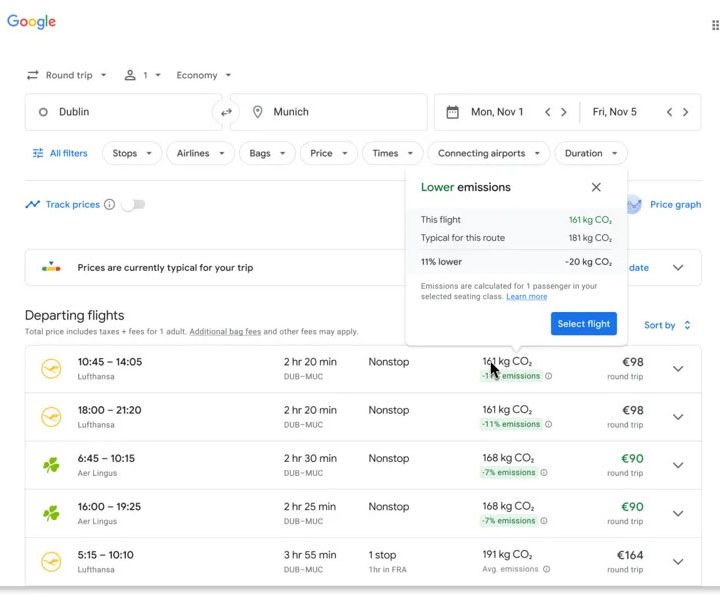
Search results for flights will now include filters and sorting for CO2 emissions for your routes. These figures will adjust based on class as well, since first-class seats take up more room and a proportionally larger chunk of the flight’s emissions than those in coach. Newer aircraft have improved fuel efficiency and will see emissions reflected in these ratings as well. To help find the best options, particularly green flights will be marked with a leaf.
Hotels will also get similar shout-outs for earning sustainability certifications such as Green Key or Earth Check. This should help tourists find hotels that have water conservation and waste reduction programs in place. This is all handy stuff to have at the ready as travel restrictions lift and more folks become comfortable with getting on a plane.
Google Maps gets friendlier with cyclists

Fresh updates in Google Maps for the U.S. will help drivers find eco-friendly routes based on estimated fuel consumption. Of course, that might not necessarily be the fastest route, but that’s an option you’ll still have in your navigation. Expect this feature to land in Europe next year.
In the next couple of months, cyclists will be able to cut down on distractions with a new “lite” navigation interface. The standard turn-by-turn directions aren’t especially useful when your phone is tucked into a pocket or bag anyway. Cyclists will also be able to find bikeshare services in 300 cities around the world through Google Maps. These regions include Berlin, New York, São Paulo, and Taipei, Taiwan, with more on the way.
Search highlights climate change facts
Disinformation on climate change is significant, and Google is updating its results interface on the topic to highlight quality information. Users will be able to peruse causes, effects, and definitions, with quality sources to back the information up.
Shopping search finds green alternatives

If you’re shopping for home appliances on Google, it will be easier to find energy-efficient options. Searches for furnaces, dishwashers, water heaters, stoves, and dryers in the U.S. will now provide a tab with helpful sustainability suggestions.
This extends to searching for electric vehicles in Google. Results will now improve visibility of EVs, as well as show estimated annual fuel savings compared to gasoline-powered cars and the location of nearby charging stations. Expect this feature to hit the U.S. early next year.
Google Finance helps you build an eco-portfolio
Google Finance will continue to highlight the environmental record of companies in their stock listings. Google has already added a sustainability score from environmental nonprofit CDP to individual listings, and soon Google Finance will provide an aggregate score of an entire portfolio. This should help investors gauge the overall impact of their contributions.
Fresh A.I. research can reduce intersection idling

Lastly, Google has announced that it’s engaged in research that uses A.I. to improve the efficiency of traffic lights in cities. Pilot projects in Israel have already produced a 10% to 20% reduction in fuel and intersection delay time. More trials are in the works in Rio de Janeiro and elsewhere in the world. Hopefully, tech like this can reduce idling and wasteful emissions.
That’s a lot to cram into a single event. For end users, much of this will only amount to user interface changes, but at Google’s scale, the cumulative effect of these changes could be significant. Nest Renew stands out as the biggest single announcement, and though it has strong potential to align with renewable energy sources, it may be ambitious to try to get users to tack on a $10-per-month carbon offset subscription.
There are plenty of reasons to be cynical of Big Tech’s commitments to sustainability, even if a lot of what Google’s been saying here sounds good. Measuring the outcome of these initiatives is a challenge in and of itself, both from an accuracy and transparency standpoint. At the very least, we can applaud the spirit in which they’re undertaken.