Did you know steam-cooking your food is one of the healthiest ways to eat? Unfortunately, the cooking method is limited by its temperature range and lacks the capability to brown meats. So, while steam is certainly a versatile form of heat, it may not be enough to accomplish everything you need to do in your kitchen.
Thankfully, a convection steam oven, which uses both steam and dry heat, provides the same health benefits but with a little extra heat. Here’s a quick rundown as to how steam ovens operate and their potential benefits.
How convection steam ovens work

A convection steam oven combines the unique capabilities of a steam oven with the cooking efficiency of a convection oven. These modes can be used separately or in conjunction with one another.
A steam oven has a reservoir that needs to be filled before you start cooking. On some ovens, this reservoir needs to be filled manually, while others can be hooked up to your home’s plumbing so that you always have water ready for steaming.
“Steam ovens are popular among cooks who have a special interest in preparing healthy meals,” according to Atherton Appliances. “Heat from the oven turns the water into steam. Food cooked in steam retains moisture better than food cooked in a convection oven. Steamed food also tends to retain more vitamins and minerals than food that is boiled.”
A convection oven uses fans to propel the heat around the inside of the oven. This ensures that your meal is cooked quickly and evenly.
“A true convection mode uses a cal-rod heating element that is wrapped around a fan … and, of course, the fan itself,” Chef Nicole Parmenter of Yale Appliance and Lighting told Digital Trends. “The heating element heats up, and the fan pushes the hot air around the oven cavity, basically to prevent hot spots. The reason why convection is more effective is because the forced hot air feels more intense. At higher temperatures, you can get a better oven sear in less time. The fan helps excess moisture evaporate.”
A convection steam oven uses both of these methods. Steam gives you a healthy cooking option, while the convection mode allows you to hit higher temperatures and brown meats. Some ovens, such as the Wolf Convection Steam Oven, use digital sensors to determine how much steam or dry heat is needed, then seamlessly switches between these two methods to give you a perfect cook.
Steam oven benefits
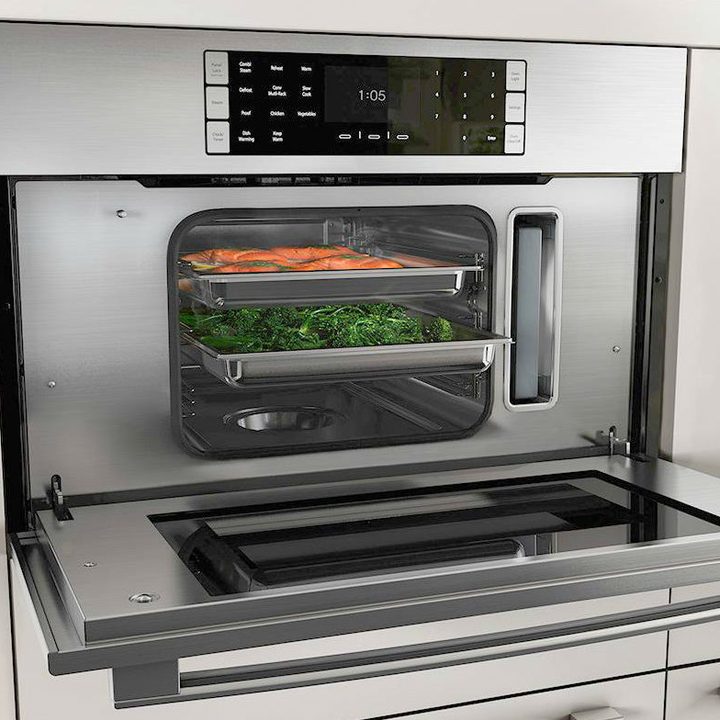
A convection steam oven, on the other hand, is capable of using both steam and dry heat. This means that in addition to the unique cooking qualities of a steam oven, you can also bake and roast in these ovens, as they can heat up to 450 degrees Fahrenheit (232 degrees Celsius).
“A convection steam oven has the ability to steam, bake, and roast,” said Parmenter. “Because it offers a steam mode, using 100% steam; a convection mode, using no moisture; and a combi-steam mode, a combination of steam and heat that uses about 50% to 60% steam. Steam cooking is highly touted for its nutritional benefits and is extremely advantageous in reheating leftover foods. Cooking with steam allows the ability to retain all vitamins and minerals in vegetables and requires less fats or oils when cooking proteins. It is also great for making grains, rice, breads, and custards that require a water bath.”
“Because the steam oven has the ability to steam and bake/roast on convection, many people think that you cannot brown/roast meat in a steam oven. If you are only using the steam mode, then no, you cannot expect meat to brown. The moisture and temperature will prevent any browning since steam is capped at 212 degrees. You would have to turn the oven to the convection mode to roast meat. Using the convection mode implies that dry heat only will be used to cook the food, and that mode will allow you to go up to 450 degrees.”
A convection steam oven gives you the best of both worlds, allowing you to cook with steam for juicy, vitamin-rich meals, while the circulating heat reduces your cooking time and provides an evenly cooked meal.
A kitchen staple or a fancy add-on?
Convection steam ovens can make an excellent addition to your kitchen, but the high price can be a downside.
Ovens can vary widely in price. You can easily find a reliable range oven for less than $1,000, but a full-size convection steam oven can cost three times as much. Chef Parmenter predicts that convection ovens’ prices will decrease as they increase in popularity, but the chance of them becoming a household staple is pretty low.
“Steam ovens and combination steam ovens have been in existence in the culinary industry for a long time, probably since the 1960s,” Parmenter noted. “As people started to become more conscientious about food production and preserving nutrients, that’s when you started to see luxury brands producing smaller versions for residential use. At first, they were expensive to manufacture, but I believe the more the market grows for this item, the more the price will come down. But not too far down. Bosch is a base-line luxury appliance and sells their steam oven for about $3,000. I’m not certain that these ovens will ever make it to Target or Walmart, but Best Buy now has a Pac-Sales section that offers Thermador, Viking, and other high-end brands.”
If you prefer to cook with steam, investing in a more budget-friendly steam microwave might be a more economical choice than a convection oven. Whirlpool sells one for around $310.