“L’Lexa, play songs from Lego Batman.”
Silence.
“L’Lexa! I said, PLAY SONGS from Lego Batman!”
Silence, again.
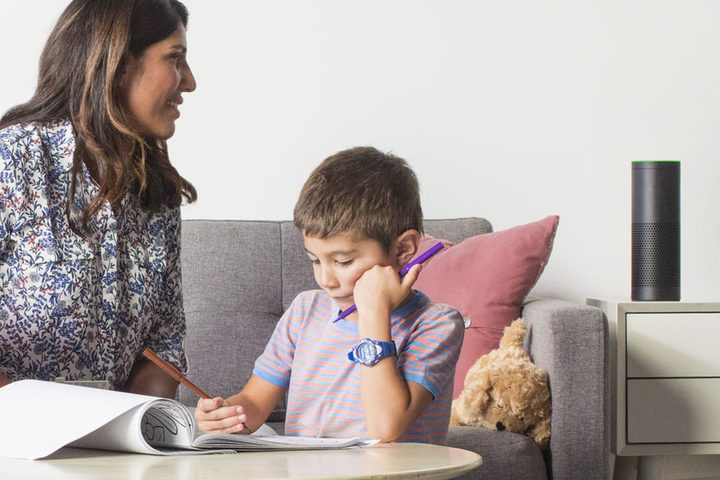
In some households, Amazon’s Alexa will respond when no one has said anything to her at all. In a few cases, she even laughs for no reason. But she still has trouble hearing my four-year-old son’s pronunciation of her name.
To be fair, he’s still figuring out how to properly say “Alexa.” I’ve coached him on it, but every time I do, deep down I wonder if it’s a good thing or a bad thing to make sure he can clearly communicate with a faceless voice projecting out of a mechanical device.
He’s very adept at asking for the time, which is hilarious considering he’s still not totally clear on what “time” is.
When he does get Alexa’s name right, he’s very adept at adding monster trucks to our shopping list or asking for the time, which is hilarious considering he’s still not totally clear on what “time” is. He uses the word “yesterday” to describe all time in the past, whether it was actually yesterday or last month.
When he goes to school, he tries to ask Alexa for cookies. His school does not have an Alexa device. His teacher tells me this with a smile that veils a hint of dismay. When he goes over to his grandparents’ house, he asks Alexa to put Spider-Man on the TV, something he’s not allowed to watch at our house. Grandpa and Grandma find this charming, not only because they find everything he does charming, but also because they don’t have an Amazon Echo device in their house. This means that my son is talking to no one, demanding immediate action.
But despite the laughs my son’s interactions with Alexa generates, there’s also something that makes me feel uneasy about it all, and I have to wonder if living in this age of voice assistants is somehow bad for him. I don’t mean bad content-wise, as we haven’t had any weird incidents with exposure to inappropriate material that you might have heard about. I just mean generally…bad.
By having a voice assistant device in the house, am I raising a child who will grow up to have unrealistic expectations about what he can get instantly? Am I blurring the line between human interaction and technology in ways that could ultimately be harmful to a little kid? Will my son use Alexa as a mechanism for getting what he wants in sneaky and devious ways, like ordering a bike, getting answers to homework questions, or in way worse ways I haven’t even thought about?

What if he falls in love with Alexa (thousands have apparently asked her to marry them) and can’t have a normal relationship as an adult? Or, what if he learns that it’s okay to verbally abuse voice assistants and then carry those actions into human relationships later on?
Okay, maybe I’m overreacting.
Here’s the thing, though: There are studies that say excessive amounts of screen time is bad for kids and adults alike. Using technology makes us all less empathetic, more anti-social, etc. But as far as I know, there are no studies that exist about children interacting with a faceless mechanical voice that will do their bidding for them. It’s just too soon to know if Alexa and other voice assistants might be harmful.
Am I blurring the line between human interaction and technology in ways that could ultimately be harmful to a little kid?
Here’s what I do know: My son is growing up in a vastly different and rapidly changing technological environment that differs from what I ever knew as a kid. While I had little choice of what to watch or listen to — forget on-demand TV or streaming music, I had to settle for A-Team reruns and a good FM rock or hip-hop station — my son has infinite choices at his fingertips. And Alexa makes those choices closer and more real than ever.
I realize that Alexa is just a somewhat weaker voice version of the internet. But somehow it feels worse. It embodies the instant gratification experience that technology brings, but masks it with a human voice, making it seem like a more authentic interaction when it’s actually not.
The other day during a walk, I asked my son about Alexa.
“Do you know what Alexa is?” I asked him.
“She’s like a computer robot,” he answered matter of factly, then ran ahead on the sidewalk to grab a stick in front of him. He grabbed the stick, turned around, and yelled:
“Hey mom! I’m a robot! You can’t catch me! Try and catch me!”
Then he took off running.

Maybe I am overthinking this just a little bit, but I doubt I’m alone in thinking there is something to be concerned about. Whether it’s Alexa or YouTube running on a smartphone, technology has stepped in as a surrogate — that babysitter that’s there to entertain our children while we occupy ourselves. And we can’t completely control the technology that our children are exposed to outside of the home.
As a technology writer, it’s my job to embrace new technologies like Alexa. But as a parent, it’s my job to ensure my son grows up to become a healthy adult. Therefore, it’s important to find that balance. I’ll just have to find a way to clamp down on Alexa once we enter that homework stage, while still giving her a place in my household. Of course, if Alexa is able to get him to do said homework or his chores, maybe I’ll sing a different tune then.
In the meantime, if you know of any tips on incorporating voice assistants into children’s lives in a healthy manner, send them my way.