
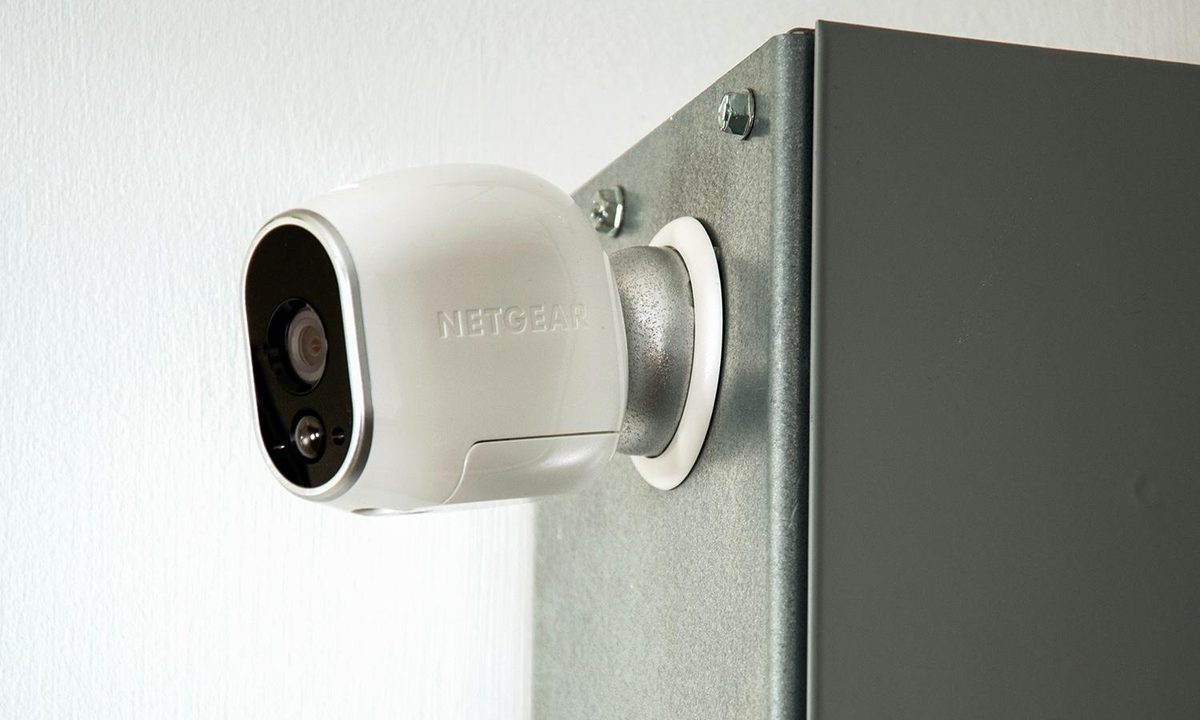
“Netgear’s Arlo cameras are small and wireless. They can go almost anywhere, which means some hard-to-delete videos could end up in the cloud for several days.”
- Wireless
- Waterproof
- Portable
- Easy to install
- Lots of cloud storage
- The accompanying app, with its “rules” and “modes” can be confusing
- No control over deleting videos off the cloud
- Battery issues in cold weather
“Why you can trust Digital Trends – We have a 20-year history of testing, reviewing, and rating products, services and apps to help you make a sound buying decision. Find out more about how we test and score products.“
Ten years ago, a home-security camera without wires would have seemed like an obvious fake – a dummy meant to convince thieves someone was watching and deter crime. But that’s not always the case anymore. Internet-connected cameras are eliminating the need for at least one wire on real cameras, and Netgear’s new Arlo security camera goes one step further, axing the power cable, too.
With no wires to run and a magnetic mount, you can literally slap one of these up in a matter of seconds. But when something goes down, can you still rely on them to capture the crucial footage?
Out of the box
The Arlo system we tested comes with two battery-operated, HD cameras and a hub that’s essential for its operation. While the cameras are small, fitting easily in your hand, the hub is going to add some extra clutter to wherever you store your router. Setup is straightforward and pretty quick. To get the system up and running, insert the four CR123 Lithium batteries in each camera, then use the included Ethernet cable to hook up the hub to your router. The app or Arlo website guide you through the rest of the account-creation and syncing process.
Small, magnetic, and wireless, the Arlo security cameras are designed to go anywhere.
If you don’t want to fiddle too much with the settings, that’s fine: The Arlo app’s presets include 80-percent motion sensitivity (meaning you’ll get motion alerts fairly frequently), which triggers the camera to capture 10-second videos. These 720p videos are stored on the cloud for seven days with the basic subscription, and are deleted when time or space (1GB of storage) runs out. It supports up to five cameras. Two other cloud tiers buy you more time, cameras and storage: Premier (30 days, 10 cameras, and 10GB for $10 a month or $99 a year) and Elite (60 days, 15 cameras, and 100GB for $15 a month or $149 a year). You’ll also get push notifications to your phone when the cameras detect movement, though you can disable these in the app if you find your houseplant dancing in the breeze is setting off too many alerts. You’ll still be able to view the videos in your library. It looks like a calendar, and you can click on the days with green circles to view your events.
You can also set up “modes,” like “Weekend” or “Evening,” which will turn off motion detection on your indoor cameras and switch it on for the outdoor ones, for example. Both of these appear to be already set up, actually, so you may not realize why your camera is unusually quiet between 5:00 p.m. and 8:00 a.m. on weekdays and all day on Saturdays and Sundays. You can also get email notifications for motion alerts, though somehow these never arrived in our inboxes. Outdoor cameras might require a different level of sensitivity than indoor ones, so you can use the “rules” and “modes” to specify different schedules for them. This wasn’t an entirely intuitive process, though Netgear does have a fairly robust FAQ section on its website. Still, we somehow seemed to still get recordings and alerts during times we thought motion detection was supposed to be off.


One thing we found pretty worrying about the storage was users’ inability to fully delete videos off the cloud. According to Netgear, after users deletes videos from their Arlo libraries, the files are flagged and placed into a cloud recycle bin, where they’re stored for an additional seven days before they’re completely deleted. Considering they’re inside the home, we can envision instances where people want certain videos gone — like if a towel slipped on the walk from the bathroom to the bedroom — ASAP.
Stick it where the sun does and doesn’t shine
The DT Accessory Pack
Up your game and the get the most out of your gear with the following extras, hand-picked by our editors:
Lithium 3V batteries ($18)
Stock up on batteries to power your camera.
VideoSecu wall ceiling mount ($7)
Secure your investment with a less easy-to-steal wall mount.
August Smart Lock ($250)
Delve further into smart-home security with a smart lock.
That makes it sound like the cameras also don’t work well head-on or close by, but we didn’t find this to be true, especially when its sensitivity levels were amped up. Just the tips of the cat’s ears were enough to set it off. Even in night-vision mode, almost any movement seemed to trigger an alert, even closer than that ideal five-foot range. It has a 130-degree field of vision and picked up all manner of flitting at the peripheries. The lag on the live stream was around six seconds, which is within the realm of expectation. It’s operating range of 300 feet didn’t quite hold up to testing, with the camera losing a connection at a little over 100 feet away.
Batteries are included
Because the Arlo is battery-operated, you’ll want to manage its power consumption carefully. Placing a camera far from the hub, watching the livestream frequently, or using “best video” recording quality all the time can drain them faster.

After a week of fairly heavy use, the batteries still reported full charge, and Netgear says they’ll last four to six months with optimized (lower-quality video) use. Some users are reporting the batteries indicate low charge levels when exposed to cold temperatures, and Netgear says it’s a known issue. The cameras are supposed to work between 14 and 122 degrees Fahrenheit (10 to 50 degrees Celsius). Since it’s been unseasonably warm in Portland, it wasn’t easy to check these claims.
Conclusion
The two-camera pack with four bases costs $350; a single-camera kit is $200, and additional cameras are $160 each. That’s pricey, but the free cloud storage is even better than ArcSoft simplicam’s $5-a-month offer. Still, it doesn’t have that camera’s sound-detection or facial-recognition features. We also found its app a bit finicky when we were trying to set up times it shouldn’t record, and the fact that we had little control over how long our videos stay in the cloud gave us serious pause — especially when we thought about all the awkward little things we might’ve done in front of the camera. Right now, though, we’re still hoping for upgrades to both the app and service from Netgear.
Highs
- Wireless
- Waterproof
- Portable
- Easy to install
- Lots of cloud storage
Lows
- The accompanying app, with its “rules” and “modes” can be confusing
- No control over deleting videos off the cloud
- Battery issues in cold weather


