“Roost calls the RSA-400 a smart smoke alarm, but it’s really just a 4-in-1 alarm where the battery contains all the smarts.”
- Detects four hazards: smoke, fire, carbon monoxide, and natural gas
- Less expensive than the competition
- Warns you before the battery dies
- Lacks some of the smart features of the Nest Protect
- Doesn’t integrate with many other smart devices
“Why you can trust Digital Trends – We have a 20-year history of testing, reviewing, and rating products, services and apps to help you make a sound buying decision. Find out more about how we test and score products.“
The Roost Smart Battery is such an ingenious invention: The $35 battery replaces the 9-volt in your smoke alarm, pairs with an app, and lets you silence false alarms from your phone and sends you alerts when there’s actually a problem. The new RSA-400 is a four-in-one smoke alarm from Roost that works with the battery as its backup, but it also gets its smarts from the 9-volt.
You can’t really talk about smart smoke alarms without mentioning the Nest Protect, and the Roost has one big advantage over the detector from Alphabet: It detects natural gas in addition to smoke, fire, and carbon monoxide. The Protect has sensors for the latter three only. But Nest does have some advantages over the Roost in terms of smart-home inclusivity.
Wired
The Roost RSA-400 ($80) and the RSA-200 ($60) both need to be wired up to work properly. Roost recommends an electrician install your detector, as you’ll need to disconnect and reconnect some wires. It’s a shame Roost doesn’t have a battery-only option, as both Nest and First Alert do for their smart alarms. Roost says in order for its sensors to work, it needs to be hooked up to more than just a battery.


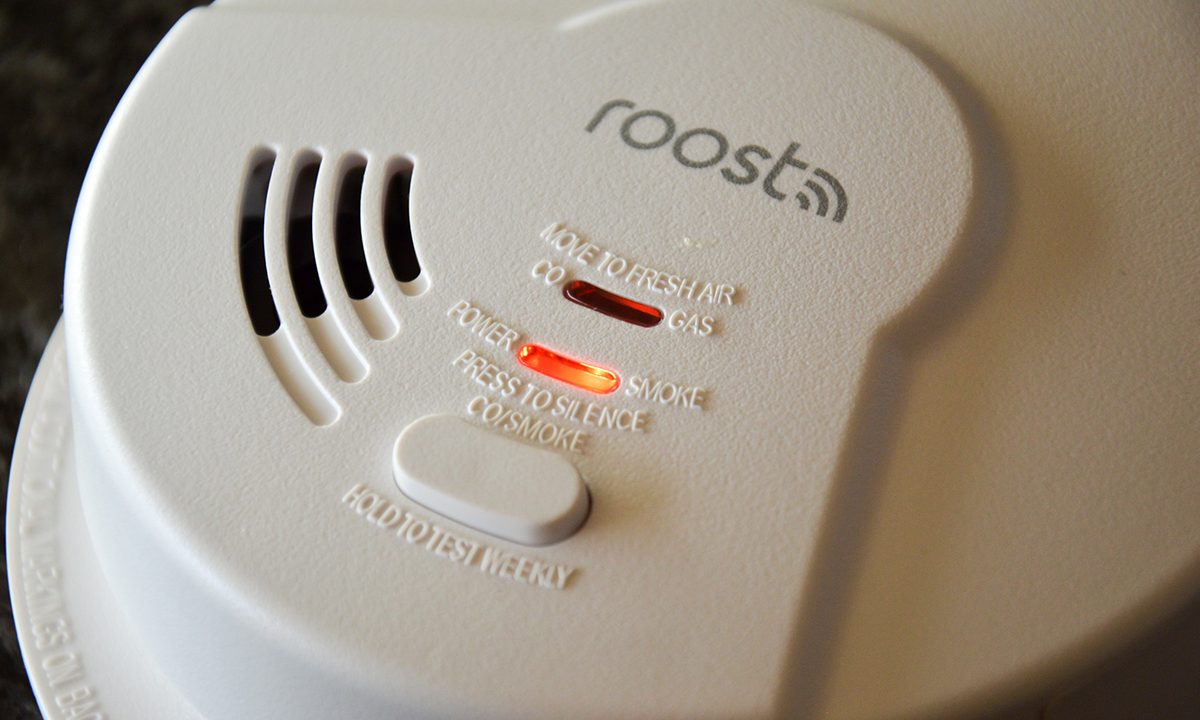
The battery, which is how it connects to Wi-Fi, is actually meant to function as a backup in case your power goes out. While the RSA-400 detects four hazards, the RSA-200 is just for smoke and fire. Both look like ordinary detectors and lack features like the Nest’s LED ring that glows different colors depending on what it detects. There are lights on the Roost RSA-400: It occasionally blips green to let you know the power’s connected, a blue light glows when CO is detected, and if you hit the test button, the lights turn red.
Loud and proud
When I tested the RSA-400 (several times), it delivered an appropriately ear-piercing shriek that would likely raise you from your sleep and definitely annoyed my neighbor and my cat. That’s great in an emergency, but it does lack Nest’s voice alerts, which warn you before the blaring sets in; that way, if something innocuous is happening, you can silence the device without hurting your eardrums.
The Roost has one big advantage over the Nest Protect: It detects natural gas.
When I hit the test button and used smoke in a can to set the alarm off, I would get an alert on my phone after about 20 seconds saying the alarm was sounding. If I had the app open, it would take a few seconds for it to register what was happening. That meant I had to wait for the little icon to turn from green with a check mark to a red square with a bell to remotely silence the device.
When that alert does pop up, I had four options: Call 911, view monitors (my contacts who I can alert that something’s alight), snooze the alarm, and view details. This is all exactly the same as when the Roost battery is installed in an ordinary detector.
Get visual
Part of the benefit of having a smart alarm is that it should be able to work with other devices to help lessen damage and alert you that something’s going down. While the Nest Protect could work with your connected thermostat to turn off in the event of CO detection, Roost doesn’t seem to have a lot of cross-device connectivity at the moment. I did set up an IFTTT recipe to have my LIFX light bulb flash red when the RSA-400 goes off, though it didn’t work when I used the alarm’s test function. There are also recipes for Hue bulbs, but IFTTT doesn’t seem to be talking to my Hue lights at the moment.


When’s the last time you tested your smoke alarm? You’re supposed to do it monthly, but both the Roost and the First Alert alarms want you to test theirs weekly. Nest says the Protect actually performs its own self-check, so you don’t have to. A weekly test seems pretty onerous, especially if you have several detectors.
Our Take
At $80, the Roost is $20 cheaper than the Nest Protect and offers an added layer of protection with the natural gas sensor. If you already have a four-in-one detector, then the Roost battery is a great way to smarten it up.
How long will it last?
The Roost alarm is under warranty for 10 years, while the battery has a one-year warranty. The battery and app could get some software upgrades along the way that make them more compatible with other products, but there’s no guarantee of that.
Should you buy it?
If you want to upgrade your hardwired detector to something smarter, then you’ll have to ask yourself what you’re looking for: something feature-packed and pretty, like the Nest Protect, or a more utilitarian device that also detects natural gas. Just remember that the RSA-400 isn’t a replacement for a battery-only smoke alarm.