
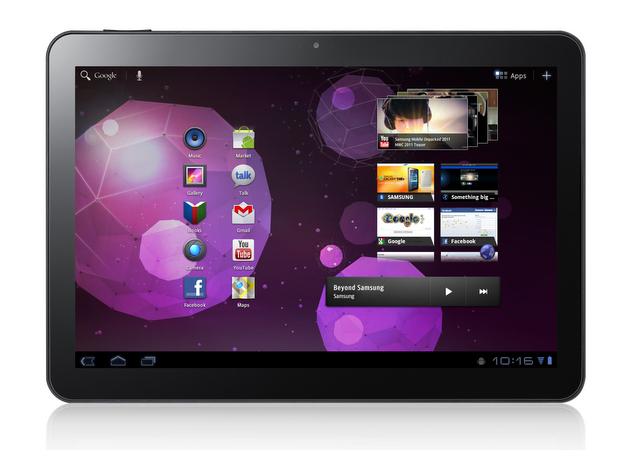
The patent battle between technology giants Apple and Samsung continues to escalate as Apple argues the Samsung Galaxy Tab 10.1 should be barred in Australia and industry watchers start to pick apart Samsung’s infringement claims against Apple. In the meantime, Verizon Wireless has filed an amicus brief in the U.S. battle between the two companies—and sides with Samsung.
In Australia, Apple and Samsung have started a two-day series of hearings on whether sales of the Samsung Galaxy Tab 10.1 tablet should be prohibited from sale in Australia. Although the tablet runs Android, Apple argues that the tablet’s design violates at least three Apple design patents. Bloomberg quotes Apple lawyer Steven Burley saying infringement should have been “plain as the Opera House” to Samsung, and re-iterated claims Apple has made in a number of international jurisdictions that Samsung’s Galaxy Tabs illegally copy key aspects of the iPad’s design. The version of the Galaxy Tab 10.1 Samsung wants to offer for sale in Australia isn’t the same as the one the company has for sale in the United States—Apple claims the U.S. version violates ten Apple patents. Samsung delayed the launch of the Galaxy Tab 10.1 in Australia until the court rules on Apple’s request for an injunction on sales of the devices; Apple’s infringement claim in Australia doesn’t cover any other Samsung tablets, or any Samsung smartphones.
Samsung has also added ammunition to its fight against Apple in Australia, last week filing a patent infringement case against Apple claiming that the iPhone 3G, 3GS, 4 and iPad 2 infringe on seven Australian patents owned by Samsung. Like other Samsung claims against Apple’s products in other venues, the patents in question center on wireless communications technologies.
Meanwhile, industry watchers are starting to pick apart Samsung’s infringement claims against Apple. The Wall Street Journal speculates that Samsung’s infringement claims may be an attempt to “sow confusion” in the courts, in a kind of mudslinging tactic to make the litigation between the two companies as messy as possible—and increase pressure on Apple to settle. The Wall Street Journal piece contrasts Apple’s infringement claims against Samsung&which center on design and technical patents—with Samsung’s claims against Apple, all of which the company has apparently committed licensing under “Fair, reasonable, and non-discriminatory terms” (FRAND, in patent parlance) via standards bodies. The idea is that companies contribute patented technology to open standards, which can then be licensed by anyone in the industry on FRAND terms. Apple has characterized companies’ efforts to get more money out of patents essentially to open technology standards as a deceptive attempt to inhibit competition through, essentially, reneging on their deals with standards bodies.
In contrast, Samsung argues its patents represented in open standards haven’t been fairly valued in the marketplace, and the company is entitled to additional compensation. The approach is similar to a broad patent infringement claim mobile giant Nokia launched against Apple last year, and which spilled over into early 2011—Nokia actually came out on top in that one, with Apple agreeing to a one-time settlement.
In the meantime, Verizon Wireless—the largest mobile operator in the United States—has filed an amicus brief with the court considering Apple’s infringement claims against Samsung in the United States—and the carrier takes Samsung’s side. Although Verizon is not a party to the case and the amicus—or “friend of the court”—brief carriers no legal standing, the mobile carrier argues to the judge that granting an injunction on the sale of specific Samsung tablet and smartphone products would harm the public interest by reducing consumer choice. The move might seem curious in light of Verizon Wireless recent successful acquisition of the iPhone, breaking a few years of AT&T exclusivity with the device. However, Verizon Wireless’s stance highlights the ongoing tension between mobile operators and mobile device makers: device makers need carrier infrastructure to…well, work, and carriers need innovative mobile devices to convince customers to sign up for service. Carriers want to be in the controlling position, and they stay there by playing handset makers against each other. The popularity of the iPhone—and the stunning loyalty of its users—could pose a significant threat to carriers’ bargaining positions.


