

Two days ago, I wrote an editorial about how happy I was that screen sizes on phones may finally be stabilizing and not continuing to grow out of control. In it, I said it wouldn’t be long before 7-inch tablets would become phones themselves. I spoke too soon. Yesterday, Asus unveiled a 7-inch device named the Fonepad. It’s basically a Nexus 7 with a phone built into it. We caught up with Asus on the Mobile World Congress show floor to check it out.
If you want to know what it’s like to use the Fonepad, you need only pick up your Kindle Fire, Nook Color, Nexus 7, Galaxy Tab 7, or find any other 7-inch tablet (or a paperback book or older Kindle) and pretend to use it like a phone. Do you feel empowered? Is this the kind of life you want to lead? If you don’t mind barely being able to hold your phone in one hand, or having a phone dialer large enough to read from across the room, the Fonepad may be the Fone for you. To me, it’s like a special accessory the phone company might give to people with fat fingers. Something given to anyone who walks into a wireless store in a muumuu.
The tablety-phoney thing is really a modified Nexus 7 with 3G built in. Though the Nexus 7 is branded a “Google” device, Asus actually manufacturers it. One look at the Fonepad and you know it came off the same assembly line. Unfortunately, a Chinese worker must have hit the “crappy” lever at the front of the plant, because many of the nice flourishes of the Nexus 7 like the grippy design, are missing, instead replaced by a gray brushed look.
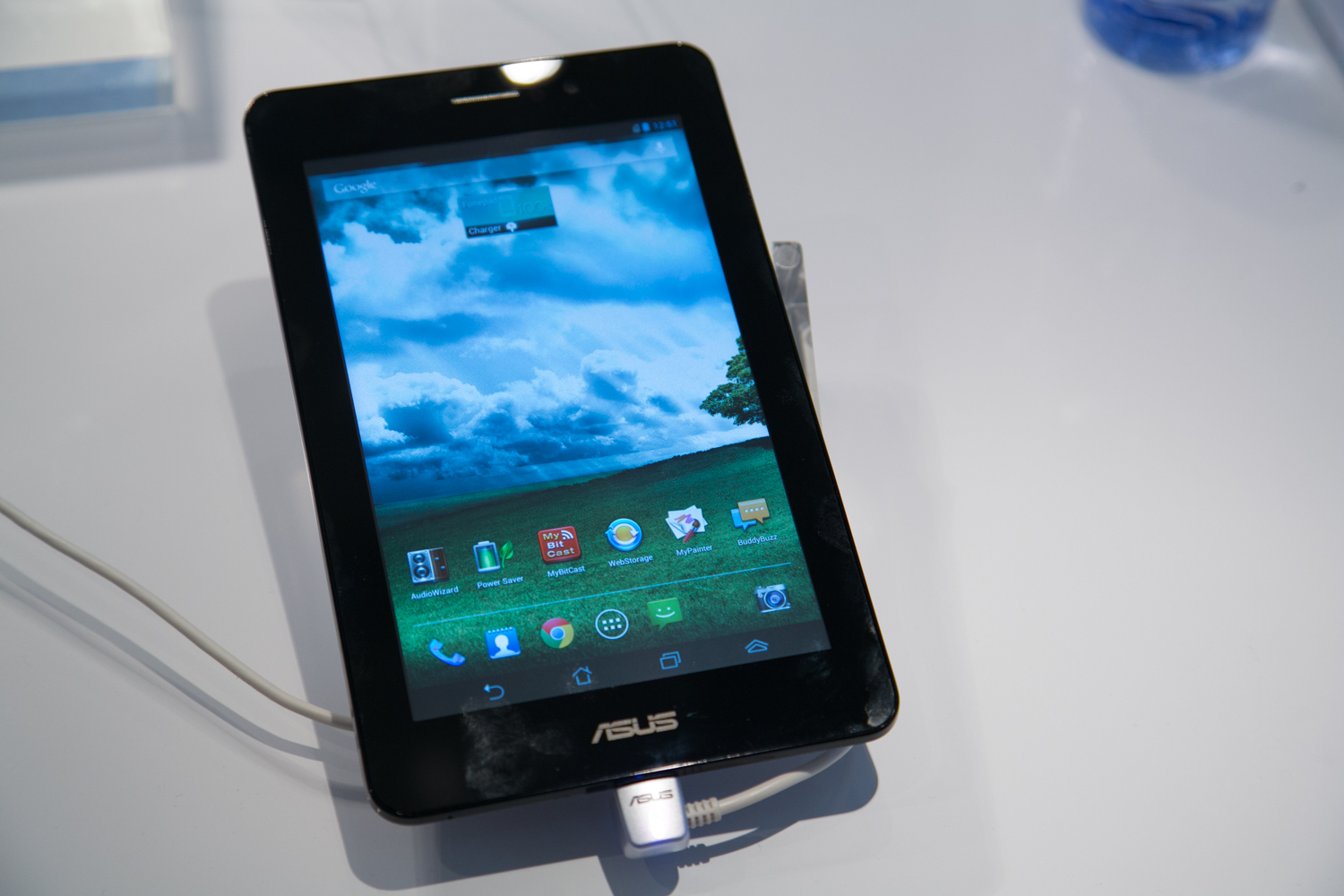
The insides of the Fonepad aren’t as impressive as a Nexus 7. Instead of a speedy quad-core Nvidia Tegra 3 processor, Asus has shoved in a single-core 1.2GHz Intel Atom processor. It does the job in standard use, but if you plan to tax your tablet phone with any difficult applications or games, you’ll find it slowing down fast.
Other specs include 1GB of RAM, 8GB of internal memory, a 1280 x 800 pixel LCD screen, a 3-megapixel rear camera, a 1.2-megapixel webcam, and a microSD slot for expanded file storage. It runs a modified version of Android 4.1 Jelly Bean and looks about like what you’d expect an Android tablet to look like.
As a phone, it’s awful. The microphone sits extremely low compared to the earpiece and if you hold it up to your head, it’s pretty much the equivalent of wearing a Phantom of the Opera mask or gluing a big book to the side of your face. You look like an idiot and won’t be able to hear your friends. It’s a lose, lose. There are some benefits to having a larger screen, but there’s almost nothing this device can do that you can’t do well on a 4.7-inch or 5.5-inch phone like the LG Optimus G Pro or Galaxy S3. If you really want a small tablet that provides benefit, you’ll want to opt for a Galaxy Note 8.0 or iPad Mini – two devices with 8-inch screens. Eight or nine inches is a great size range for tablets. Seven inches is not.
The Fonepad will hit shelves around the world in the next few months for about $250, but don’t expect to see it much in the United States. Because Asus has only included 3G support but no LTE, no U.S. mobile carrier is likely going to stock the Fonepad. Of course, for you die hards, just remember: If there’s a will (and there shouldn’t be), there’s always a way.
Update by Jeff: The Fonepad’s back plate is metal, not plastic. The correction has been made to clarify this. The original text said it had a “plastic look” to it.


