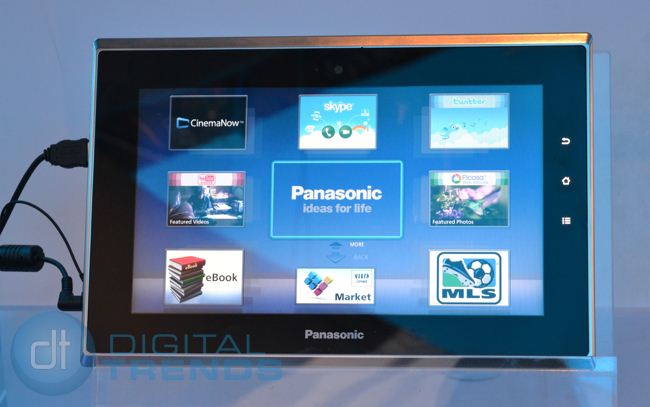
At Panasonic’s press conference Tuesday, speakers were somewhat cagey about offering details on any tablets. We got little more than a sideways glance at the devices, learning only that they connect with Panasonic’s Viera TVs. Yesterday, we got a closer look at the 10-, 7-, and 4-inch tablets and learned more about their currently limited capabilities.
For the moment, the Viera tablets are little more than touch screen remotes. The exhibitor told us that as it stands, the tablets (and we hesitate to give the 4-inch model that label) are really just companion pieces to Panasonic’s Viera Connect TVs. The devices have no cellular connection, relying completely on Wi-Fi, though we were told that this could be a future update. We were told that they could function as stand-alone tablets, but are intended for living room use. Panasonic has just opened up its SDK to developers and is in the process of reviewing and accepting apps, which would give it stronger legs to stand on as a stand-alone device. Until further notice, it’s primarily for finding and streaming content for the TV and does not work to connect apps to your television; for instance, the e-reader feature can’t be sent to your screen.
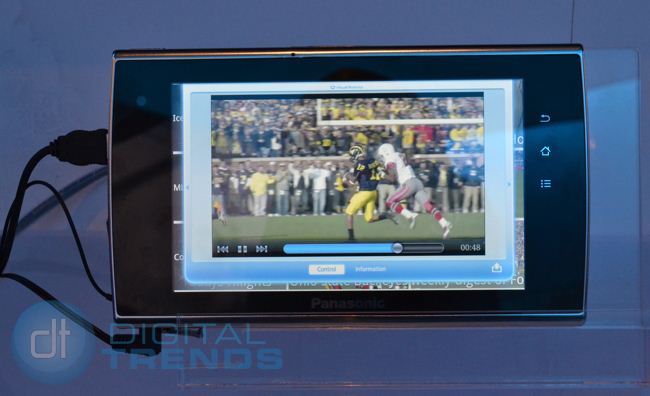
As for specs, the temporarily titled Viera Tablets run Android 2.2 with Panasonic’s Viera UI operating on top. The 10- and 7-inch models feature HDMI and USB ports, as well as card readers. The 4-inch only has an HDMI port. There are no storage specs yet, since the devices are only prototypes.
During our look at all three, the system seemed laggy and couldn’t demo too many functions. Still, the 10- and 7-inch tablets are sleek machines, and inarguably give viewers a heightened user experience with Viera’s Connect app store, dubbed Marketplace, but the 4-inch version seems downright useless. It’s a thick, small brick, similar in feel to a digital camera, and we can’t imagine how it would appeal to someone wanting to take full advantage of the smart TVs and their capabilities.
There’s nothing new or innovative about the Viera Tablet, but it’s meant to put this technology into the average consumer’s hands. It’s definitely capable of doing this, provided the finished version refines some of its rougher edges. But let’s be honest, if this is Panasonic’s entrance into the tablet wars, it’s a pretty weak one. We were told the tablets are expected sometime in 2011.
On the other end of spectrum, we saw a Panasonic product that the average consumer could never dream of owning. Panasonic showed us its 152-inch 3D plasma TV, that packs a whopping 4,096 x 2,160 pixels and will set you back $500,000. The same set was introduced at last year’s CES, but only in 2D. The exhibitor reported that the upgraded version is currently only available to the corporate market, but that it will eventually be available for everyone — as we were told, if you can fit it in your front door, you can probably afford it. Panasonic recently sold its first unit, but the average buyer shouldn’t start saving up yet, as it’s not even set in stone it will be available for the general public.
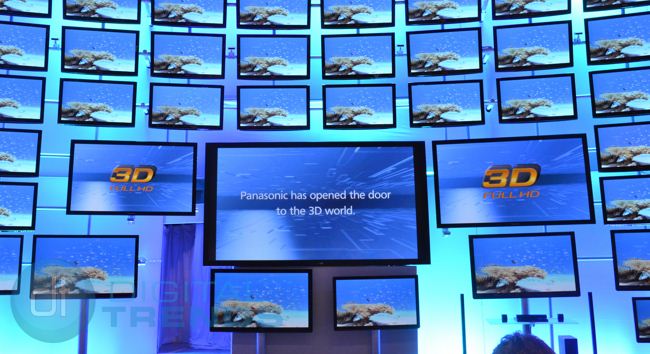
Fortunately for the rest of us, the TV is now shipping in 103- and 85-inch models. The set uses active shutter in order to use the quicker response of the plasma technology in its screens, and yes, the glasses are heavy and dark, but the effect is worth it. It’s one of the crispest, most stunning visuals we’ve seen out of 3D TV this year. Of course, some of that might be attributed to its monstrous size.
And if its any comfort, the glasses have been upgraded to chargeable units, getting rid of its former battery-powered models. The higher-end model comes with a single pair; otherwise they cost $159 each.