
 There’s no shortage of messaging apps that can replace your native text messaging service in the App Stores. Apps like Imo.im, and of course Whatsapp are among the most popular, but there’s a crop of contenders from Asia that you may or may not be familiar with growing exponentially, and they’re beginning to find a solid footing with the U.S. audience. Here’s a quick look at messaging app imports that could soon become popular options for avoiding your native texting client.
Kakao Talk

Launched in 2010, Kakao Talk was founded in Korea by Beom-Soo Kim, the former CEO of Next Human Network, the company formed after a merger between South Korean companies Naver.com and Hangame Communications. Kakao Talk provides users with an interactive chatting experience, a library of emoticons, and an app-to-app calling feature that uses your data plan instead of your minutes.
One thing we’ve noticed with the app is that celebrities – primarily in Asia for now – are using it to keep fans up to date through Kakao Talk messages.
The app is primarily popular in South Korea, with half of its 60 million users coming from that country. The app reportedly hosts one billion inbound and outbound messages per day.
Kakao Talk is available on iOS, Android, Bada, Blackberry and Windows Phone devices.
LINE

There’s a stark similarity between LINE’s user interface and Kakao Talk, which makes sense given that LINE was launched by the Japanese subsidiary of Next Human Network. The app’s messaging service is extremely similar in design and user experience with Kakao Talk, but it’s easy to use and comes with similar bells and whistles — like voice-to-voice calling and in-app emoticons. Other features include group chatting and “stickers” that you can message to your friends. The one caveat is that the app’s voice-to-voice feature can be buggy and unreliable as our calls were often dropped. Where LINE differentiates itself from Kakao Talk is that it’s making a push to be a mobile social medial destination. You can publish updates to a Timeline, and it even recommends its other standalone branded apps for taking photos, painting, sending greeting cards, or gaming.
In just eight months since its launch, the app has garnered 20 million users, and claims it reached that milestone faster than Facebook (it took 38 months). Today it has over 60 million users worldwide (approximately 29 million in Japan) and is projected to reach 100 million users by the end of 2012.
The app is available for iOS, Android, and Windows Phone devices.
Nimbuzz
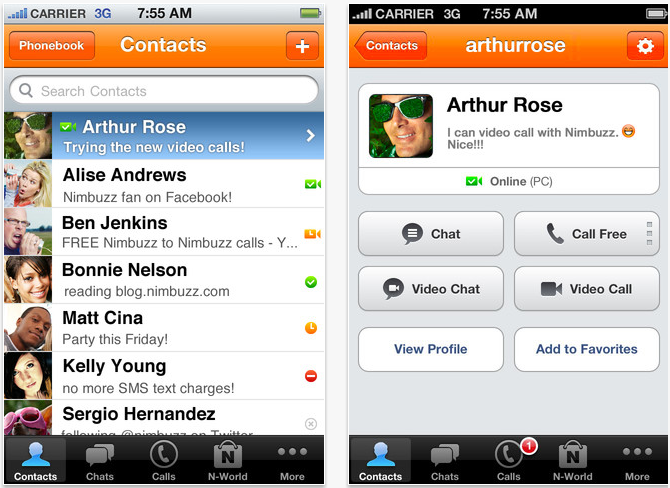
Nimbuzz isn’t a shoe-in for this list since it doesn’t get its beginnings in Asia. In fact the startup began in the Netherlands in 2006, but the company has since relocated its headquarters to India and replaced its key staff with Indian executives after it became hugely popular with consumers in the country. It currently has over 100 million users globally,17 percent of which reside in India and 6.5 percent in the United States. The company projects to have 400 million users by 2014.
Its interface is very reminiscent of Whatsapp. However, we have to admit when it comes to calling or chatting via video (features that Whatsapp doesn’t offer) Nimbuzz might offer a superior experience. Users can call friends who have the app downloaded for free, or talk face-to-face with its free video calling feature. A unique service that Nimbuzz also provides is the ability to chat by texting with your friend through video, but without the audio. While it might sound peculiar to you, it’s ideal for users who would prefer to see each other but are on networks that restrict access to VoIP calling services.
Nimbuzz is also making a hard sell to compete directly with Skype. The majority of its features are focused on calling services, including the ability to call landlines and cellphones for a minute-by-minute fee, similar to what Skype offers.
Nimbuzz is available on iOS, Android, Blackberry, Windows Phone, Nokia, and even Java devices.

Tencent Holdings, a Chinese holding company that owns the wildly popular Tencent QQ (a free instant messaging service based in China) has a sizable piece of the mobile messaging market with WeChat. With 200 million users, it’s among the most popular messaging apps in the world. But WeChat is unique in its approach as the app focuses on voice messaging – it’s a feature offered in LINE, which buries its voice messaging into a secondary page. Rather than offering voice-to-voice calling, users can record a voice message and send it to their friends just you would with a regular text-based message. Of course if you prefer to send text messages, the app supports it through the same interface, along with the emoticons and “stickers” that you’ll find in other services.
Similar to LINE, WeChat has extended its service to offer a social media component called “Moments.” On this page, which not surprisingly resembles Facebook’s Timeline, users can share content as long as you publish a photo that’s stored on your phone.
WeChat is available on iOS, Android, and Windows Phone devices.


