
“Why you can trust Digital Trends – We have a 20-year history of testing, reviewing, and rating products, services and apps to help you make a sound buying decision. Find out more about how we test and score products.“
If I were Motorola, I’d be pretty worried right now.
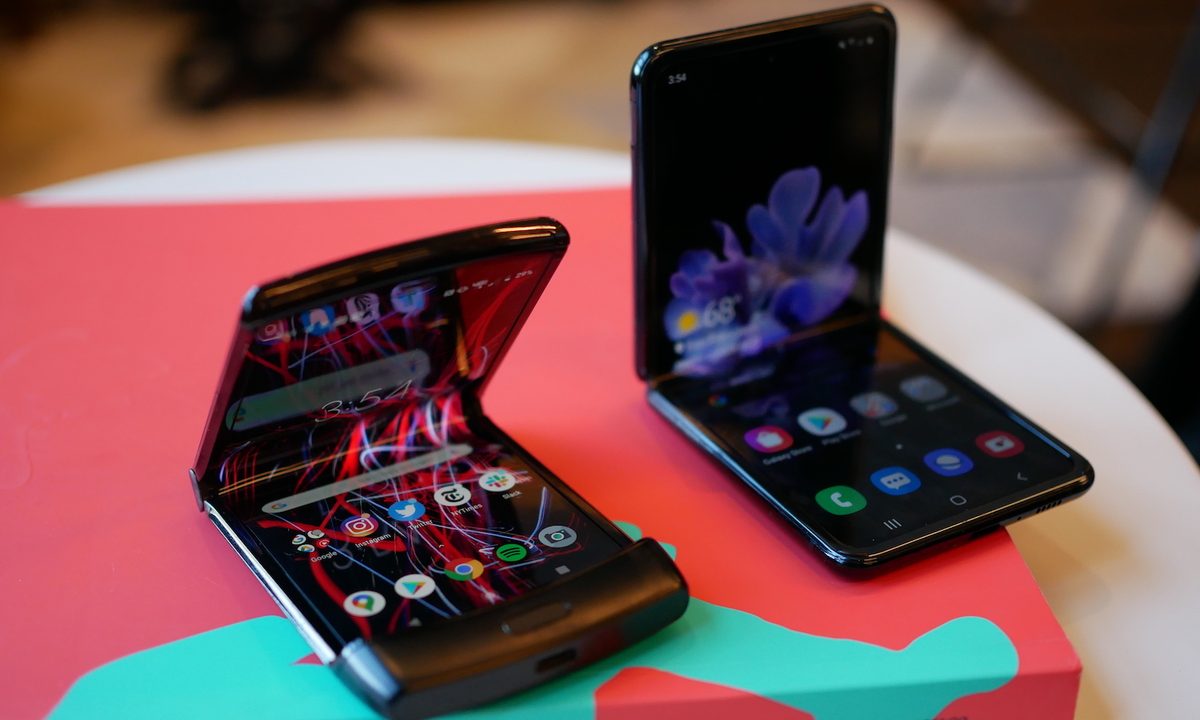
Samsung’s horizontally folding Galaxy Z flip new smartphone looks better than Motorola’s Razr in every way. Samsung’s had this on the roadmap since the company’s first folding-screen smartphone, the Galaxy Fold, but the Z Flip isn’t replacing the Fold, as it very well could for many customers who might’ve been considering the Motorola Razr.
“We see the folding category as splitting two ways,” Caleb Slavin, Senior Manager of Smartphone Product Strategy at Samsung, told Digital Trends. “The flip style is more about having that really compact form factor, really easy to fit in your pocket, more of a style-focused device.”
Inevitably, the Galaxy Fold felt like a tablet; the Z Flip feels like the future. It’s the same feeling I got when I first held the new Motorola Razr, but one thing immediately stands out above the Razr — and that’s build quality.
Mirror metal and foldable glass
It starts with the in-hand feel. The Galaxy Z Flip feels like a flagship Galaxy phone that was literally folded in half. Picking it up, you’ll immediately feel the well-balanced weight of the phone, which thankfully carries over when it’s flipped open. The aluminum and glass that compose the Z Flip somehow feels sturdier than the stainless-steel Motorola Razr, partially due to the resin back and plastic screen used on the Razr. The Z Flip also uses foldable glass to protect the display — a touch that significantly bumps up the look and feel.

Samsung refers to it as “Samsung Ultra Thin Glass” but doesn’t offer much in the way of details, other than boasts about its durability. While we can’t quite test that yet, it’s clear that there’s much less separation between the glass, frame, and hinge keeping this intersection neat, tidy, and less prone to damage. All of these were issues for Samsung’s first foldable phone, the Galaxy Fold, upon its initial release, and though we’ll have to see how foldable glass holds up, we’re happy to see it and the structural improvements around it.
The Z Flip is a flashy device too, with mirror finishes in each color option (mirror purple, mirror gold, and mirror black) that make up the front and back of the device, which sort of looks like a makeup compact when closed. The only interruption in the closed façade is the dual-camera setup and a teeny-tiny 1-inch OLED touchscreen that takes up about just as much space. The small touchscreen can answer or reject calls, show the time and date, and display other quick notifications; it doubles as a viewfinder for taking selfies. It’s a very small viewfinder, but it’s workable, considering a selfie can only go as far as your arm can reach.
Prying the Z Flip open, you’ll feel some satisfying resistance which you can fidget with nervously, partially opening and closing the device without much worry. Samsung says this hinge is tested for over 200,000 full open-and-close motions. Good resistance carries through the range of motion on the hinge, which is great for avoiding a floppy feel, but still doesn’t give you the spring-loaded satisfaction that yesteryear’s snap-open flip phones gave us — something the new Motorola Razr also couldn’t nail.
Display
Fully unfurled, we’re looking at a 6.7-inch AMOLED display and a slightly tall 21.9:9 aspect ratio. The height isn’t anything you’ll look at twice, as you might with Sony’s Xperia 10, for instance, and the bezels surrounding it are small enough to keep the device feeling normal in hand. There is a noticeable crease in the middle where the display bends, but if you’re looking straight on at the device, it’ll be hard to find.

New UI features
Samsung added a few bits to the Z Flip’s UI that prove it wasn’t just relying on the form-factor to carry this experience through. It’s not a lot, but there are small, welcome additions like Flex Mode, which detects when the phone is half-open and separates the UI into two screens for certain apps.

For instance, if you open the phone to about a 90-degree angle, launch the camera app, and set the Z Flip on the table, not only do you essentially have a tripod setup, but the bottom half of the screen becomes strictly controls (shutter button, mode switch, etc.) while the top half becomes a dedicated viewfinder. This also works with the Gallery app, which makes the bottom half a touchpad of sorts for swiping through photos on the top half of the screen, and YouTube, which separates videos from the comments and information section.
They’re not the most useful features in the world of tech, but at least the tripod proposition adds some value while the rest simply add a bit of fun and novelty.
Performance with little sacrifice
When it comes to performance, the Z Flip isn’t the supercharged powerhouse that the Galaxy S20 Ultra aims to be, but I’m happy to report you won’t be lacking for power either. Equipped with Qualcomm’s Snapdragon 855 Plus processor with 8 GB RAM and 256 GB storage, the Z Flip’s chipset is a small step above most 2019 flagships. There’s also no option for expandable memory, but if these are the minor sacrifices needed to either keep price down, battery life up, or the profile thin, then I’m more than pleased with the decision. With a 3,300 mAh battery and the option to charge wirelessly or share power wirelessly to other devices, all sounds up to snuff here, but day-long battery life is an important aspect we’ll need to confirm after some more time with the device.
Dual cameras straight from the Galaxy S20
On the subject of small sacrifices, we’re not getting big boisterous camera arrangements on the Z Flip but rather a pair of 12 MP wide-angle and ultra-wide-angle cameras. This more modest setup should still yield some alluring results, as they’re the same optics you’ll find on the brand-new Galaxy S20 and S20 Plus. So, really the only thing you’re missing from Samsung’s latest camera tech is the telephoto 3× zoom camera.
Conclusion, price, and availability
Motorola just released the new Razr last week, and it couldn’t have come at a worse time. If a compact foldable smartphone is your thing, you can spend less than the $1,500 Verizon exclusive — albeit only about $100 less, $1,380 — and get a better horizontally-folding phone, with more carrier choice, in Samsung’s Galaxy Z Flip. When I say “better,” I mean in just about every way. While beauty is in the eye of the beholder, design, durability, and performance are not. Although we’ll need to see how some of those metrics finish out over time, Samsung has a very strong head start with a foldable phone that feels like a no-compromise flagship device.
The Galaxy Z Flip will be available in select stores and online at Samsung.com starting February 14.


