
“Why you can trust Digital Trends – We have a 20-year history of testing, reviewing, and rating products, services and apps to help you make a sound buying decision. Find out more about how we test and score products.“
Filmmakers have been ripping off the motormouthed, jukebox-boogie style of Quentin Tarantino for so long now that the ripoffs have spawned their own ripoffs, which in turn have spawned their own ripoffs, and so on into oblivion. The latest branch of this incestual family tree of archly violent hitman comedies is Bullet Train, a hyperactive, supersized barrage of jocular kill-or-be-killed mayhem. As directed by David Leitch, folding a bunch of sixth-hand Tarantino-isms into his own identifiable John Wick schtick, the film plays like the great great great grandson of Pulp Fiction. This means that it’s also related to multiple generations of bastard offspring, straight back from Free Fire to Seven Psychopaths to Smoking Aces to some of the earliest and most idiosyncratic of the pretenders, the lads-and-cads underworld picaresques of Guy Ritchie.
Bullet Train takes all the stereotypical hallmarks of the QT school of crime caper — the ironic pop needle drops, the digressive pop-culture blather, the “I shot Marvin in the face” punchline ultra-violence—and blows them out into a neon, candy-coated Saturday morning cartoon of flippant carnage. True to its title, the film unfolds almost entirely aboard a single locomotive, racing from Tokyo to Kyoto on the Shinkansen railway. That moving backdrop is reflected in the super-sonic speed of the banter and gunplay, but not in the nonlinear path of the narrative, which keeps breaking off into flashback detours of pertinent backstory splatter, including a literal body count tallied in a fourth-wall-breaking montage and the belated payoff of a background news story that makes a slithering, unconventional deposit into Chekhov’s armory.
Zen cool is one of the trustier weapons in Pitt’s arsenal
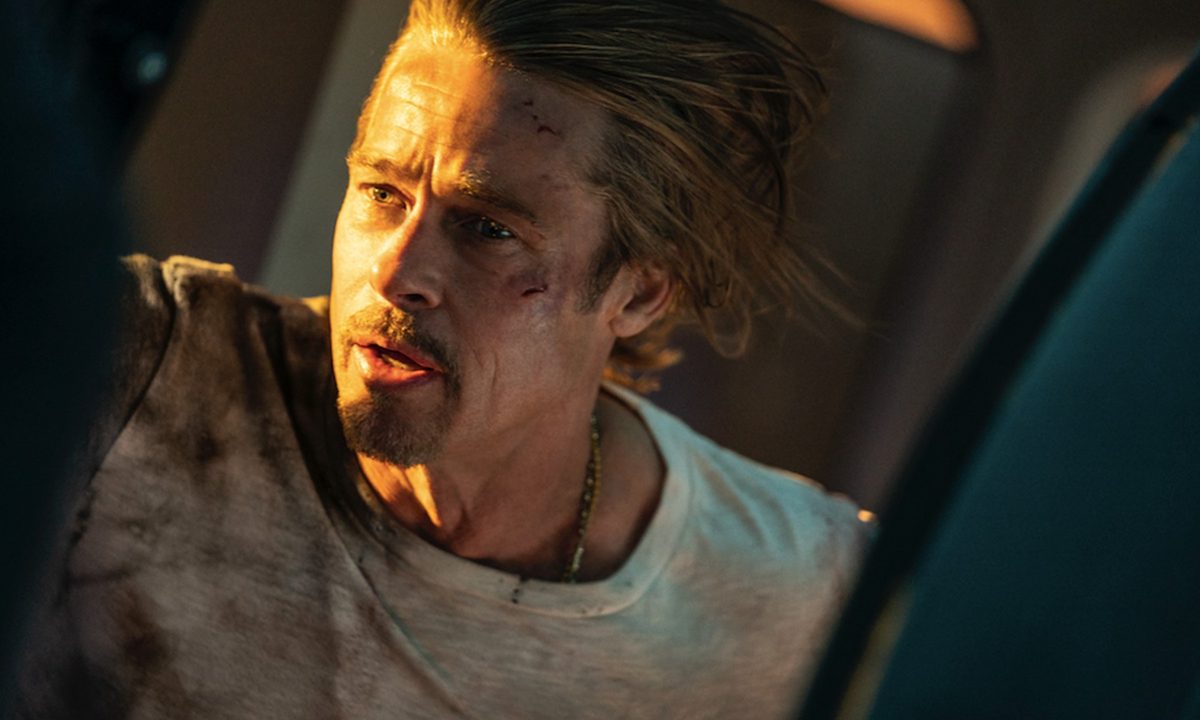
Holding the movie together, like superstar crazy glue, is the breezy nonchalance of its headliner, Brad Pitt. He’s been cast as a newly enlightened hired gun, coming off a long break from the killing business. Zen cool is one of the trustier weapons in Pitt’s arsenal — he recently won an Oscar trying out a relaxed, vaguely menacing variation on it — and here the actor twists that quality into a can’t-we-all-get-along agreeability meant to clash comically with his line of work. He’s the closest thing to a wrong-man everyman in a cast of characters made up almost exclusively of gangsters and murderers. In practice, that means a lot of scenes of Pitt spouting therapy lingo and shouting stuff like “Aww, c’mon man!” as he dodges death — a taste of the glib R-rated sitcom patter of the dialogue, which teeters rather constantly between funny and just plain obnoxious.
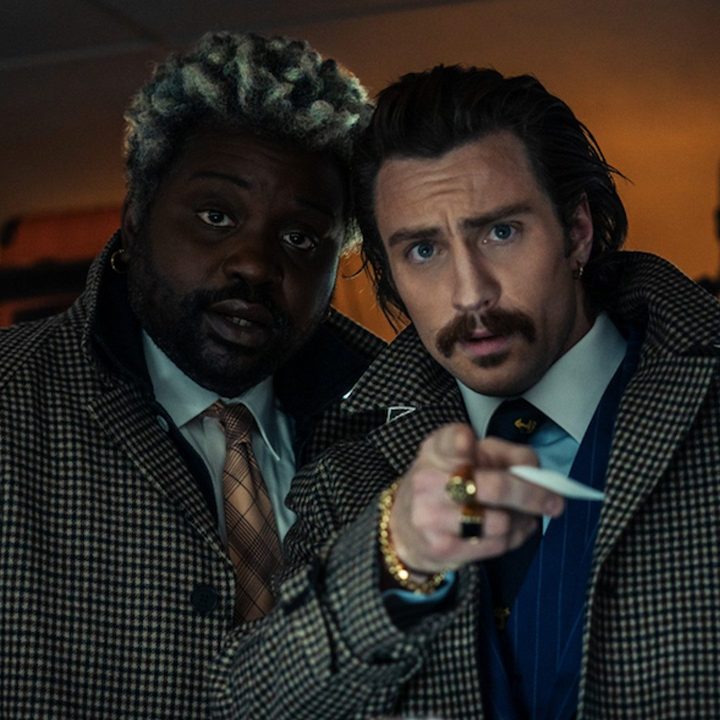
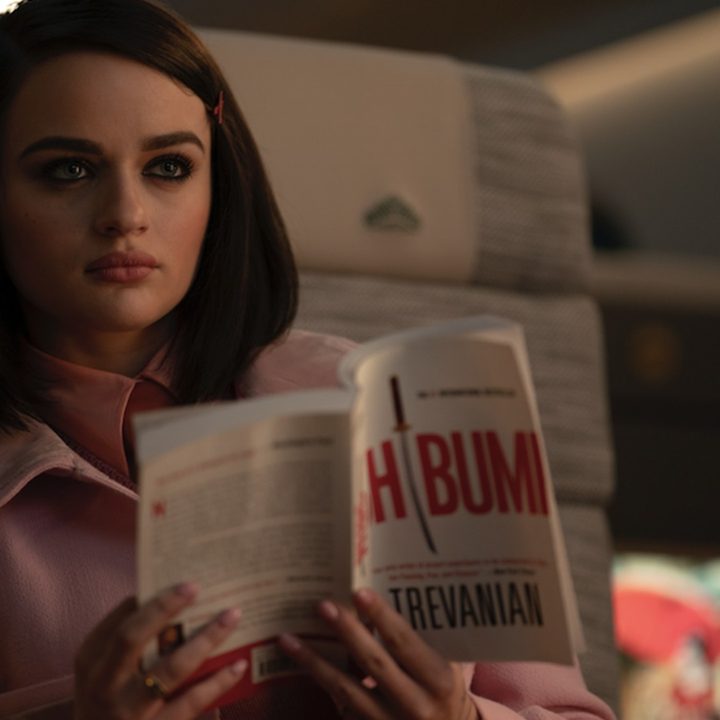
Ladybug, as Pitt’s character is codenamed, has a seemingly simple assignment: snatch a briefcase of ransom money from the train in question. Trouble is, it’s being transported by the movie’s answer to Jules and Vincent — a pair of nattering, hitmen brothers from a different mother named Tangerine (Aaron Taylor-Johnson) and Lemon (Brian Tyree Henry). The two are escorting the cash, along with the kidnapped screw-up crimelord scion (Logan Lerman) they’ve rescued, to the kid’s notoriously brutal Yakuza-by-way-of-Russia kingpin father, The White Death. To make matters increasingly, exponentially more complicated, the passenger manifest also includes a bunch of other assassins with crisscrossing schemes and motives, played by the likes of Joey King, Andrew Koji, the rapper Bad Bunny, and more. (There’s scarcely a single role in this movie not occupied by someone recognizable; even the bit parts facilitate big-name cameos.)
Bullet Train is a bit like a version of Murder on the Orient Express where everyone’s trying to kill everyone and no one’s trying to solve anything.
Surprisingly, this relentless cocaine binge of a yuk fest has literary roots. It’s based on Japanese author Kōtarō Isaka’s acclaimed, bestselling novel MariaBeetle. Isaka generally specializes in mysteries, which accounts for the twisty, locked-room plotting and the Clue-board eccentricity of the characterizations. Bullet Train is a bit like a version of Murder on the Orient Express where everyone’s trying to kill everyone and no one’s trying to solve anything. The script, from Fear Street adaptor Zak Olkewicz, squeezes some fun out of the convolutions, getting us guessing at how these various vendettas and subplots will intersect. It also successfully exploits some of the unique properties of the setting, including how the train pauses for only a single minute at each station, adding a periodically ticking clock to the escalating series of obstacles faced by Ladybug and company.
Leitch, the ex-stuntman relevantly responsible for pageants of action excess both balletic (Atomic Blonde) and jokey (Deadpool 2), seems similarly drawn to the logistical limitations of the Shinkansen. The narrow passageways and cramped compartments lend themselves naturally to his taste for intense and mechanically precise close-quarters combat—the way he’ll make a miniature spectacle, for example, out of wrestling to click a clip into a magazine with a muscled forearm around your jugular. Leitch’s vastly influential choreography (“Wickian” is among the more useful recent additions to the adrenaline-junkie vernacular) has always flirted with slapstick. Bullet Train completes the pickup line, fully converting the full-contact skirmishes and gory kill shots into jokes. Here, a brawl in a quiet car becomes the broadest of farces, two men pausing their tooth-and-nail fight to the death to address the oblivious yuppie passenger shushing them.
Are we genuinely meant to care about the cold-blooded assassin with the habit of comparing his marks and mates to characters from Thomas & Friends?
Bullet Train is at its most enjoyable in its earliest stretches, when the plot is racing to catch up with itself, the complications seem to forever be compounding, and the cast list of colorfully exaggerated comic-book killers keeps growing by leaps and bounds. It’s when all the parts are at last in place that the flimsiness of this bombastic Rube Goldberg IMAX epic comes into focus. Behind all the nihilistic snark is a soap-opera meditation on destiny that assumes a bit too much investment in the fate of characters mostly defined by their quirks of dress, speech, and preoccupation. Are we genuinely meant to care about the cold-blooded assassin with the habit of comparing his marks and mates to characters from Thomas & Friends? (It’s a running gag that counts as either the worst parody of Tarantino TV-brain ever or just the ultimate example to kill the trend.) The late entrance of martial-arts luminary Hiroyuki Sanada is a blatant Hail Mary for gravitas, a late bid to give a generally meaningless pileup of bodies and archetypes the impression of philosophical weight.
Best to appreciate Bullet Train for the novel scale of its pastiche — the way Leitch has given three decades and counting of Tarantino worship its hugest stage yet, via an overlong live-action anime with nearly as many familiar faces as an Oscar ceremony and an aesthetic that sometimes suggests a T-Mobile commercial with a $90-million budget. Still, Leitch has failed, as nearly every QT-indebted hotshot before him has, to capture an essential truth of the master’s work: Even before he ditched the oft-imitated touchstones of his early Miramax video-clerk breakthroughs, Tarantino was a subversive storyteller, as interested in confounding the expectations set by his shuffled plot elements as he was in squeezing fresh cool from them. Bullet Train has the Jack Rabbit Slim’s moves but not the touch. It’s Pulp Distraction at best.
Bullet Train opens in theaters everywhere Friday, August 5. For more reviews and writing by A.A. Dowd, visit his Authory page.


