

“Director Tilman Singer's Cuckoo is a strange, frequently thrilling surrealist horror film.”
- Tilman Singer's sharp direction
- Hunter Schafer and Dan Stevens' performances
- Paul Faltz's rich, bright cinematography
- A lackluster central mystery
- A messy third act
- Several superfluous supporting characters
“Why you can trust Digital Trends – We have a 20-year history of testing, reviewing, and rating products, services and apps to help you make a sound buying decision. Find out more about how we test and score products.“
Not enough movies are set in secluded mountain resorts. They’re environments that are uniquely capable of eliciting emotions like fear, restlessness, and — above all else — paranoia. Emotions, in other words, that form the foundation of any great thriller or horror story. No movie has, of course, ever utilized a mountainside resort as well as The Shining, which uses sinister ghosts and tragic domestic strife to turn a sprawling, mansion-like hotel into a suffocating source of intense cabin fever. Many films since have unsuccessfully tried to replicate that classic’s singularly unsettling effect, but few have truly seized on the brilliance of its setting.
Cuckoo does the latter, and wisely avoids committing the former mistake. It’s an imperfect film where the resolutions prove less satisfying than the buildup to them. The latest thriller from Luz writer-director Tilman Singer is, nonetheless, undeniably the product of a storyteller with an unconventional style and a penchant for capturing the uncanny. Those two talents are employed to impressive effect in Cuckoo, an eerie thriller soaked in paranoia that is greatly elevated by the extremely game performances of its two leads and Singer’s sharp rendering of its central locale.
Cuckoo exists in a world of crooked perspectives and slanted lines — one where shadows don’t just stretch and twist, but also reach toward you. This is made apparent in the film’s exquisitely composed opening image, in which a staircase bannister divides the frame in a diagonal line and separates the darkened interior of a stairwell’s second level from the light shining in from the floor below. In that light are the twisted shadows of two arguing adults. It is a scene, unconventionally shown, of recognizable familial turbulence. Then, in a move that cuts like a sharp prick and only intensifies the unease growing in the pit of your stomach, Cuckoo cuts to an even more unnerving sight: That of a young girl writhing in her pink-walled bedroom as her hands grip her long red hair, which covers her face and body like a shawl, and threaten to tear entire chunks out.
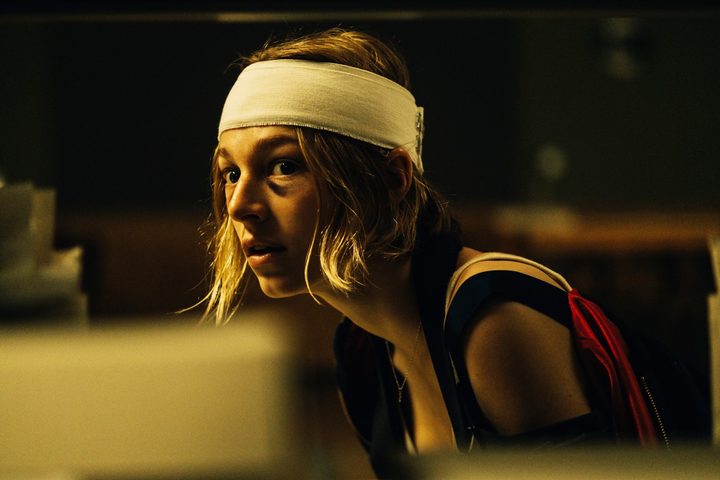
These are images of domestic familiarity that, thanks to a few key framing and blocking choices, are imbued with a sense of bizarre, underlying horror. It’s this deliberately off-key note that Cuckoo attempts to maintain across its entire 103-minute runtime. The demands of its mystery box plot, unfortunately, prevent it from doing so in its final half. For much of the film’s first hour, though, Singer succeeds at keeping the viewer and his protagonist off-balance. He does so even while introducing his unlikely hero, Gretchen (Euphoria star Hunter Schafer), an angsty teenager who’d rather be making music with her band than moving to a resort in the German Alps with her father, Luis (Marton Csokas), stepmother, Beth (Jessica Henwick), and half-sister, Alma (Mila Lieu). The recent death of Gretchen’s biological mother has, however, forced her to start living with Luis and his new family full time, much to her and her father’s apparent frustration.
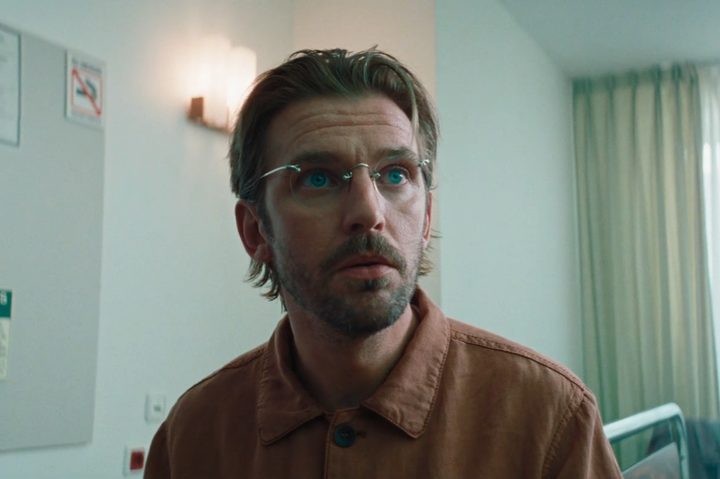
Her situation only worsens when she meets Luis’ boss and the owner of the resort they’ve relocated to: Herr König (a delightfully hammy Dan Stevens from Abigail), a German businessman whose odd demeanor immediately rubs Gretchen the wrong way. Her obvious dislike of König doesn’t stop her from accepting his offer to work a salaried position as his resort’s front desk clerk, though, and it’s during her first few shifts on the clock that Gretchen witnesses strange instances of exhausted women throwing up in the resort’s lobby and meets Ed (Àstrid Bergès-Frisbey), a French tourist she immediately wants to run away with. Things quickly take an even more nightmarish turn when Gretchen finds herself chased one night by a screaming, red-eyed woman (Kalin Morrow) capable of terrifying feats of strength and speed.
Singer and cinematographer Paul Faltz make the most out of Gretchen’s first run-in with her dangerous stalker. The duo constructs the sequence out of long, steady pans and tracking shots that first emphasize the deserted, winding nature of the mountainside road that Gretchen must take on her bike to get home. Then, in one shocking flourish, they announce the arrival of her pursuer with a shot that drifts from Gretchen’s back to a side view of a nearby assortment of guest houses as a hooded woman bursts out of one and breaks into an unnaturally fast sprint. Singer and Faltz follow up this moment with several seconds of pure, dread-filled silence as Gretchen’s eyes drift from the dark tree branches that hang above her down to the shadows they cast on the road — a shift in her gaze that reveals the presence of another, shadowed figure running behind her with its arm outstretched.
There’s a level of directorial control present in this sequence that is consistent throughout all of Cuckoo, which ranks along with Osgood Perkins’ Longlegs as one of this year’s most visually striking horror films. Singer builds his latest effort using patient, often sharply composed images that accentuate both the beauty and surreality of Cuckoo‘s mountainside resort. Meanwhile, production designer Dario Mendez Acosta’s use of pale pinks and greens for the resort’s hotel rooms and hospital walls, as well as the aged-wood paneling of its lobby, creates an effectively odd, discombobulating juxtaposition of old and new when paired with the spotless white and glass walls of Luis and Beth’s hyper-modern home. The resulting effect is one that only further heightens the off-putting and yet alluring strangeness of Cuckoo‘s story and desolate world.
While Singer does an effective job of introducing the mysteries surrounding both his film’s strange, red-eyed monster and her relationship with Stevens’ obviously shady Herr König, Cuckoo loses a bit of its steam once the full picture of what’s really going on within the grounds of König’s resort starts to become clear. By the time it has devolved into a shoot-’em-up, cat-and-mouse chase through a single building in its third act, Cuckoo has already started to feel less like the high-concept, hallucinatory horror film it initially seemed to be and more like a standard action-thriller. The loss of the enticing, unearthly haze that covers so much of Cuckoo‘s first half immediately renders the film significantly less interesting and also retroactively reveals just how shallow its story has been all along.

What Cuckoo lacks in dept,h it tries to makes up for in style and flair. Not only do Singer, Faltz, and editors Terel Gibson and Philipp Thomas fully commit to the film’s freaky ideas and rhythms, but Schafer and Stevens also give it their all with performances that could not be further apart. Schafer’s turn is one of tightly wound nerves and barely contained emotions that inevitably come spilling to the surface. If Cuckoo were any other film, it might seem like she was bringing too much to the table, but her work is both countered and complemented by that of Stevens.
The latter actor has emerged over the past 10 years as one of the greatest go-for-it performers working today, and he responds to the raw vulnerability of Schafer’s performance with a knowingly evil turn that is simultaneously over-the-top and perfectly tuned into Cuckoo‘s idiosyncratic sensibilities. Schafer and Stevens’ performances are both uncomfortable and also provoke discomfort. They are each doing heightened and slightly askew work here, and that’s fitting for a film like Cuckoo, which presents a version of our world that seems familiar and not — straight and yet slanted. Its lasting power may be limited, but anyone who seeks it out should find it difficult in the moment to refuse Cuckoo‘s call.
Cuckoo is now playing in theaters.


