At the Digital Trends flagship office in Portland, Oregon, Spotify is something of a religion. Seemingly everyone uses the ultra-popular music streaming platform, as evidenced by our Slack channel dedicated to sharing new music, which is full of Spotify links and not much else.
I’m not here to hate on Spotify. By all accounts (including my own), the Swedish service offers the best user interface out there, coupled with a massive music library and some magical tools to help you find new jams — but it doesn’t have everything for everyone. After spending six months with Spotify Premium, I bailed immediately and switched over to YouTube Red. Why? Mixtapes and remixes, baby.
Mixtapes
Today, hip-hop music dominates the (U.S.) streaming charts. Drake’s most recent hit single, God’s Plan, destroyed records on Spotify and Apple Music, and according to Statista, hip-hop and R&B music accounted for nearly 30 percent of music streaming in 2017 — nearly double that of rock (the next most-streamed genre). When I say, “I don’t use Spotify because I like rap,” I can understand why you might be confused.
Most mixtapes don’t live on popular music streaming platforms.
But I grew up on mixtape rap. Thanks in part to 50 Cent and his G Unit crew, rappers during the early-mid aughts increasingly chose to record and release free “mixtapes” rather than paid albums for several reasons. The average hip-hop listener is both younger and less affluent than listeners of other genres, and offering free music incentivized fans to support rappers in other ways, like buying merch or concert tickets. (Sure, Fiddy squandered his fortune in dumb ways, but that’s neither here nor there.) Further, recording mixtapes meant rappers could “cover” each other’s songs, rapping over rivals’ beats in the spirit of competition, without paying royalties.
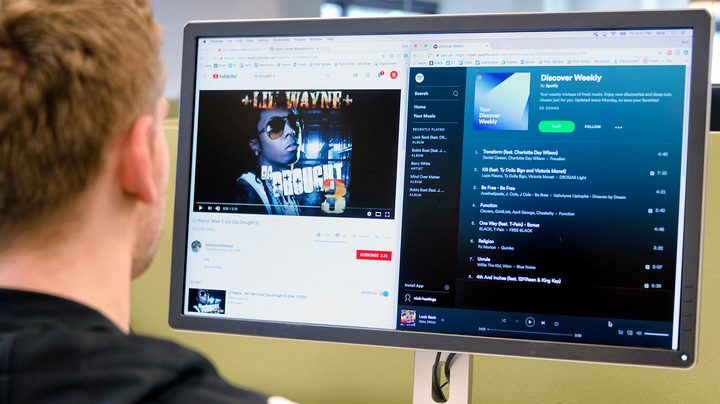
Because they’re not paid projects, most mixtapes don’t live on popular music streaming platforms. Lil Wayne’s Da Drought 3 — a two-disc, 29-song odyssey considered by some to be the greatest mixtape ever, featuring Wayne at the peak of his powers and Nicki Minaj in her first mainstream appearance — is nowhere to be found. The same goes for celebrated mixtapes like A$AP Rocky’s LiveLoveA$AP, Chance The Rapper’s Acid Rap, and Earl Sweatshirt’s Earl, not to mention the rest of Wayne’s mixtapes (seriously, the guy is an animal). Hell, Curren$y has 14 different albums available on Spotify, and more than 50 mixtapes in his catalog, per Wikipedia. You do the math.

The mixtape model has fallen out of favor in recent years as artists can simply upload their own work onto Spotify and watch the royalties stack up. Still, there’s a sizable collection of mixtapes out there that will never be available on streaming services, and I’m not ready to just say c’est la vie.
Remixes
I “discovered” electronic dance music, or “EDM,” during the waning months of my college career. (I put “discovered” in quotation marks because I already knew it existed. I had just previously associated the genre with hazy, hedonistic frat parties and thus disregarded any potential value it may have held.) If you’re unfamiliar with EDM, you may picture a dark room filled with people bouncing along to a fist-pumping house beat a la Daft Punk’s Homework.
That’s accurate, but it’s also quite reductive. Every genre of music has sub-genres, but EDM specifically is difficult to categorize, thanks to a vast variance in sonic elements generated in computer programs. Modern country music is almost always typified by acoustic guitar and harmonic “scooping,” and rap music is fairly easy to identify by the vocalist speaking rhythmically rather than singing outright. With EDM, though, a song can sound like anything, so long as some of it is synthetic and not recorded live. Both this song and this song fall under the EDM umbrella, and further, they’re actually produced by the same guy under two different names.
A huge part of the EDM scene is the remix culture that exists among producers.
Back to the point: A huge part of the EDM scene (if you can call it that) is the remix culture that exists among producers. As soon as a new song comes out, rival artists — who, for the record, are usually on friendly terms with one another — rip it, load it into their production software of choice, and start putting their own spin on it. Many iconic electronic tracks came into existence this way, and artists will even connect with others to commission official remixes for release on companion EPs. Sometimes, these tracks are uploaded onto Spotify, but more often than not, they’re originally released via Soundcloud before floating around the internet waiting to be heard.
In the three-plus years that I’ve been listening to electronic music, I’ve compiled a list of choice tracks totaling around 250. By my rough count, less than 75 of those tracks aren’t a “remix,” “flip,” “edit,” or “mashup” of one or more original tracks. Because of laws surrounding royalty payments and intellectual property, many (nay, most) of these remixes will never be available on Spotify, Apple Music, Google Play Music, or Tidal.
Why YouTube Red?
I’ll be honest: I didn’t write this to sing the praises of YouTube Red. It’s a neat service, but I’m less concerned with the tangible benefits of a subscription — ad removal, the ability to lock your phone and keep a video playing, downloading for offline viewing, and access to Red Originals — than I am with the lack of a better option out there.

If you want to download every mixtape from Datpiff or every EDM remix from Soundcloud, be my guest. If you use a dedicated music player, you might well have space for it all. Most of us, though, listen primarily on our phones, and spare storage space is an uncommon luxury. Plus, Soundcloud is on the brink of dissolution, and if it bites the dust, a lot of music — electronic and otherwise — is going to temporarily disappear until artists find a new home for their work.
YouTube is the only place where all this music coexists peacefully. Sure, streaming videos instead of audio tracks can devour your data, but that’s where YouTube Red comes in. As mentioned, you get to download videos and playlists for offline viewing (though this will quickly eat up your storage space).
I would still consider Spotify the best streaming service for most people.
More importantly, though, a Red subscription ($10 per month, or $13 for iOS users) includes a subscription to Google Play Music — essentially the same thing as Spotify or Apple Music — for no extra charge. Google Play Music doesn’t offer Spotify’s snappy UI or Apple Music’s cool Beats 1 Radio, but its library of tunes is every bit as vast, and you can crank up the audio bitrate to 320kbps (equal to Spotify’s maximum and greater than Apple Music’s).
I would still consider Spotify the best streaming service for most people. And YouTube isn’t perfect: Videos get deleted all the time, which is why I keep a Word document with all my EDM stuff. But if you’re a remix-hunting weirdo like me, you might want to consider your options.