
There’s little doubt that 5G technology is one of the hottest topics right now, and as we all start using it in our daily lives, we’re understandably curious about how it works. 5G improves upon 4G, but there’s quite a bit of nuance involved with how you actually connect to the network. In the case of 5G, there are two clear parts of the technology: Sub-6 and mmWave.
When your phone connects to “5G,” you could be connecting to either type of 5G network coverage. But which one you connect to can dramatically change your 5G experience. Here are the basics you need to understand the difference between Sub-6 5G and mmWave 5G.
What is Sub-6 5G?
Differentiating between Sub-6 and mmWave is simple: Just look at the radio spectrum being used for the network. Sub-6 5G uses frequencies below 6GHz — that’s easy to understand. This is important for a couple of reasons: This is where 4G, 3G, and 2G networks have historically operated, and this is the 5G you’re most likely to interact with within the next five years.
The best 5G carriers have been able to deploy “nationwide” networks quickly using their existing towers and spectrum because Sub-6 5G doesn’t require anything more than tower upgrades. They simply make 5G-specific changes to the towers and can start serving 5G right alongside 4G throughout most of the country. And because carriers already have considerable spectrum holdings in these lower frequencies, they can provide relatively high output with 5G without compromising their 4G offerings.
All of this means that for the next handful of years, most of the time you’re using 5G, it’ll be Sub-6. And unfortunately, at least for the next few years, that Sub-6 5G won’t be appreciably better than the 4G to which you’re accustomed.
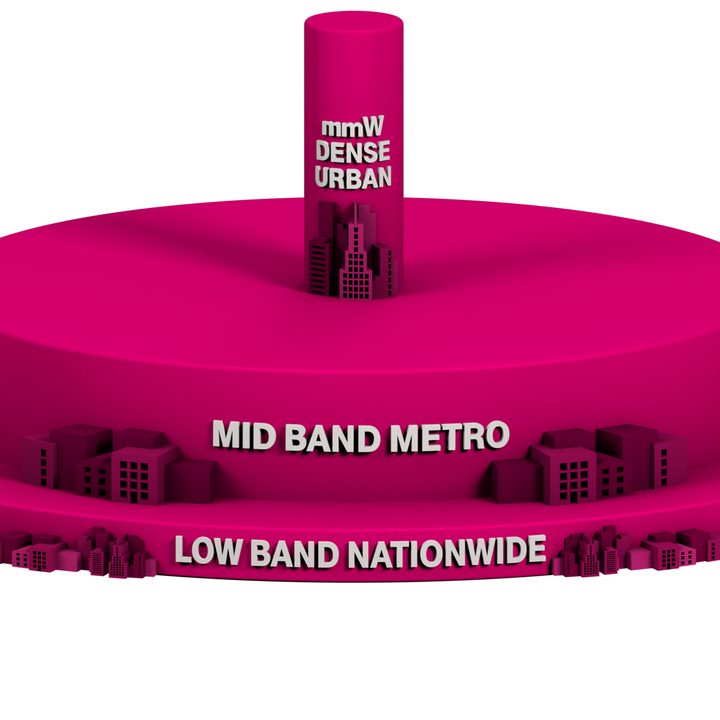
The problem is that Sub-6 networks don’t provide a dramatically better experience than the latest 4G networks. That makes sense — sure it’s 5G, but it’s operating under many of the same constraints as the 4G networks before it. Sub-6 5G networks are only marginally faster, with marginally lower latency, than 4G networks.
The only substantial experience improvement to be found with Sub-6 is in the so-called “midband” frequencies, between 2GHz and 6GHz, where 4G networks traditionally haven’t operated but 5G can. With wide amounts of unused spectrum, no competition with existing 4G networks, and some new network technology, midband 5G can be a great “Goldilocks” network that balances higher speeds with decent range and object avoidance. Midband is going to be an important part of every carrier’s overall 5G strategy, as regularly highlighted by T-Mobile’s “layer cake” approach.
What is mmWave 5G?
Then there’s mmWave (millimeter wave), which uses dramatically higher frequencies, ranging between 30GHz and 300GHz. Carriers are currently operating between 30GHz and 40GHz, but government auctions have recently released new spectrum up to 48GHz. Beyond that, the 60GHz range is actually unregulated spectrum, and 70GHz-plus is often used for very specific point-to-point fixed wireless networks.
But back to mmWave 5G on your phone: This is an entirely new network that has no relation to existing 4G networks or infrastructure. That means that it has incredible potential but will take dramatically longer to deploy compared to Sub-6 networks.
By using previously untouched spectrum, mmWave 5G networks can provide tremendous data speeds and ultralow latency. Whenever you hear talk of 3Gbps download speeds, 1-millisecond latency, and futuristic real-time communications between devices, cars, and medical equipment, it’s all based on mmWave.
Verizon, AT&T, and T-Mobile have all launched mmWave networks, but the deployment is slow. Because mmWave frequencies are so high, it introduces considerable problems with coverage. The higher the frequency, the shorter the radio waves can travel. That means you need a lot of towers. And to call them “towers” is a bit of a misnomer — unlike traditional cell towers, these are so-called “small cells” that are hyperlocalized to provide service to an area as small as one city street, in one direction.
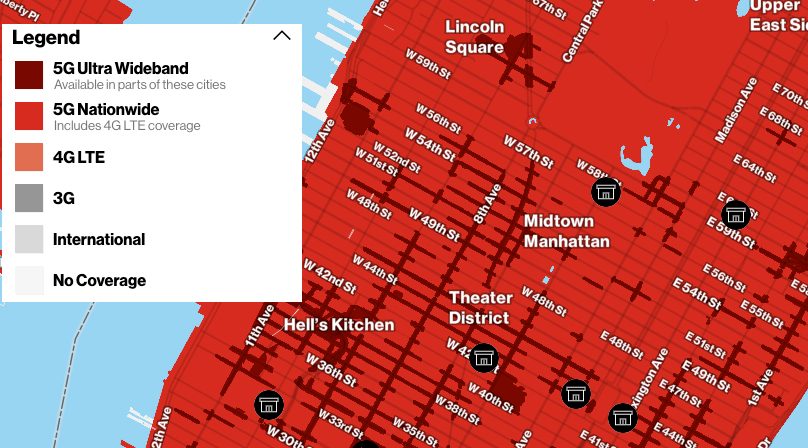
This is necessary because of mmWave’s short range, and also because obstacles of any kind can dramatically impact its performance. Buildings, cars, trees, and even windows can stop an mmWave signal. So now, in order to provide anything approaching coverage, you need to have hundreds and thousands of small mmWave cell sites dotted all along streets. Simply put, mmWave isn’t forgiving here. This is a reality every carrier is facing.
With these technical hurdles, mmWave rollouts are very slow. While you can find mmWave 5G in parts of some cities, it’s incredibly inconsistent — even the direction you’re facing can determine whether you get a signal. But when you do get a signal, the speeds are absolutely mind-blowing: Upward of 3Gbps download speeds, with single-digit millisecond latency. And mmWave also has immense capacity potential, meaning more devices can be connected to a single network at once, without any degradation of service. That’s absolutely game-changing, no matter how you look at it.
Verizon and AT&T have both chosen to give their mmWave networks an additional brand separate from their Sub-6 5G networks. Verizon has 5G UWB (Ultra Wideband), and AT&T has 5G+. This is mostly confusing, but at least it’s useful for determining whether your phone is connected to Sub-6 or mmWave 5G.
You’ll be using both Sub-6 and mmWave soon enough
Sub-6 is the 5G of the present, while mmWave is clearly the 5G of the future. But it isn’t quite that simple. It’s clear that we’ll need to use both Sub-6 and mmWave together eventually. Both are good at different things — Sub-6 with consistency and coverage, mmWave with speed and density — and they can be deployed together. By using both, carriers can leverage their strengths and provide a better overall experience.
The goal is for your phone or other device to always be connected to a 5G network and be able to switch seamlessly between Sub-6 and mmWave without you knowing it. It’ll be here sooner than you think.


