“Why you can trust Digital Trends – We have a 20-year history of testing, reviewing, and rating products, services and apps to help you make a sound buying decision. Find out more about how we test and score products.“
Update: Kodak and Bullitt Group are bringing the Kodak Ektra to the U.S. with a lower price tag and an improved camera. By Julian Chokkattu.
Kodak has a phone. You heard that right — everyone’s favorite old camera company is in the mobile market with the Kodak Ektra. It’s an Android phone with a giant 21-megapixel cam on the rear, and it’s built to mimic a point-and-shoot camera.
The company announced the phone in October 2016, and the phone is actually made by a tech company called Bullitt Group. Kodak assures us that the device “was a joint effort between Bullitt Group and Kodak,” and that the Kodak team was heavily involved in the Ektra’s design and development.
The Kodak Ektra has been available in Europe for a few months already, but the company is finally bringing it to the U.S. While our first impressions at CES weren’t entirely positive, Bullitt Group told Digital Trends the launch in the U.S. was delayed a little to address some concerns such as the price point and shutter lag experienced in the camera. The shutter lag fix comes via a software update, which will be issued to European devices as well, and it will also bring several other new features and improvements such as RAW file support, improved face detection performance, and enhanced low-light performance.
The other big improvement? The U.S. price will no longer be $550, but $400.
Nostalgic design
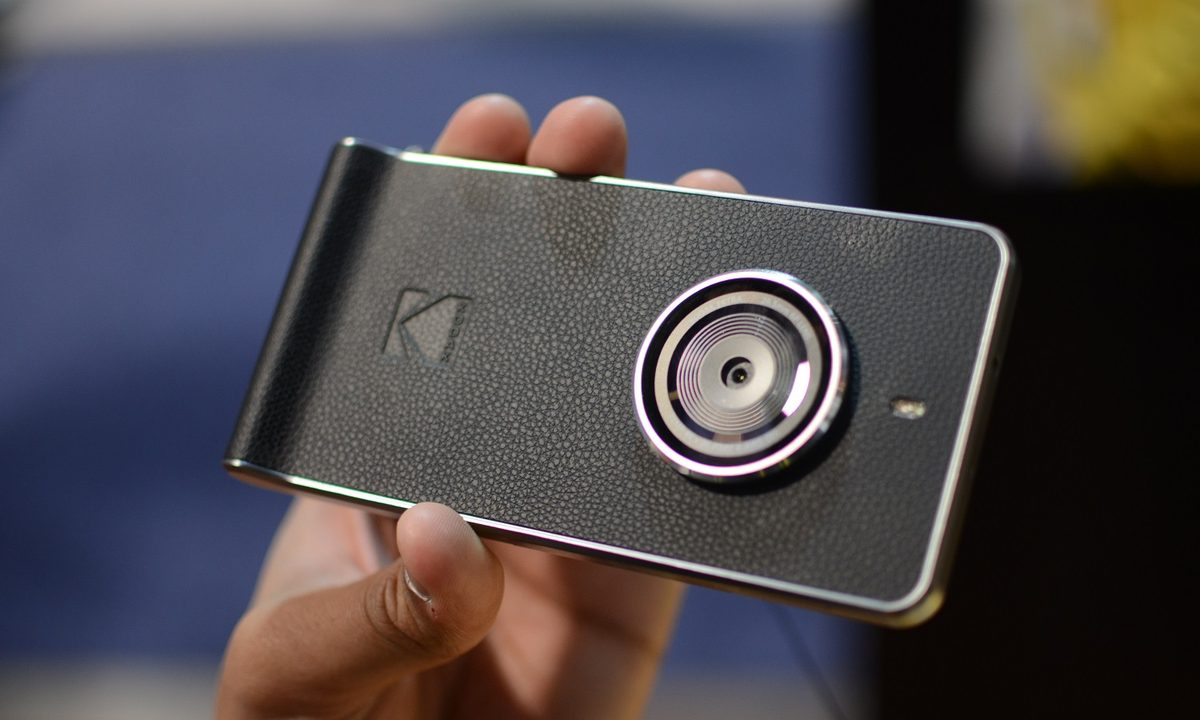
Everything about the Kodak Ektra is meant to revive nostalgia of Kodak’s “Ektra” camera from the 1940s — notably the leather finish on the back of the smartphone. On the back of the device sits a large 21-megapixel camera, reminiscent of the Nokia Lumia 1020.
Sadly, there’s no optical zoom — and while Kodak said the large size of the camera is largely an aesthetic choice, the anti-glare glass “collects more light, and therefore more data.” Kodak claims it helps improve image quality.
The design of the Ektra is unique and something different — even if it is a little thick. Kodak says it’s meant to be chunky, as it’s meant to help the device be more ergonomic for one-handed photography.


The bottom of the device curves out, acting as a grip when holding the device in landscape mode. It felt comfortable and compact, only packing a 5-inch display. What’s handy is the dedicated camera button on the right side — there is a power button above it, and volume controls at the top right edge. You can double tap the button to launch the camera.
There are no on-screen buttons — instead, you use the capacitive multi-touch navigational buttons on the bottom of the screen.
Solid specs
The Kodak Ektra features surprisingly solid specifications — notably, it comes with a USB Type-C charging port, 3GB of RAM, a 1,920 x 1,080-pixel resolution (Full HD), and a large 3,000mAh battery.
It does have a headphone jack and a MicroSD card slot that can add up to 128GB of additional storage. The latter feature is necessary if you want to take a lot of photos and videos because the phone only comes with 32GB of storage (a lot of phones do). Kodak informs us that there is an NFC sensor.
The Kodak Ektra is powered by MediaTek’s Helio X20 deca-core processor. In our brief test, the device seemed to fly without any hiccups. Apps opened quickly, and swiping through a webpage in the browser as well as through the home screen was smooth. We’ll stress test the device further when we get our review unit later this year.
Unfortunately, the camera-phone runs Android 6.0 Marshmallow, which is the 2015 version of Google’s Android operating system. Bullitt Group handles software updates for the device, but the company said it’s still waiting for MediaTek and the Android qualification program for the Helio X20 to push an update to support Android 7.0 Nougat.
Still, you get a stock Android experience with almost zero modifications by Bullitt. There are quite a number of pre-installed apps, but some of these are all a part of the experience of getting the Kodak phone. One app, for example, takes photos that mimics classic Super 8 film stocks. Snapseed is also available, and it’s directly integrated into the camera app.
Camera needs more testing
If the main highlight of the Ektra is the camera, you would think it would be the best experience of the device. Unfortunately, in our initial brief time with the device, it was the primary weak point.
The rear camera has 21 megapixels, optical image stabilization, and an aperture of f/2.0. The front camera has a 13-megapixel with an aperture of f/2.2. All of that sounds good on paper, but when we tried to take photos with the camera there was noticeable shutter lag.

Shots were blurry, and the picture quality was merely “okay.” The user interface is meant to feel like a traditional camera — there is even a mode dial that lets you swap between different modes, such as automatic and manual. The manual mode is a great option as well as the mode dial, but simply rotating the wheel was a sluggish experience.
All of this should be fixed in version 2.0 of the camera, so we’ll have to test it further with our review unit.
Availability and price
The U.S. Kodak Ektra supports GSM networks, so it will only work on AT&T and T-Mobile networks. You can purchase it now at B&H, Amazon, Best Buy, and Kodak’s website for $400.
We’ll be testing the Ektra’s camera extensively, and we’ll check if the update to the camera does indeed greatly improve the experience.
Highs
- Stock Android
- Unique design
- No software hiccups
Lows
- Thick
- No optical zoom
- Still on Android 6.0