  1. Home
  2. Phones
  3. Mobile
  4. News

MediaTek’s Dimensity 9200 chip is packed with world’s-first tech

Add as a preferred source on Google

MediaTek has announced the Dimensity 9200 smartphone processor, which according to the company, “combines ultimate performance with significant power savings, extending battery life and keeping smartphones cool.” Built using cutting-edge techniques, it’s the first flagship chip from the maker to include both Sub-6 5G and mmWave 5G connectivity, meaning it’ll be more attractive to brands launching phones in the U.S. as well as globally.

Built using the latest second-generation 4nm process, it’s the first chip to use the second-generation ARM V9 architecture, the first with new LPDDR5X RAM, and the first with a UFS 4.0 and MCQ storage system. The processor uses a single ARM Cortex X3 running at 3.05GHz, three 2.85GHz Cortex A715 cores, and four 1.8GHz Cortex A510 cores for efficiency. The Dimensity 9200 is also the first chip to use ARM’s 11-core Immortalis G715 GPU, which supports hardware ray tracing.
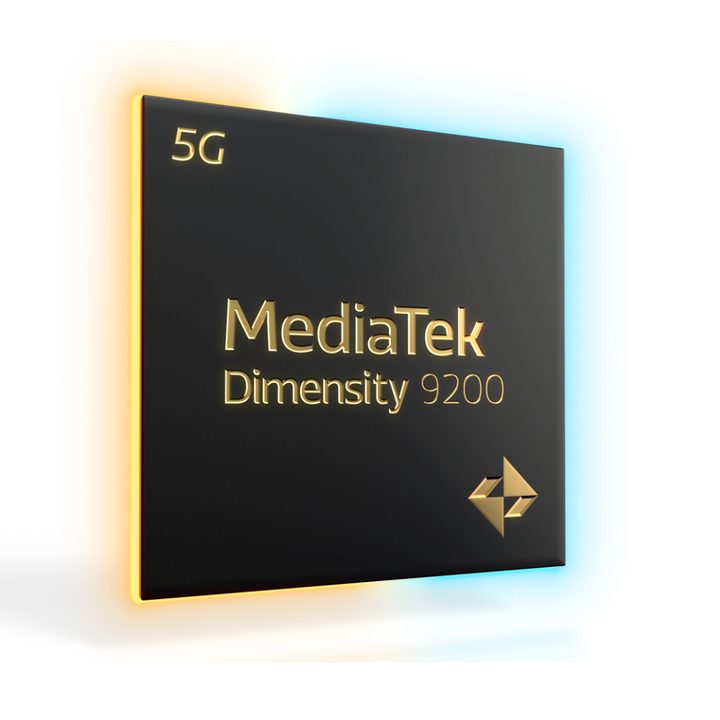
MediaTek Dimensity 9200 processor.
MediaTek

What does all this mean? It means more power and better efficiency compared to the Dimensity 9000, and across many of the processor’s abilities. MediaTek estimates 30% better power efficiency for AI-noise reduction tasks and 45% better efficiency for AI-super resolution tasks. The AI processing unit (APU) is also touted as being up to 35% faster than the previous generation.

Recommended Videos

The Imagiq 980 Image Signal Processor (ISP) has been upgraded with support for RGBW camera sensors, and updated AI promises improved HDR, new cinematic video modes, and less blur in photos. The chip supports cameras with up to 300 megapixels and the ability to record 8K video. The Dimensity 9200 also supports displays with up to a 144Hz adaptive refresh rate and a WQHD resolution.

MediaTek says the Dimensity 9200 will be part of its Dimensity Open Resource Architecture (DORA) initiative, where manufacturers can customize the chip to meet requirements. We’ve recently seen how Oppo and MediaTek successfully worked together on the Reno 8 Pro using DORA and the Dinemsity 8200 Max processor.

When will we start to see phones with the Dimensity 9200? MediaTek says its launch partners will be revealed before the end of the year. The company also promises a faster and broader release than that of the Dimensity 9000, which didn’t have a huge impact outside China. It wants more phones released in the U.S. to use the chip, but says this may take some time to realize.

Andy Boxall
Andy has written about mobile technology for almost a decade. From 2G to 5G and smartphone to smartwatch, Andy knows tech.
WhatsApp Plus is here, and you can safely ignore this subscription
WhatsApp wants a monthly fee for what other apps include by default, and that's a problem Meta can't dress up with custom icons.
WhatsApp Plus screenshots.

WhatsApp has fiercely defended its status as a free, no-nonsense online messaging app for over a decade, but a new subscription tier is muddying the waters. 

Meta is rolling out WhatsApp Plus, a paid subscription model, to a limited number of iPhone users using the latest version of the App Store. 

Read more
Apple and Google just put a lock on your green-bubble texts, and it’s about time
The green bubble finally has something to brag about. Apple and Google's unlikely alliance brings real encryption to everyday cross-platform texting.
E2EE arrives on RCS for iPhone and Android phones.

For years, texting between an iPhone and an Android device felt less like a private conversation and more like shouting across a crowded street. Well, that changes on May 11, 2026, as Apple and Google jointly launched end-to-end encryption (E2EE) for RCS messaging. 

The long-awaited feature is rolling out first in beta with iOS 26.5 (also announced today) and the latest version of Google Messages. 

Read more
The Razr Ultra 2026 is everything a flip phone should be, but I’m not paying $1,500 for it
A flip phone was never supposed to cost this much. At $1,500, the Razr Ultra finds itself in an uncomfortable fight against everything else your money can buy.
Motorola Razr Ultra

I'll be blunt: $1,500 is a lot of money to spend on the Razr Ultra, a clamshell phone that folds in half. In fact, it's a lot of money to spend on any smartphone, especially when a Galaxy S26 Ultra or iPhone 17 Pro Max costs less and still leaves a few hundred dollars in your pocket, or throwing in a couple of hundred bucks can get you a full-fledged book-style foldable. 

For me, the Razr Ultra doesn't quite make a strong case at $1,500. In isolation, it's a genuinely impressive flip phone that gets all the basics right and delivers the premium experience you'd expect at this price. The Alcantara back, the 5,000-nit display, the silicon-carbon battery, and the dual cameras on the back make it sound like a complete package.

Read more