

Are foldable phones the future? The Samsung Galaxy Fold and Huawei Mate X are two examples of what future smartphones could look like, with tablet-sized screens hidden beneath a fold. But what if the future doesn’t mean making even bigger screens, but instead shrinking down the size of our existing displays?
Motorola has revealed the new Motorola Razr, and it’s a foldable phone with a twist. Borrowing heavily from the classic Motorola Razr V3‘s design, the new Motorola Razr asks why we can’t simply make big phones smaller again by folding a 6.2-inch screen into a smaller package. Here’s everything you need to know about the foldable Motorola Razr phone.
Interested to see how the new Motorola Razr plays in real life? Check out our Motorola Razr hands-on review.
Design and display


The new Motorola Razr doesn’t just borrow the Razr V3’s name — it calls back to that phone’s classic clamshell design too. The Razr folds vertically, folding the top of the display into the bottom, leaving a hefty bottom chin that protrudes to sit flush with the folded display. You’ll find the phone’s fingerprint scanner on this chin too.
But Motorola didn’t just adopt the clamshell fold to appease rosy-eyed retro-enthusiasts — turns out it’s the most favored design for a fair amount of consumers. Motorola tested over 20 prototypes with different designs, and it was the clamshell that won out for providing the perfect mix of portability and the large screen we’ve all come to love. Some serious engineering was required to bring the new Razr’s fold to life, and it’s led to Motorola creating the first zero-gap hinge where the folding screen can sit flush with each other. The mechanical elements of the hinge move to either side of the fold, closing the gap entirely, and protecting against dust and dirt ingress while closed.
That cutting edge engineering is complemented with some top-notch build materials too. The new Motorola Razr is made from a stainless steel body and 3D Gorilla Glass, and those premium materials add to the device’s heft. At 205g it’s a weighty phone, and that weight will add to the satisfying feeling from closing the phone to end a call. Yup, the Razr’s iconic “close to hang up” feature is back, though you can turn it off if you’re not a fan. Unfortunately, there’s no IP-rated water-resistance except for the usual Motorola splash-proofing.
The inner Flex View display is a 6.2-inch POLED running a 2142 x 876 resolution in a super-long 21:9 aspect ratio. While we appreciate the long, Cinemawide aspect ratio, the comparatively low resolution is something of a disappointment. Expect to see pixels if you lean in close.
But there’s more to get excited about here than just the inner display — there’s a display on the outside too. Once again calling back to the original Razr V3, the new Razr features a 2.7-inch GOLED Quick View display running an 800 x 600 resolution on the outside of the phone. While you’re unlikely to settle down to watch any Hollywood blockbusters on the external display, don’t discount the Quick View’s usefulness. You’ll be able to quickly check your notifications, reply to messages and emails, use Google Pay, change music tracks, and even call upon the Google Assistant — all without flipping your phone open. Once you do flip your phone open, app continuity means you’ll open to whatever you were looking at on the Quick View display.
Specs and battery

With the Motorola Razr being something of a design and engineering pioneer, you might expect the similarly high-end specifications. Unfortunately, anyone hoping for the latest in smartphone hardware is going to be disappointed, as Motorola has opted for midrange hardware. But even with that caveat, there’s still a lot to love here.
Key Specs
- CPU: Qualcomm Snapdragon 710
- Memory: 6GB
- Storage: 128GB
- MicroSD storage: None
- Screen size: 6.2 inches (internal Flex View display), 2.7-inches (external Quick View display)
- Resolution: 2142 x 876 (internal Flex View display), 800 x 600 (external Quick View display)
- Connectivity: USB-C, Bluetooth 5.0, NFC
- Battery: 2,510mAh
- Size: 172 x 72 x 6.9 mm (unfolded), 94 x 72 x 14 mm (folded)
- Weight: 205g (7.2oz)
- Operating system: Android 9.0 Pie
Motorola hasn’t been one for using top “flagchip” processors in its flagship phones in recent years, and the new Razr is powered by the Qualcomm Snapdragon 710, a premium midrange chip from 2018. It’s slightly disappointing the newer Snapdragon 730 wasn’t used, but unless you’re playing the latest 3D games you shouldn’t notice a huge performance gulf compared with flagship phones.
6GB of RAM is definitely a more acceptable stat to see on the sheets, alongside 128GB storage as the one and only option. That’s a good amount, but it’s the only storage you’ll get, as there’s no MicroSD card for further expansion. In fact, there’s no SIM card tray at all, since the new Razr uses eSIM exclusively.
The new Razr is powered by a 2,510mAh battery, which seems a little underpowered at first glance. However, that’s only if the 6.2-inner display is being used often — liberal use of the 2.7-inch outer screen for most day-to-day tasks and the midrange specs could well mean the battery lasts for longer than you’d initially expect. We’ll be sure to put that theory to the test in our full review. There’s no wireless charging, but it does come with Motorola’s 15W Turbopower charging as standard.
Software and special features
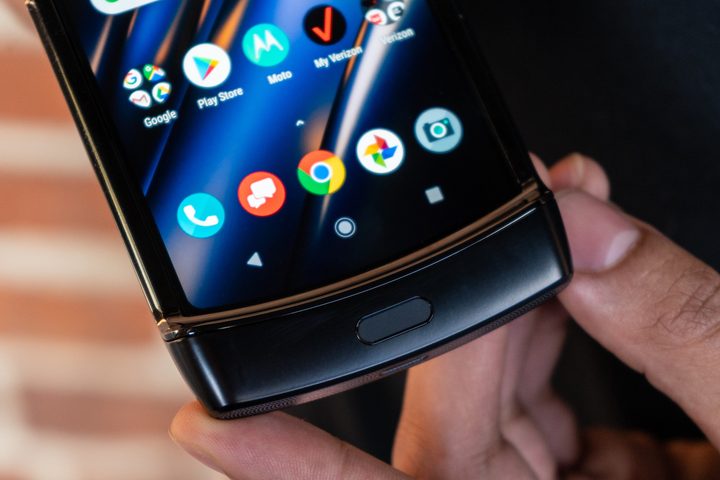
We’ll hit you with the worst news first: The Motorola Razr won’t be launching with Android 10. Instead, it’ll launch with Android 9.0 Pie. Expect Android 10 to follow later, but it won’t be ready for launch, unfortunately. Thankfully, Motorola has never favored heavily customized Android interfaces, so your Razr experience will be close to stock Android, making it an attractive prospect for purists.
Motorola will be including its Moto Actions in the phone though, so you’ll be able to make various gestures with the phone to activate specific functions. Examples include the double wrist twist to open the camera, or making a double chopping motion to toggle the flashlight. Once you get used to them, you’ll wonder how you ever lived without them.
Camera

Unlike other folding phones, you’ll only find a single lens on the front and back of the new Motorola Razr. The rear-facing lens is a 16-megapixel lens with an aperture of f/1.7 and electronic image stabilization (EIS). Around the front, you’ll find a 5-megapixel selfie lens with an aperture of f/2.0. Based on stats alone, it’s fair not to expect the Motorola Razr to be entering our list of the best camera phones.
But it’s not bereft of camera fun, as Motorola has added some tricks involving the external Quick View display. Take a quick selfie by showing the external screen your palm, and it’ll take a selfie after a short countdown. When you’re using the phone unfolded, the external display will show any active shot timers, as well as showing a preview of the shot once you’ve taken it — letting your subject take a look. If you’re taking a picture of a child or animal, the Quick View display can play a fun animation to snag their attention.
Release date and price
Like most foldable phones, it’s fair to say the Motorola Razr is unlikely to be for everyone, but if you’re sold on it, then you’ve probably only got two questions. How much, and when? It’s available exclusively for Verizon customers, and orders will begin shipping on January 9, 2020. Pre-orders begin on December 26, making it the perfect product to splurge some Christmas cash. You’ll need a lot in your cards though, as the new Razr starts from $1,500. That’s an expensive prospect for a phone with midrange specs.


