
Chinese companies have championed the art of charging smartphones at superfast speeds, and that especially holds true for brands under the BBK Electronics umbrella — OnePlus, Oppo, Realme, Vivo, and iQOO. Of these brands, Oppo leads R&D endeavors for itself alongside OnePlus and Realme, which use its proprietary technologies by rebranding them. Among the features that make Oppo one of the best smartphone brands for enthusiasts is fast charging.
At Mobile World Congress 2022, Oppo exhibited its 240-watt charging technology that can charge a smartphone fully in just 10 minutes. While this inexhaustibly fast-charging technology is yet to arrive on a commercial smartphone, Oppo and the companies under it, including OnePlus and Realme, are already launching phones with charging rates up to 150W. OnePlus’ recently launched flagship device — the OnePlus 10 Pro — supports up to 80W charging, which the company has claimed can replenish the phone’s 5,000mAh battery in just about 30 minutes.

In the U.S., however, OnePlus leaves owners of its new flagship a reason to lament, which is a lower charging speed than the global unit. Unlike the global model, the OnePlus 10 Pro is limited to 65W charging in the U.S., where it joins other flagships that skip faster-charging technologies from their global counterparts.
Although there might be a marginal difference between devices sold in and outside the U.S., there is one caveat to note: The OnePlus 10 Pro’s dependence on the official charger. Because the smartphone uses Oppo’s proprietary SuperVOOC technology, it does not charge at the maximum supported charging speed — 65W in the U.S. and 80W globally — with any third-party charger.
So what happens if you are out and about and leave your OnePlus SuperVOOC charger behind? That is what we will find out by comparing the OnePlus 10 Pro’s charging speeds when using SuperVOOC 80W, SuperVOOC 65W, and USB-PD.
SuperVOOC 80W vs. 65W on OnePlus 10 Pro
The OnePlus 10Pro comes with an 80-watt charger in the box in all locations except North America. That is because Oppo’s proprietary SuperVOOC 80W charging technology is not compatible with the typical electric supply voltage of 110V to120V in the U.S., Canada, Mexico, and the Central American, South American, and Asian countries that rely on the standard.
Charging with SuperVOOC 80W
We begin the OnePlus 10 Pro’s charging speed test using the SuperVOOC 80W charging brick and note the charging rate between 5% and 100% capacity on the 5,000mAh battery using the Battery Log Android app. The results are recorded at an ambient temperature of 30-degree Celsius (86-degree Fahrenheit), while the app also records the battery’s internal temperature.
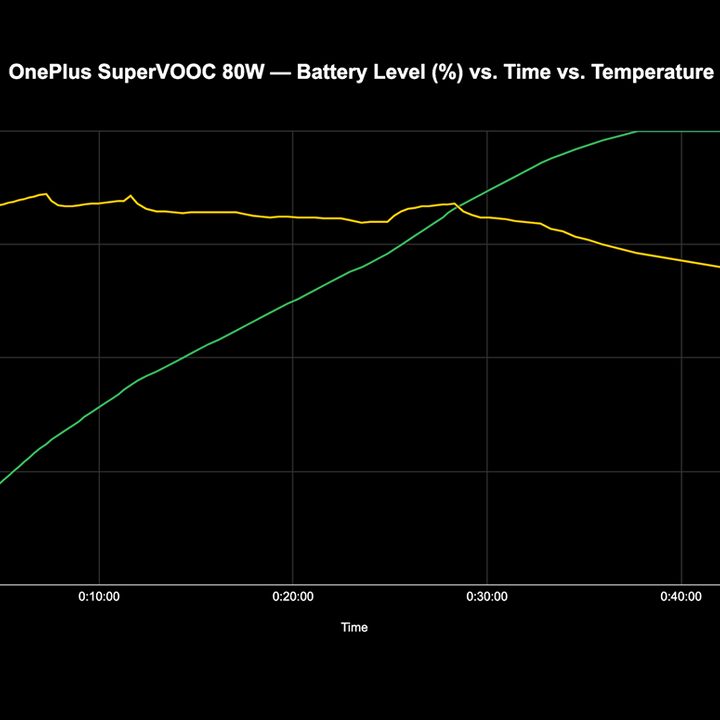
In our test, the OnePlus goes from 5% to 50% battery capacity in just 15 minutes. It takes another 12 minutes to reach 80%, and to more minutes to rack up the remaining 20%, taking a total of 37 minutes to achieve 100% battery capacity using the 80W SuperVOOC charger. The results line up with OnePlus’s claims about charging the battery from 0% to 100% capacity in 32 minutes. The slightly longer charging time results from the deviance from perfect lab conditions used by OnePlus and Oppo to test the charging rate, as well as our higher ambient temperature.
The OnePlus 10 Pro mops up 50% charge in a little over 15 minutes with SuperVOOC fast charging.
Speaking of temperature, the OnePlus 10 Pro’s internals are at 41-degree Celsius (106-degree Fahrenheit) at the beginning of our test. The temperature rapidly rises and reaches 45-degree Celsius (113-degree Fahrenheit) around the 30% mark in less than five minutes. However, after this point, the temperature begins to wane and falls below the threshold of 40-degree Celsius (104-degree Fahrenheit) just as charging approaches completion. At the end of the test, the battery’s temperature is 38-degree Celsius (100-degree Fahrenheit).
Charging with SuperVOOC 65W
An 80W SuperVOOC charging brick is bundled with my OnePlus 10 Pro review unit. Therefore, I used a 65W Oppo charger relying on the same underlying charging technology as that ofOnePlus. The company claims there is only a meager difference between the charging durations of both the chargers; the 80W takes 32 minutes (in ideal conditions of a lab run), whereas the 65W charger takes 34 minutes to go from 0% to 100%. A user is unlikely to observe any significant difference between the two in real life, especially since we seldom drain our phones’ batteries completely before charging them again.
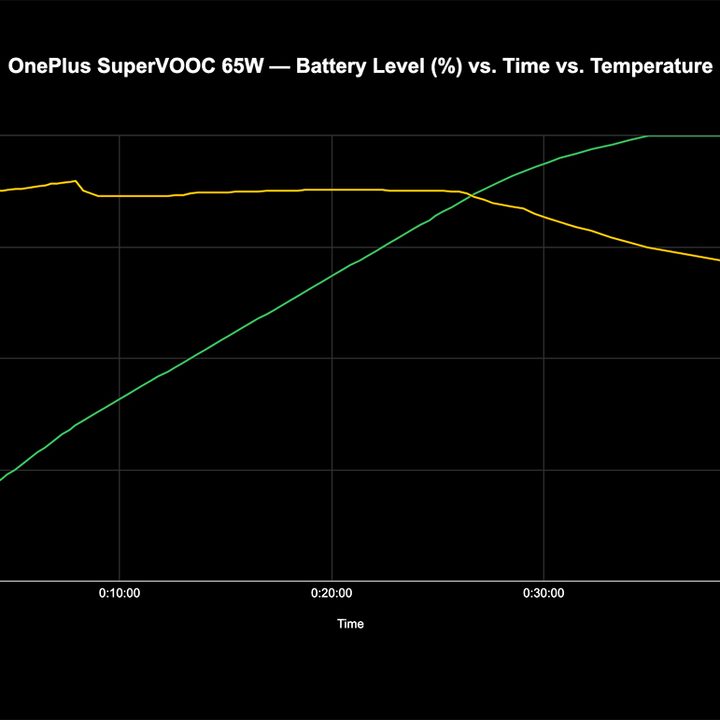
During our test of the 65W SuperVOOC charging, the OnePlus 10 Pro takes merely 13 minutes to go from 5% to 50% battery charge. Surprisingly, this time is less than what the OnePlus 10 Pro took when using the bundled 80W charger. The phone takes another 11 minutes to reach 80% charge, taking a total of 24 minutes to go from 5% to 80% battery capacity. It reaches 100% two minutes faster than an 80W charger. This is perplexing.
As we turn to battery temperature to explain this anomaly in our readings, we realize the OnePlus 10 Pro reaches its peak battery temperature of 45-degree Celsius (113-degree Fahrenheit) in just one minute of charging, i.e., around 18% battery after starting at the same temperature as in the previous section. The OnePlus 10 Pro’s battery undulates between 43-degree Celsius (109-degree Fahrenheit) and 45-degree Celsius (113-degree Fahrenheit) until the phone reaches 85% battery, following which the battery’s temperature declines sharply as it rushes to complete charging in 35 minutes.
The vague difference between SuperVOOC 80W and 65W on the OnePlus 10 Pro does not matter.
Although both 80W and 65W charging standards take nearly the same time, 80W turns out marginally slower in our tests. The only possible explanation for this is the sudden spike in temperature we notice between the 20- and 30-minute marks. This could owe to a sudden surge in processing load due to a background process. Otherwise, you can expect both the charging technologies to take nearly the same time.
USB-PD on OnePlus 10 Pro
After testing the fast-charging capabilities of the bundled chargers, we move to evaluate how fast the OnePlus 10 Pro can charge with more widely accepted chargers. This test measures the time taken by the OnePlus flagship to charge using a widespread, generic charging standard through USB Type-C ports — USB Power Delivery or USB-PD. It is commonly used across smartphones and laptops and allows a power throughput of up to 100 watts.
Brands such as Samsung and Motorola rely on USB-PD instead of a proprietary charging standard to add fast-charging capabilities to their smartphones. Meanwhile, companies such as Xiaomi have added support for high-speed charging through USB-PD on devices — such as the Xiaomi 11i HyperCharge — that also support their proprietary charging standards. OnePlus and its sister companies, in contrast, lack support for superfast charging through USB-PD. The OnePlus 9 Pro was limited to charging at 18W through non-OnePlus chargers over USB-PD despite supporting 65W fast charging using OnePlus chargers. The inequity appears to continue on the OnePlus 10 Pro.
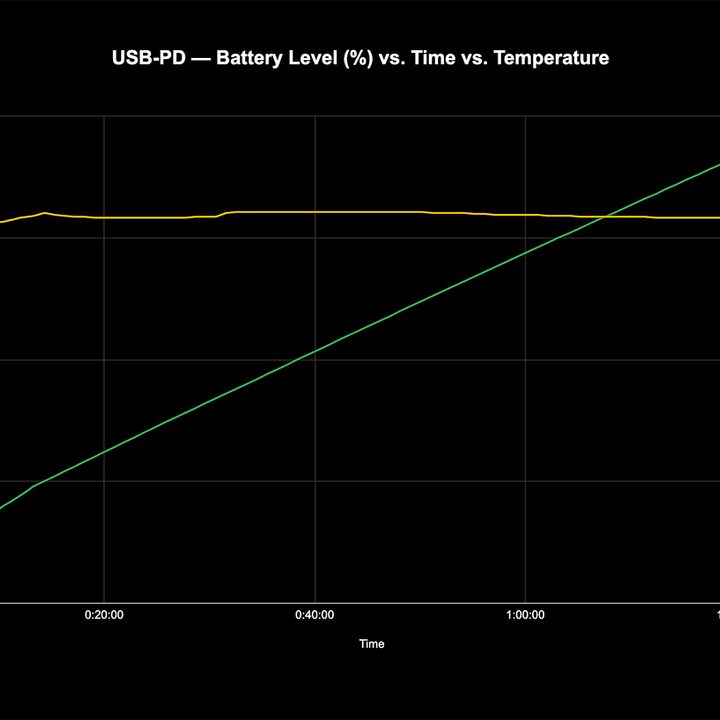
During our test using the Ugreen 100W GaN charger that supports USB-PD at up to 100W, the OnePlus 10 Pro took precisely 1 hour and 30 minutes to go from 5% to 100% battery charge. It completed charging up to 50% in a little under 40 minutes while taking more than an hour to reach 80% after starting at 5% battery.
Thankfully, the temperature does not waver much from the 40-degree Celsius (104-degree Fahrenheit) mark while using USB-PD.
This result proves that OnePlus once again forsakes democratic charging standards such as USB-PD in favor of its own proprietary technology. This means you will be left with no other option but to keep a dedicated charger for the OnePlus 10 Pro and also carry one with you wherever you go. Unfortunately, the 65W and 80W SuperVOOC chargers do not support fast charging on devices like the Samsung Galaxy S22 Ultra or laptops, including Dell XPS or various MacBook models that charge over USB-C. This means you will be left to haul different chargers for different devices.
Final thoughts
The OnePlus 10 Pro, despite its shortcomings in software, has amazed us just like any other OnePlus device in the past. Yet the limited charger support and the lack of compatibility with a broader range of charging standards make it prone to falling behind options such as the Galaxy S22 Ultra. Admittedly, some users will be able to benefit from a range of OnePlus fast-charging stations seen at several airports. Still, it leaves room for disappointment, even for devout OnePlus fans who might commute to work daily, travel a lot, or have multiple devices to charge at home.


