
Google officially released the Pixel 6 and Pixel 6 Pro today at its Pixel Fall Launch event. Google’s latest Pixel phones are the most advanced devices Google has released so far, with notably better cameras, better graphics, and a more advanced chip. Read on to learn all about the Pixel 6 and Pixel 6 Pro, including details on each model’s design, camera features, specs, pricing, and availability.
Pricing and availability
The Pixel 6 and Pixel 6 Pro are available for purchase now. The Pixel 6 retails for a starting price of $599, and the Pixel 6 Pro starts at $899. You can buy one on Google’s site today. It’ll also be available for pre-order on AT&T starting October 19. New and existing customers can get the Pixel 6 Pro for up to $700 off with a trade-in and the Pixel 6 for $15/month without a trade-in.
A new design

With many new phone releases, you won’t notice much of a difference in design at first glance. The Pixel 6, however, looks quite different from previous models right off the bat. The most noticeable difference is the rear camera, as the camera bump is thicker (it’s more of a ridge) and goes all the way across the back of the phone instead of sitting in the upper-left-hand corner like on the Pixel 5a 5G and the Pixel 4a.
The regular Pixel 6 has a 6.4-inch screen, while the 6 Pro boasts a larger 6.7-inch display. Both have IP68 protection and screens made of Corning Gorilla Glass Victus, which provides up to twice the scratch resistance when compared to previous Pixel phones.
The phones come in vibrant colors, with the Pixel 6 offered in pale orange/peach, pastel green/teal, and black color options. The Pixel 6 Pro comes in tones of silver, gold, and black. The accent color on the camera bump is different from the main phone color, giving the device a bit more character.
Better cameras
The cameras on the Pixel 6 and Pixel 6 Pro are much better than what we’ve seen on previous Pixel phones. The Pixel 6 has a 50-megapixel wide sensor and a 12MP ultrawide sensor, while the Pixel 6 Pro has the aforementioned camera sensors, plus a 48MP telephoto sensor with 4x optical zoom.
The larger camera sensors allow for up to 150% more light, and therefore better photos. There’s a 94-degree field of view on the front Pro camera as well, so you can fit everyone in your selfie shot. There are also new features like Face Unblur to clear up blurry photos and even a way to remove unwanted people and objects from the background.
Tensor chip
Another standout feature on the Pixel 6 series is the Tensor chip. A competitor to Apple’s A15 Bionic chip, Google’s Tensor chip has built-in computational photography, while also allowing for up to 80% faster performance. The Tensor chip should mean a more intelligent and intuitive phone overall.
Graphics
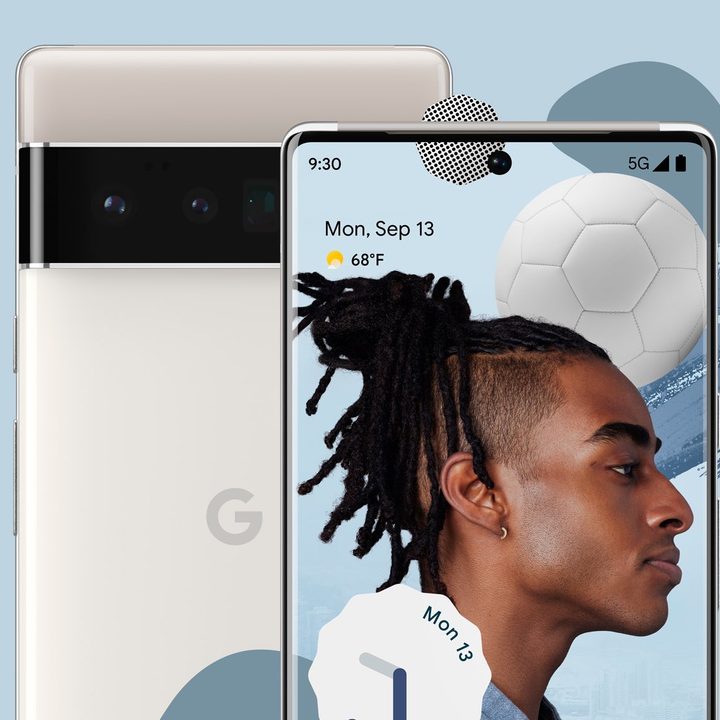
The Pixel 6 Pro boasts a 3120 x 1440 display. The Pro has a 120Hz refresh rate, with LTPO technology to lower the refresh rate down to as low as 10Hz. This makes it so the phone can save on battery and dynamically vary the refresh rate depending on your specific usage. The Pixel 6 has a resolution of 2400 x 1080 at 90Hz.
Key Specs
Here are the specifications on the Pixel 6 and Pixel 6 Pro.
| Google Pixel 6 | Google Pixel 6 Pro | |
| Color options | Pale orange/peach, pastel green/teal, and black | Silver, gold, and black |
| Display | 2400×1080 (90Hz) | 3120×1440 (120Hz, adaptive) |
| Storage and memory |
128GB, 256GB storage; 8GB, 12GB RAM | 128GB, 256GB storage; 8GB, 12GB RAM |
| Cameras | 50MP main, 12MP ultra-wide,12 MP Selfie | 50MP main, 12MP ultra-wide, 48MP telephoto, 12MP Selfie |
| Battery | 4,614 mAh | 5,000 mAh |
| Chip | Google Tensor | Google Tensor |
| Dimension | 158.6 x 74.8 x 8.2mm | 163.9 x 75.8 x 8.9mm |
| 4G, 5G, etc. | 5G | 5G |
| Other (water resistance, durability) | IP68, Gorilla Glass Victus | IP68, Gorilla Glass Victus |


