1. Home
  2. Phones
  3. Android
  4. Mobile
  5. News

Qualcomm’s long-awaited second-gen 3D Sonic fingerprint sensor is 50% faster

Add as a preferred source on Google

Qualcomm wants to make its in-display fingerprint sensor a little bit more seamless. Its first-generation Sonic Sensor was introduced a few years ago, and at the time offered a decent experience — but since then, has been overtaken in terms of speed and performance by competing optical sensors. Now, Qualcomm has finally launched a new, second-generation 3D Sonic sensor with big improvements.

The new sensor is 77% larger than Qualcomm’s original 3D Sonic Sensor, measuring in at 8mm square, compared to the original’s 4mm by 9mm. In other words, you’ll be able to place your finger on a larger portion of the screen, making the overall experience a little more seamless.

Recommended Videos

Perhaps even better is the fact that Qualcomm says the new sensor is a hefty 50% faster than the original. Combined with the larger surface area, users should be able to get into their phones more easily. The new sensor is about as thin as the last-gen version, coming in at 0.2mm.
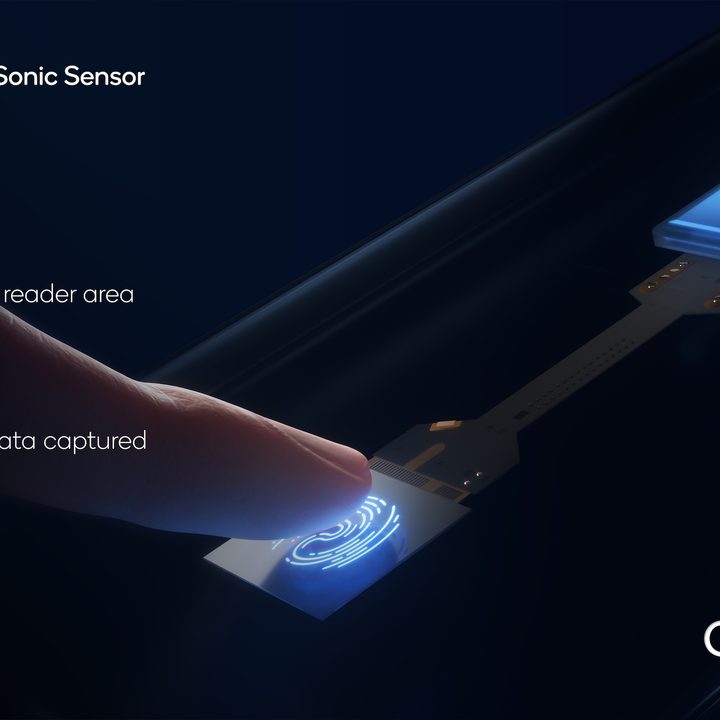
Image used with permission by copyright holder

Qualcomm says that the new fingerprint sensor is expected to debut on mobile devices in early 2021. We’re not yet sure how early in 2021 that is, but Samsung is set to launch the Samsung Galaxy S21 on January 14, so it’s entirely possible that the companies have been working together on the tech, and that the next-gen Galaxy device will include it. The previous-gen sensor was included in the Galaxy S10, Note 10, Galaxy S20, and Note 20.

Of course, the future of fingerprint sensors in phones is a little uncertain. While Apple has switched to Face ID over Touch ID, most Android manufacturers have stuck with fingerprint sensors, mostly under the display. Rumors suggest Apple may soon include both in its phones, which would help ensure that users can easily get into their phone, even with a face mask on.

It’s about time for an upgrade to the 3D Sonic Sensor. When the first-generation version debuted on the Samsung Galaxy S10, it was considered pretty fast — but by the time the S20 rolled around, competing optical sensors generally outperformed the 3D Sonic Sensor, and the S20 suffered in reviews because of it. The flip-side of that is that Qualcomm says the 3D Sonic sensor is very secure, and hard to trick. Regardless, hopefully the new sensor will bring the Galaxy series in line with the competition.

Interestingly, Qualcomm touted the fact that its other fingerprint sensor solution, the 3D Sonic Max, won a CES 2021 Innovation Award. This technology was initially shown off in late 2019, but never made it to market — even as the standard 3D Sonic sensor was in development. Qualcomm now says that this even larger sensor, which can recognize two fingers among other advancements, will finally launch in phones this year.

Christian de Looper
Christian de Looper is a long-time freelance writer who has covered every facet of the consumer tech and electric vehicle…
Samsung PenUp adds new stylus tricks to your Galaxy phone, if it support an S Pen
Galaxy S Pen users now have more brushes to mess around with
Samsung Galaxy S26 Ultra in hand

Samsung’s PenUp app is getting a useful creative upgrade for Galaxy users, especially those who use the S Pen for casual digital art. For those unaware, PenUp is Samsung’s app for sketching and coloring templates. It works with touch input, but the latest update should be most useful on Galaxy phones and tablets with S Pen support.

The latest PenUp update, version 3.9.22.23, adds 53 new brushes through the “Download more brushes” option. It also adds Dual brush, a new tool that lets two strokes work together for layered effects.

Read more
Apple should just give the Neo treatment to its upcoming iPhone 18e and I’ll bite
There, I said it, I want the iPhone Neo
iPhone XR

For years, Apple has approached its affordable iPhones with a predictable formula: take an older flagship design, remove a few premium features, lower the price slightly, and position it as the “entry point” into the ecosystem. Financially, the strategy works. Emotionally, it often does not.

That is exactly why the upcoming iPhone 18e represents such a major opportunity for Apple. Instead of treating it as another watered-down flagship, Apple should fully embrace a “Neo” identity, one built around color, personality, experimentation, and smart hardware reuse. Apple has already executed it perfectly with the MacBook Neo. It just needs to follow that template for an affordable iPhone.

Read more
Your Android phone can now share files with any iPhone using a Quick Share QR code
Quick Share just got a trick that makes cross-platform file sharing almost painless.
iPhone receiving file via quick share qr code

Sharing files between Android and iPhone has always been a pain, but Google is quietly fixing that. The company launched a new Quick Share feature that made Android devices compatible with Apple’s AirDrop, allowing users to easily transfer files between iPhones and Android devices. 

However, not all Android devices have the hardware to support Quick Share-AirDrop compatibility, which means not all Android smartphones can access this feature. To solve this problem, Google announced a new QR code-based file-sharing system, which allows any Android device to transfer files to iPhones. 

Read more