  1. Home
  2. Phones
  3. News

Signal messenger wants to protect you from phishing with these new in-app changes

Signal has introduced new safety features to help users detect and avoid scams.

Add as a preferred source on Google
Signal app banner on an iPhone.
Rachit Agarwal / Digital Trends

If you use Signal, there’s something important you should know. The encrypted messaging app has rolled out a set of new in-app safety measures designed to protect you from phishing and social engineering attacks.

To help protect Signal users from phishing and social engineering attacks, we’ve introduced additional confirmations and educational messaging in the app to help people better detect fraudulent profiles, especially message requests from scammers posing as Signal.

More changes… pic.twitter.com/ASZNCXHNFM

— Signal (@signalapp) May 11, 2026

This isn’t out of nowhere either. Back in March, Signal confirmed that its platform had been targeted by phishing attacks aimed specifically at government officials and journalists. It seems that these new changes are a direct response to that.

What are the new safety changes in Signal app?
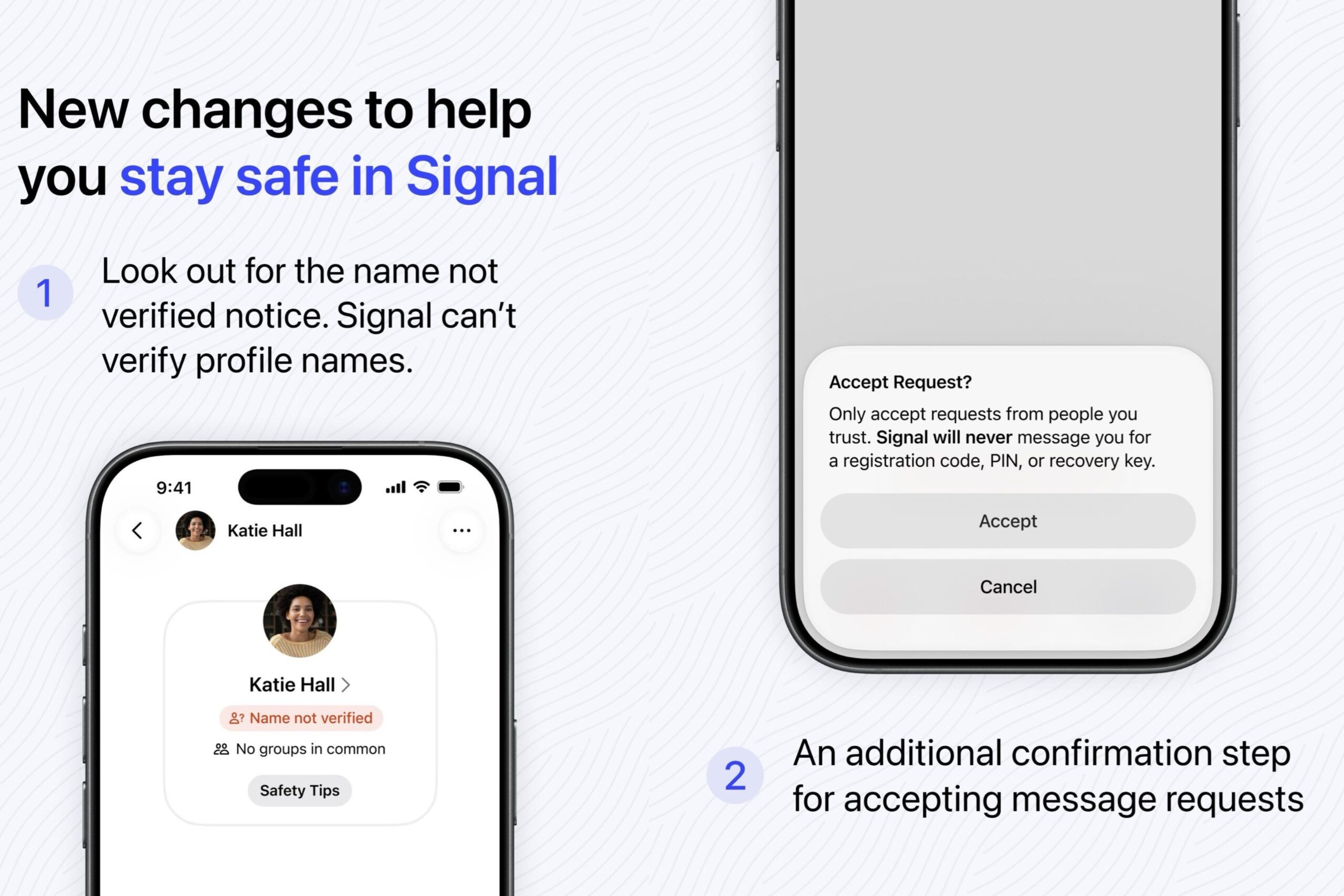
The most notable addition is a “name not verified” notice that now appears on profiles. This is important because Signal cannot actually verify the names users display on their profiles. Anyone can claim to be anyone since the profile name is set by individual users.

Recommended Videos

Signal has also introduced an extra confirmation step when you receive a message request. The idea is to only accept requests from people you actually know and trust. This is quite similar to how WhatsApp handles chats from unknown numbers, where you get the option to accept or cancel when it comes from an unknown number.
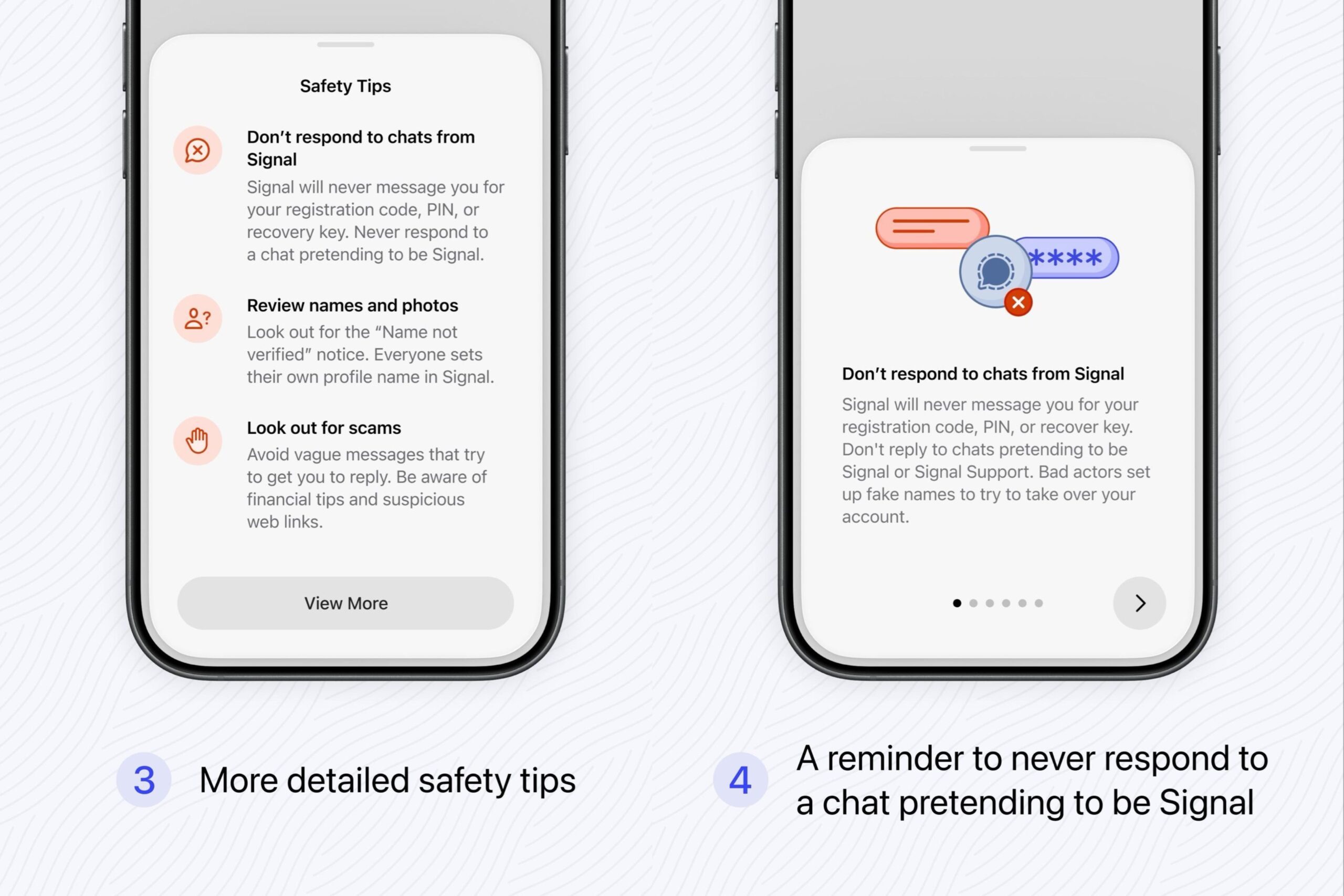
The app now also surfaces more detailed safety guidance directly in the interface. You’ll see reminders not to respond to chats claiming to be from Signal, since Signal will never reach out to ask for your PIN, registration code, or recovery key. If someone is asking for any of those things, it’s a scam.

The app also highlights vague messages – designed to lure a reply, suspicious web links, and any chat pushing financial tips – as red flags to watch for.

Why this matters?

Social engineering is one of the most common ways people get compromised online. It doesn’t require a technical hack. It just requires tricking you into handing over the right information.

Scammers impersonating Signal itself is a particularly sneaky tactic because it exploits the trust people place in the app. Signal has confirmed more changes are on the way, so this is just the beginning of a broader push to make the platform safer for everyone.

Manisha Priyadarshini
Manisha Priyadarshini is a tech and entertainment writer with over nine years of editorial experience.
WhatsApp Plus is here, and you can safely ignore this subscription
WhatsApp wants a monthly fee for what other apps include by default, and that's a problem Meta can't dress up with custom icons.
WhatsApp Plus screenshots.

WhatsApp has fiercely defended its status as a free, no-nonsense online messaging app for over a decade, but a new subscription tier is muddying the waters. 

Meta is rolling out WhatsApp Plus, a paid subscription model, to a limited number of iPhone users using the latest version of the App Store. 

Read more
Apple and Google just put a lock on your green-bubble texts, and it’s about time
The green bubble finally has something to brag about. Apple and Google's unlikely alliance brings real encryption to everyday cross-platform texting.
E2EE arrives on RCS for iPhone and Android phones.

For years, texting between an iPhone and an Android device felt less like a private conversation and more like shouting across a crowded street. Well, that changes on May 11, 2026, as Apple and Google jointly launched end-to-end encryption (E2EE) for RCS messaging. 

The long-awaited feature is rolling out first in beta with iOS 26.5 (also announced today) and the latest version of Google Messages. 

Read more
The Razr Ultra 2026 is everything a flip phone should be, but I’m not paying $1,500 for it
A flip phone was never supposed to cost this much. At $1,500, the Razr Ultra finds itself in an uncomfortable fight against everything else your money can buy.
Motorola Razr Ultra

I'll be blunt: $1,500 is a lot of money to spend on the Razr Ultra, a clamshell phone that folds in half. In fact, it's a lot of money to spend on any smartphone, especially when a Galaxy S26 Ultra or iPhone 17 Pro Max costs less and still leaves a few hundred dollars in your pocket, or throwing in a couple of hundred bucks can get you a full-fledged book-style foldable. 

For me, the Razr Ultra doesn't quite make a strong case at $1,500. In isolation, it's a genuinely impressive flip phone that gets all the basics right and delivers the premium experience you'd expect at this price. The Alcantara back, the 5,000-nit display, the silicon-carbon battery, and the dual cameras on the back make it sound like a complete package.

Read more