
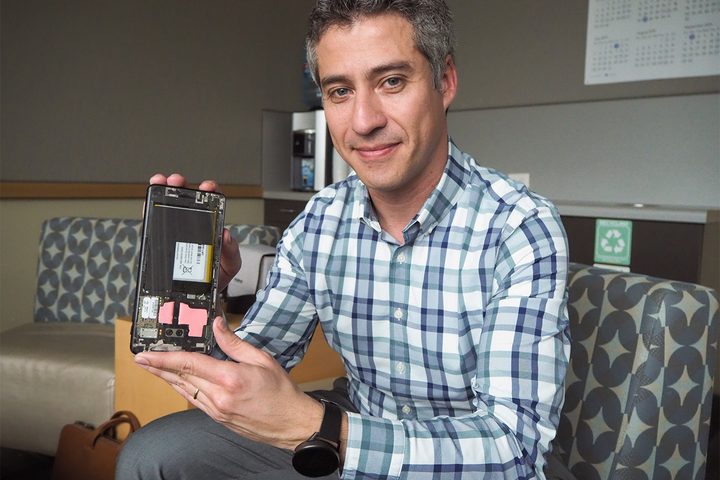
I’m looking at what by all accounts is an ordinary smartphone. It’s black, made of glass and metal, and runs the latest version of Android. It’s also a unique glimpse of the future: It runs on the 5G networks AT&T and Verizon and Sprint and T-Mobile are even now racing to erect across the country. Faster speeds, lower latency, vast connectivity options … frankly, 5G seems sort of miraculous.
“It’s kind of like magic,” jokes Ignacio Contreras, director of Product Marketing with Qualcomm and a leading 5G champion for the company. I’m in Qualcomm’s sprawling corporate headquarters in San Diego on what must be the only cold and rainy day so far this winter (thanks, Mother Nature). Contreras is holding a reference design phone, recently unveiled by the company to help carriers and manufacturers plan out their next phones.
Expectations are all over the map regarding the next generation of phone. Will they be clunky bricks, thanks to heavy, power-inefficient chips? Will they double in thickness, yet only support a few hours of connectivity? We’ll see at Mobile World Congress later this month, of course, but in the meantime, we can lean on reference designs … and Contreras is confident that you’ll like what you see.
“What will be proven over the next few weeks — what we’re seeing with this reference design — is that 5G phones can have a nice, slick design. That’s a challenge that has been resolved,” Contreras says.
Solving the millimeter wave problem
The reference design supports both sub-6Ghz networks and emerging millimeter wave networks, and intriguingly, it addresses one of the big fears network analysts have about high-frequency bandwidths: Those signals don’t travel very far, and ordinary objects can impede them. Put a hand over an antenna and it can impact signal quality (remember Steve Jobs saying “you’re holding it wrong”? Yep, we’re right back there.) In this reference design, Qualcomm has a solution to a problem many engineers and technicians thought insurmountable.
“People thought it was impossible. But it has been solved.”
“It’s very challenging. There’s no question about that,” Contreras said. “Up until a couple years ago, people thought it was impossible. It’s impossible. But it has been solved.” Partly that comes down to new components and technologies – stay tuned for news, we’re guessing – and partly it comes down to this reference design, which has not one but several antennas.
“In this reference design, we have three of these millimeter wave modules,” Contreras explained. One sits at the top of the phone, while radios line the left and right edge as well. “So if you block one of the antenna with your hand, or put it right next to an object, there’s another one that can still become active and be able to talk to the cell tower.”
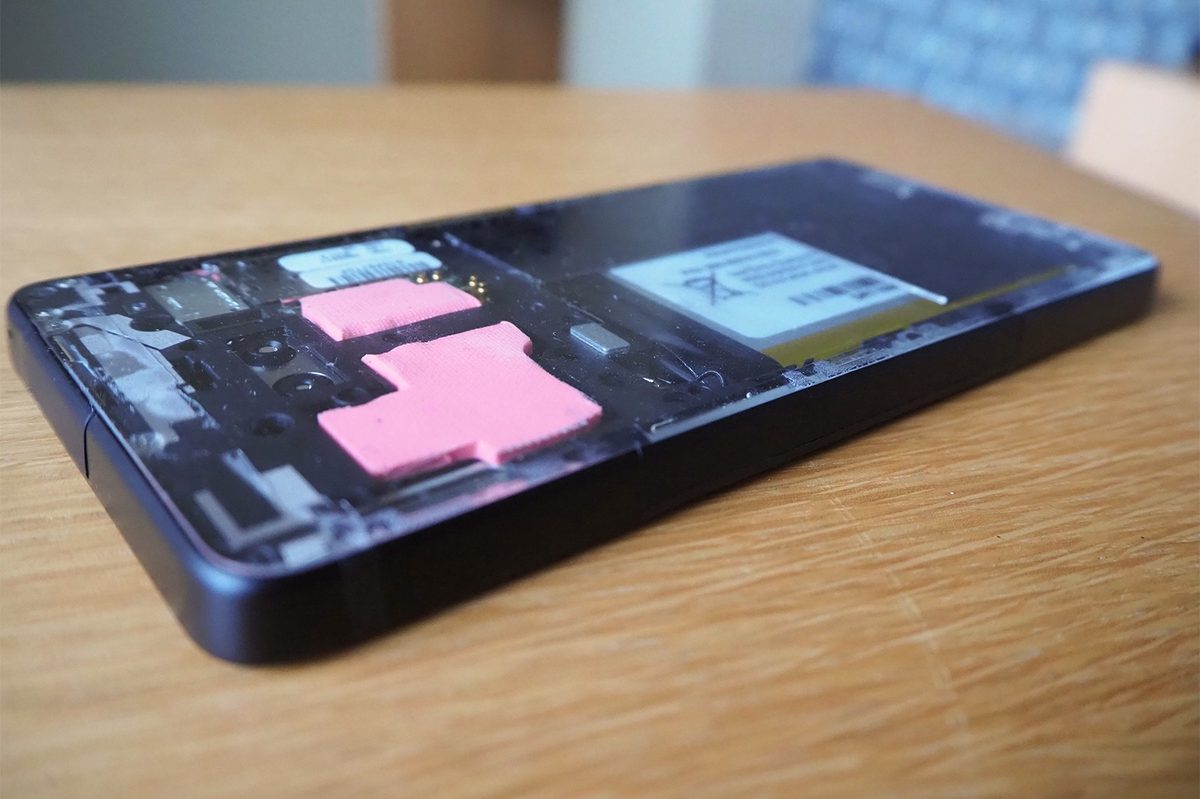
Just consider: At any time, the chip needs to track signal quality and strength from each antenna to figure out which beam candidate is the best. It needs to quickly switch should one get blocked. It needs to handle transitions between different transmitters and base stations as well. And all while someone is walking, biking, or driving in a car at 75 miles an hour.
“Just to make it work is challenging. Making it work in this form factor, what you expect today with a smartphone, is crazy,” he told Digital Trends. “It’s kind of like magic, and kudos to all the engineers that work very long hours to get all of these things resolved.”
“Just to make it work is challenging. Making it work in this form factor, what you expect today with a smartphone, is crazy,”
This isn’t a dramatic change, by the way: Current phones contain as many as six or seven antenna; Qualcomm says you can expect 5G phones to have eight or nine. Technologies built into Qualcomm’s chips combine the signals from them and optimize return signals to ensure continuous coverage, regardless of any one antenna.
There’s the whole radio frequency part of the signal as well: Transceivers, filters, amplifiers — 5G requires a whole new set of those. “That’s why at Qualcomm, we had to start working on modules, not just selling discrete components,” he explained. Again, stay tuned.
Solving the power problem
A big part of the challenge with any network technology is power efficiency. And 5G comes with its own unique problems here. The higher bandwidths of 5G networks require more processing to operate, Contreras explains. To address it, the company leans on a technology called CDRX, or connected discontinuous reception.
More 5G coverage
- What is 5G? Here’s everything you need to know
- 5G phones are on the way: Here’s every phone that will support 5G
- 5G vs. LTE: What’s the difference, and does it matter?
- Is 5G millimeter wave spectrum dangerous? We asked an expert
“You’re connected, but you schedule with the tower to receive data only at certain points of time. Because if you have a high throughput, it might be more efficient to receive data in bursts, versus having a continuous flow of data,” Contreras said. That lets the phone put some monitoring components to sleep, and will only wake them when it knows data is coming.
Compare it to a hybrid car engine, which turns off the gasoline engine whenever possible in favor of the more efficient battery.
What will we see at MWC?
That’s not coming any time soon, you say? Au contraire.
“Virtually all major android manufacturers will be announcing or launching flagship 5G phones,” Contreras said. “Networks will be deployed across the globe – in the United States. Europe. Japan. South Korea. Australia, and China will see networks lighting up and growing.”
The future isn’t coming, in other words. The future is here.
“We feel a bit excited about what’s going to happen at Mobile World Congress, because the level of scale – networks, OEMs [original equipment manufacturers], infrastructure vendors — it’s just one standard. The ecosystem is very streamlined,” Contreras said.


