  1. Home
  2. Phones
  3. News

Your Android phone may soon offer smart suggestions based on your activity

Contextual suggestion could bring Pixel 10's Magic Cues to more Android phones.

Add as a preferred source on Google
The Galaxy S24 Ultra's screen.
Andy Boxall / Digital Trends

With the Pixel 10 series, Google introduced Magic Cue, an AI-powered feature that analyzes how you use your phone and offers tailored suggestions and app actions to make everyday tasks quicker and smoother. So far, it has been limited to Google’s latest flagships, but the company appears to be working on bringing something similar to more Android phones.

According to Android Authority, Google is prepping a new feature call Contextual Suggestions, which will offer users “helpful suggestions from apps and services based on their routine activities and locations.” The company has already started testing this feature in Google Play Services version 25.49.32 beta.

Recommended Videos

Users on the latest beta can enable it by navigating to Settings > Google Services > All services > Other and tapping the toggle on the Contextual suggestions page, though it’s not yet available to all beta testers. The settings page provides an example of how it works, highlighting that if the user often listens to music while working out, the feature can automatically prompt the music app to suggest a playlist when they arrive at the gym.

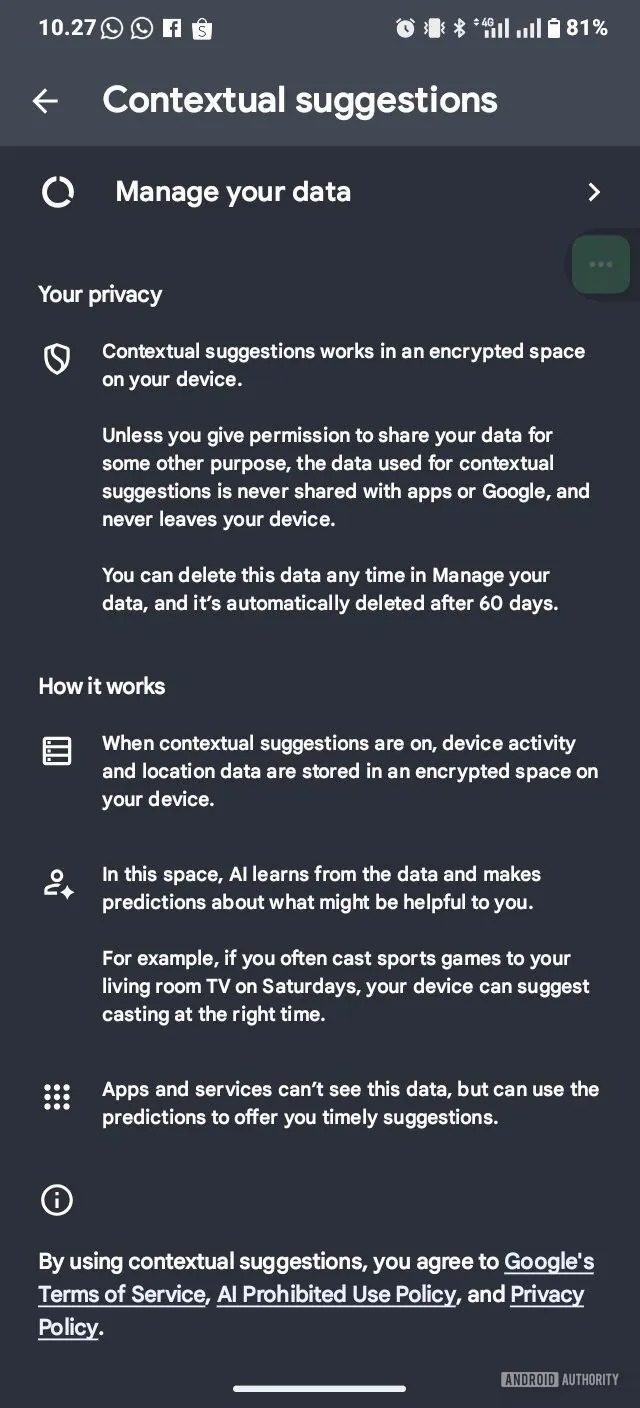
For suggestions that rely on the user’s location, the settings page has a toggle to enable location sharing. It also includes a “Manage your data” option that lets users delete the data collected for contextual suggestion, along with a section about privacy stating that the feature works in an encrypted space on device and doesn’t share user data with other apps or Google.

How Contextual suggestions work

A section about how the feature works further reveals that it relies on device activity and location data to make predictions about what might be helpful for the user. It provides an additional example stating that if a user often casts sports games to their TV on a specific day, it can offer a casting suggestion on that day at the appropriate time.

It’s not immediately clear whether Contextual Suggestions will be limited to Google’s own apps or extend to third-party apps. Google is expected to share more details when the feature rolls out widely.

Pranob Mehrotra
Pranob is a seasoned tech journalist with over eight years of experience covering consumer technology. His work has been…
Qualcomm leak suggests we have entered the ludicrous era of pricey phones
Your next Android flagship could cost more because of one tiny chip
Snapdragon 8 Elite

We have reached the point where the processor inside a flagship phone may cost as much as an entire budget Android phone. That sounds absurd, but it also feels exactly like where premium phones are headed. Samsung already raised the Galaxy S26’s starting price by $100 over the Galaxy S25, and the next wave of Android flagships could climb even higher.

According to a new leak from tipster Abhishek Yadav, Qualcomm’s upcoming Snapdragon 8 Elite Gen 6 Pro could cost upward of $300, significantly raising the bill of materials for next-generation Android flagships.

Read more
Samsung phones will block those nasty push notifications brimmning with adware
Galaxy users may get a cleaner notification bar
Front view of the Galaxy S26

Push notifications are useful until apps start treating them like free ad space. On Android, this gets especially annoying because promotional alerts are not always clearly separated from important notifications. Users often have to guess which setting controls ads, and many end up turning off notifications entirely just to stop the spam.

Samsung now appears to be addressing this issue with a new Device Care update that can detect and block apps that send too many promotional notifications.

Read more
Apple’s 2028 iPhone display sounds impossible, but Samsung and LG are scrambling to build it
Android phones have had curved displays for years and accepted the distortion as the price of aesthetics. Apple is spending two years and billions of supplier dollars to not accept it.
iPhone 2027 mockup

Apple doesn’t ask its suppliers to build things. It tells them to, hands them a deadline, and watches billions of dollars move on product lines and supply chains. 

The company is reportedly pushing Samsung and LG to build a fundamentally new OLED cathode material called IZO (Indium Zinc Oxide) for a four-sided bending display planned for 2028 iPhones (via ETnews). 

Read more