A bridge camera is an intermediate step between an interchangeable lens model (either mirrorless or DSLR) and a smaller point-and-shoot. While bridge cameras often resemble an interchangeable-lens camera in appearance, their insides are much more like point-and-shoots. You won’t find a bridge camera with anything larger than a 1-inch-type sensor, for example, and sensor size plays an important role in image quality.
The use of smaller sensors, however, allows bridge cameras to fit incredibly long zoom lenses in much less space than what would be required for a DSLR or mirrorless camera. For this reason, bridge cameras are often called “superzooms.” Since zoom range and sensor size form a balancing act, you won’t find the longest zoom on the bridge camera with the largest sensor, so you’ll have to decide which feature matters most to you before deciding.
At a glance:
- Best overall: Sony Cyber-Shot RX10 IV
- Best for video: Panasonic Lumix FZ2500
- Best extreme superzoom: Nikon P1000
- Best budget superzoom: Canon SX70 HS
- Best for low light on a budget: Panasonic Lumix FZ300
Best overall: Sony Cyber-shot RX10 IV

The Sony Cyber-shot RX10 IV is the best bridge camera — if you can afford it. Built around a relatively large 1-inch sensor and relatively long 25X zoom lens, it’s a luxury camera that comes as close as possible to giving you the best of both worlds, sensor size and zoom.
The sensor is the same one found in Sony’s popular RX100 line, which — no surprise here — also took top spot in our roundup of the best point-and-shoot cameras. While the physical size of the sensor gives the RX10 great low light capability for this class, it also boasts a resolution of 20 megapixels for excellent detail, even if you want to make large prints.
With a zoom range equivalent to 24-600mm, the lens spans everything from a decent wide-angle to a full-on super telephoto. It’s a big improvement over previous RX10 cameras that topped out at just 200mm, and means you can shoot everything from landscapes to sports with ease. The maximum aperture remains decently bright across the zoom range, going from f/2.4 to f/4. That means you only lose just over a stop of light as you zoom in. Combined with the larger sensor, the RX10 will easily beat most other cameras on this list when it comes to taking pictures in less-than-perfect light.
The RX10 IV is also a faster camera than previous versions. It focuses in as little as 0.03 seconds and shoots continuously as high as 24 frames per second.
Even with all of its features and performance, the RX10 IV remains an expensive investment. It is also a rather large camera that weighs 2.4 pounds, putting it in the same weight class as many DSLRs. To put things in perspective, no DSLR lens offers that much zoom range, and the telephoto zooms that reach 600mm do not come cheap.
Best bridge camera for video: Panasonic Lumix FZ2500
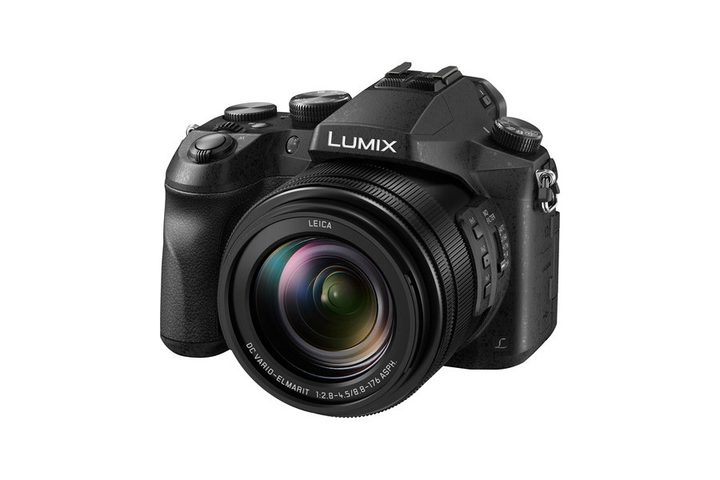
The Lumix FZ2500 also uses a 20MP, 1-inch-type sensor that delivers outstanding image quality for the class. Its lens is shorter than the RX10 IV’s, however, with an equivalent focal length of 24-480mm. Maximum aperture is f/2.8 to f/4 which, like the RX10 IV, allows for reasonably good low light performance, especially compared to the smaller-sensor competition below.
Where the FZ2500 stands out is video. Despite being released in 2016, it still offers best-in-class features for the videographer. It can shoot two flavors of 4K, both Ultra HD (3,840 x 2,160) and wider DCI (4,096 x 2,160), at up to 30 frames per second. True 24 fps is also supported for the cinematic look. Video enthusiasts will also benefit from features like V-Log L, a flat color profile that preserves more dynamic range, as well as 10-bit 4:2:2 output over HDMI suitable for an external recorder. These are very impressive features on a bridge camera, or really any camera at this price.
On the downside, Lumix FZ2500’s 4K is recorded from a 1.4X crop, meaning you lose some of the wide-angle and ultimately sacrifice some low light quality by effectively reducing the size of the sensor. Still, serious video shooters in need of a portable camera with an integrated long zoom could do much worse.
Best extreme superzoom: Nikon Coolpix P1000
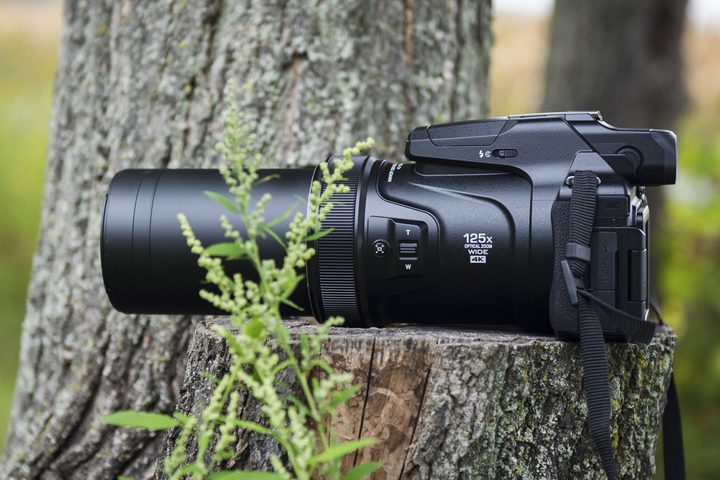
The Nikon Coolpix P1000 is a bit of a show-off. The mother of all superzooms, it takes the concept to a whole new level with a 125x lens. That’s an equivalent focal length range of 24-3000mm, a telephoto length that is simply unheard of on interchangeable lens cameras. It’s enough to take pictures of the craters in the moon. Even with its powerful optical stabilizer, getting sharp shots at 3,000mm will be tricky without a tripod.
At the 24mm end, the P1000 has a maximum aperture of f/2.8, which isn’t bad, but it drops severely as you zoom in, shrinking to f/8 by the time you hit 3000mm. That means your light gathering ability at the telephoto end is just 1/8 what it is at the wide end. No, we don’t expect anyone will need 3000mm indoors, but it could still lead to noisier shots when shooting outdoors in less than ideal light.
Light sensitivity is also limited by the small sensor. Behind the monstrous lens is standard 16-megapixel 1/2.3-inch sensor, a run-of-the-mill size for point-and-shoots. It is backside illuminated (BSI), which should help slightly with light sensitivity, but it will be no match for the FX2500 and RX10 IV above.
On the video front, you do get 4K at 30fps, although without the advanced features of the FZ2500.
Overall, while the P1000 is certainly an exciting camera, you should consider just how much zoom you really need before deciding on it.
Best superzoom on a budget: Canon PowerShot SX70 HS

The Canon PowerShot SX70 HS extends your reach with an impressive 65x zoom — that’s an equivalent focal length of 21-1,365mm! With both a wider wide-angle and a narrower telephoto, it can achieve perspectives the RX10 IV and FZ2500 simply can’t. However, the downside is that it makes use of a much smaller sensor, and image quality will likewise be worse, particularly in lower light.
While the SX70 HS carries over the same basic design as its predecessor, one new feature is 4K video. It doesn’t offer the advanced video settings of the FZ2500, but for casual use it should be just fine.
But what really makes the SX70 attractive is the price. At around a third the cost of the RX10 IV, it’s much easier on the bank account. If your primarily goal is getting a long optical zoom and you don’t care as much about raw image quality, this is a solid choice.
Best for low light on a budget: Panasonic Lumix FZ300
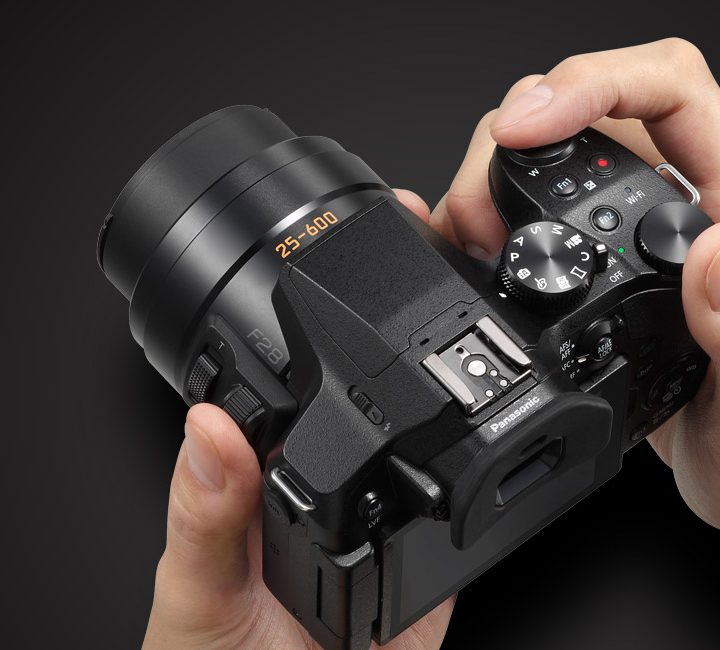
The Lumix FZ300 trades outright zoom power for a faster constant aperture. Its 25-400mm lens is the shortest on this list, but its paired with an f/2.8 maximum aperture that is maintained throughout that entire zoom range. This is the only camera on this list that doesn’t reduce light sensitivity as you zoom in.
However, because this uses a 12.1MP 1/2.3-inch sensor, actual low light performance will still be inferior to the likes of the Sony RX10 IV and Lumix FX2500, both of which use larger 1-inch sensors. Given the price difference, however, that’s forgivable.
Panasonic also tosses in a few other big features to make the Lumix FZ300 really enticing. There’s 4K video, five-axis image stabilization, and a 12 frames-per-second (fps) burst speed – all wrapped up in a splash-proof body with both an electronic viewfinder and a tilting touchscreen.