  1. Home
  2. Social Media
  3. Web
  4. Legacy Archives

Suddenly Facebook friends with a lot of giraffes? Here’s why

Add as a preferred source on Google

If you find that a lot of your Facebook friends are sporting an adorable giraffe as a profile picture, it’s because they failed to answer the following riddle:

“3:00 am, the doorbell rings and you wake up. Unexpected visitors. It’s your parents and they are there for breakfast. You have strawberry jam, honey, wine, bread and cheese. What is the first thing you open?”
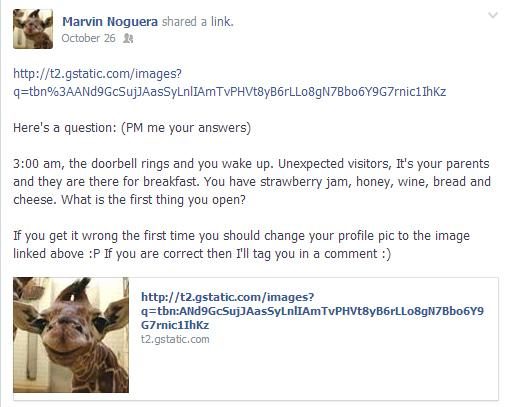
facebook giraffe riddle
Image used with permission by copyright holder

Friends are encouraged to send in their answers to the update poster via private message (don’t be a spoil sport by commenting with the answer publicly!). If they are correct, they will be acknowledged via comment tag. If they are wrong, they have to update their profile photo, keep it on for 24 hours, and re-post the riddle on their own Timelines.

Recommended Videos

This is similar to a meme where users were required to change their profile pics to their favorite cartoon character from their childhood. I did it one better and created a whole album:
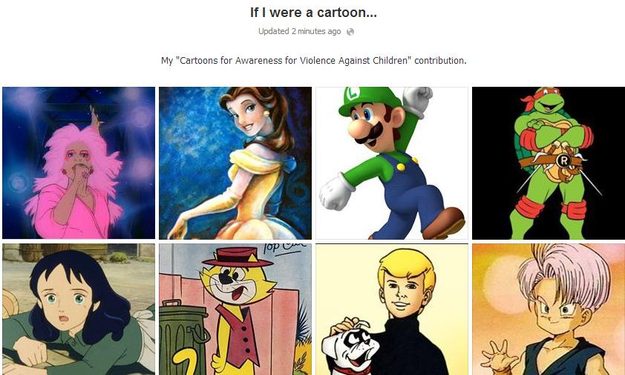
facebook cartoon profile photo album
Image used with permission by copyright holder

While Cartoon Network had an event page dubbing the fourth week of November as the official “Choose a Cartoon Character as Your Profile Picture for a Week” Week, this trend was transformed and taken over by social networks, turning it into a campaign against child abuse.

Both of these are examples of pictivism, where users post profile or other pictures in support of some type of cause. A few other notable examples were when women posted their bra sizes or colors during National Breast Cancer Awareness Month to confuse people make people more aware of the disease. And of course, this past March we saw users change their profile photos en masse to the red equal sign, in support of marriage equality. There’s been much debate over whether this type of activism (or slacktivism, as many have labeled it) can make an actual impact, though it certainly rallies attention. 

While most pictivism campaigns support have some philanthropic or awareness-raising focus at their centers, it doesn’t look like the giraffe Facebook riddle has a specific or official purpose – other than to promote fun and giraffes.

And yes, while you can certainly look up the answer (all I had to type into Google is giraffe and it generated search queries like “giraffe riddle” and “giraffe challenge”) and send it in to your pals participating in the challenge, a little part of you will always know what a lying liar you are.

Jam Kotenko
When she's not busy watching movies and TV shows or traveling to new places, Jam is probably on Facebook. Or Twitter. Or…
Meta wants you to pay for WhatsApp now, and it’s already testing the waters
WhatsApp

WhatsApp has been free for over a decade, but Meta is starting to change that. The company is testing a paid subscription tier called WhatsApp Plus, and if you haven't heard about it yet, you probably will soon. The rollout was first spotted by WABetaInfo, and Meta's own Help Center page has since confirmed some of the details. 

So, what do you actually get?

Read more
Tinder wants to check your humanity by gazing into an orb. Yes, you read that right
Staring into an orb to prove you are human is no longer science fiction.
tinder-world-id-human-verification

Online dating is already a trust minefield, and now Tinder wants to add an eyeball scan to the mix. The popular dating app has announced a global partnership with World, the biometric identity company founded by OpenAI's Sam Altman. To prove you are a real human on Tinder, you will soon have the option to get your eyes scanned by a physical orb device.

What is World ID and how does Tinder's human verification work?

Read more
I didn’t expect food reels to help my diet – but they might
Scroll now, snack less later
Representative Image

A new study led by researchers at the University of Bristol has found that people trying to resist food cravings may be using social media content featuring indulgent meals as a substitute for actually eating them. The findings challenge the long-held assumption that exposure to tempting food imagery leads to overeating.

The research, conducted in collaboration with the University at Buffalo School of Management, explored how visual engagement with food content influences eating behaviour. Across three experiments involving 840 participants aged between 19 and 77, researchers combined online surveys with a controlled laboratory study to examine how people respond to food-related media.

Read more