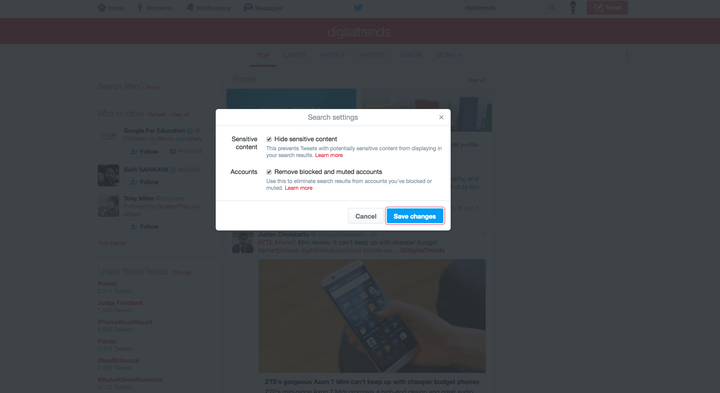
Having landed on desktop earlier this month, safe search is now available on Twitter for Android. The feature, which hides content deemed “sensitive” from search results, is part of the company’s efforts to suppress abuse on its platform.
The “safe search” option is automatically enabled on both the web and Android. However, users do have the option to disable the function.
To access safe search on desktop simply head into search and then click on the overflow button. This will bring up a drop-down menu with “search settings” at the very top of the list: click on it and you’ll be given the option turn the feature off — or leave it unchanged to keep it on. Desktop users must also click “save changes”. Safe search is also heading to Twitter for iOS soon.
The update brings to mind Google’s SafeSearch filter, itself designed to enable people to block violent or adult images from appearing in search results.
Twitter is also collapsing potentially abusive and “low-quality” replies from conversations on desktop. As a result, when you click to expand a tweet with a long list of replies, you are no longer shown sensitive content in correlation with other responses, especially if it is deemed as irrelevant to the thread. Users can still access these tweets by scrolling through a conversation and selecting “show less relevant replies” at the bottom of the list.
A Twitter spokesperson told Digital Trends the company is using machine learning algorithms to identify, analyze, and flag abusive tweets. Until now, Twitter has mainly focused on improving and enhancing its reporting functions for users. Its new approach sounds similar to the models being utilized by Facebook in regards to its News Feed. However, the big blue social network has suffered its fair share of mishaps when it comes to removing material that violates its guidelines.
Unlike Facebook, Twitter insists it is not deleting so-called sensitive content from its site altogether. Instead, its efforts revolve around “collapsing” (basically hiding) offensive items. Referring to the new process in regards to search, Ho said the following in his blog post: “While this type of content will be discoverable if you want to find it, it won’t clutter search results any longer.”
Additionally, the company is cracking down on repeat offenders. Twitter claims it no longer tolerates permanently suspended users from creating new accounts. Its new policy targets users that set up multiple profiles purely to abuse and harass others. Twitter also recently began placing a 12-hour timeout on accounts behaving in an abusive manner toward non-followers.
The company stepped up its approach to harassment in November, shortly after a BuzzFeed report claimed its delayed response to the issue was causing internal chaos.
In December, it plugged a huge gap in its product management department by hiring a new VP of product — an exec position that had been left vacant for almost a year — in the form of ex-Google alum Keith Coleman. Both Ho and Coleman have been tweeting about the new changes over the past couple of weeks.
Updated on 02-23-2017 by Saqib Shah: Added info of safe search availability on Android.