
Using data from the Atacama Large Millimeter/submillimeter Array (ALMA) in Chile, a team of researchers has been conducting a survey on protoplanetary disks — the belts of dust that eventually form planets around young stars. And the researchers have shared fascinating images of the planets from their survey, showing the various stages of planet formation.
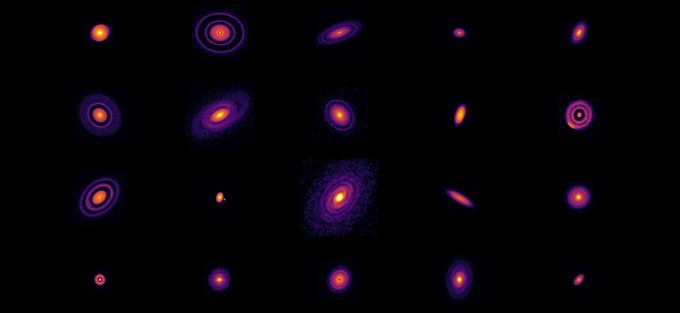
This image shows twenty different protoplanetary disks at various stages of planet formation, taken with the ALMA and collated by the researchers. The team were delighted by the detailed nature of the images that were available from the ALMA: “It was surprising to see possible signatures of planet formation in the very first high-resolution images of young disks,” graduate student and member of the research team Jane Huang said in a statement. “It was important to find out whether these were anomalies or if those signatures were common in disks.”
Previously, studies about planetary formation had only a small number of samples to work from, making it hard to know if observed features were typical or anomalous for early-stage planets. By using data on twenty disks, the researchers can be more statistically confident in their findings and make more useful generalizations about planet formation.
The biggest surprise finding from this survey, according to the researchers, is that large planets which are similar in size and composition to Neptune or Saturn in our Solar System do in fact form much more quickly than previously thought. In addition, these planets tend to form in the outer edges of solar systems, far away from the stars around which they orbit. This is important because it could be an answer to the question of how rocky Earth-sized planets are able to grow without being destroyed in their turbulent younger years.
The current scientific understanding is that a planet is born when dust and gas gradually collect inside a protoplanetary disk, starting off with tiny dust particles and eventually building up to larger rocks. After millions of years, this matter coalesces to form a planet. Under this understanding, it would be expected that this process would be most commonly found in older star systems. But the new ALMA data suggests otherwise: some of the protoplanetary disks that were surveyed were only around one million years old, but still showed the features that would indicate planet formation like rings and gaps. However, even with the larger sample size of twenty protoplanets available to study, more data is needed to know whether this faster planet formation is typical or is an anomaly of a few systems.


