  1. Home
  2. Space
  3. Photography
  4. News

Astronaut reveals source of ‘intriguing’ bright light on Earth

Add as a preferred source on Google

Peering out from the International Space Station 250 miles above Earth recently, European Space Agency astronaut Samantha Cristoforetti spotted an “intriguing” bright light in the middle of a desert.

The bright light of a solar power station as seen from space.
NASA/ESA/Samantha Cristoforetti

Sharing several photos of the strange sight, the Italian space traveler noted how unusual it is to see a bright spot like this in the daytime.

Recommended Videos

After conducting some research, she was able to confirm that the light was coming from a tower at a solar thermal power plant in Israel’s Negev desert.

“Intriguing sight! A bright dot in the Negev desert,” Cristoforetti tweeted to her one million followers. “So unusual to see human-made lights in day passes! It’s a concentrated solar power plant, one of the technologies to get renewable energy from the Sun. With one of the world’s tallest solar power towers!”

Intriguing sight! A bright dot in the Negev desert…so unusual to see human-made lights in day passes! It’s a concentrated solar power plant, one of the technologies to get renewable energy from the Sun. With one of the world’s tallest solar power towers! #MissionMinerva pic.twitter.com/MFbCpXpxmG

— Samantha Cristoforetti (@AstroSamantha) August 25, 2022

The Ashalim Solar Thermal Power Station spotted by the ISS astronaut comprises more than 50,000 computer-controlled heliostats, or mirrors, with a 250-meter-high solar power tower at its center.

The mirrors track the sun, reflecting its light onto a boiler at the top of the tower that produces steam to power a turbine. The plant reportedly produces enough energy to power around 70,000 households.

Below is a closer image of the plant as seen on Google Maps:
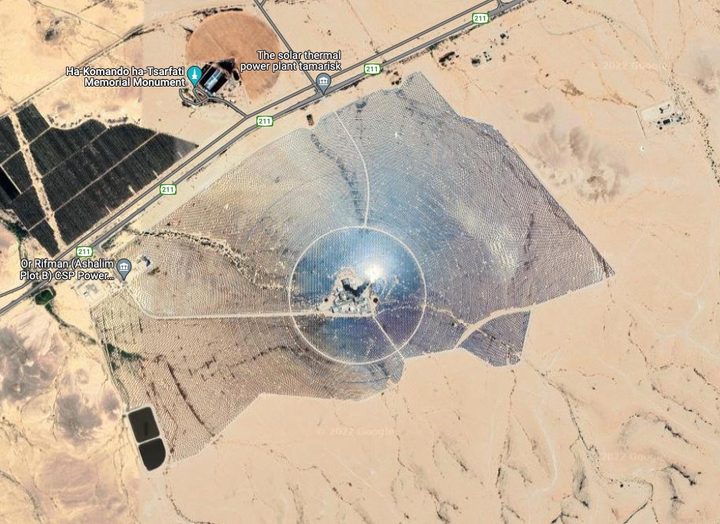
A solar thermal power station in Israel, as seen from space.
Google

And here’s a picture of the tower captured from the ground:

 Ashalim Solar Thermal Power Station.
Iskra Piotr/Creative Commons

During their downtime, ISS astronauts like to head to the station’s seven-window Cupola module to take in the amazing panoramic views of Earth and beyond. Some, like Cristoforetti, like to grab one of the station’s Nikon DSLR cameras to capture some of the extraordinary scenery.

Recent space station inhabitant Thomas Pesquet was particularly handy with the camera, and went to great lengths to give himself the best chance of grabbing some top shots during his stay.

Trevor Mogg
Contributing Editor
Not so many moons ago, Trevor moved from one tea-loving island nation that drives on the left (Britain) to another (Japan)…
Artemis II crew preps for lunar orbit – and Orion’s cosmic commode
'It's the one place we can go during the mission where we can actually feel like we’re alone.'
The Orion spacecraft's toilet.

Four astronauts are about to embark on a historic voyage that will take them around the moon in a spacecraft about the size of a large camper van.

During the Artemis II mission, NASA astronauts Reid Wiseman, Victor Glover, and Christina Koch, and the Canadian Space Agency’s Jeremy Hansen, will spend 10 days inside the Orion capsule after being blasted to space by the SLS rocket from the Kennedy Space Center in Florida, hopefully next week.

Read more
It’s here! NASA reveals full livestream schedule for crewed moon mission
The coverage starts on Friday.
NASA's SLS lunar rocket on the launchpad at the Kennedy Space Center, with the moon shining brightly in the background.

The excitement is building with NASA now just a few days away from sending four astronauts on a voyage around the moon.

On Wednesday, the space agency shared its schedule for coverage of the final buildup and main event, including a Q&A with the astronauts this Friday, blast off on Wednesday, April 1, and regular updates as the crew make their way to the moon.

Read more
Peek inside NASA’s Mars habitat where humans train for life on the red planet
Four volunteers are staying in isolation for more than a year.
A scene inside NASA's Mars simulation habitat.

NASA has offered a sneak peek inside its Mars simulation habitat where four volunteers have now spent 150 days isolated from the outside world.

By living within the confines of the 1,700-square-foot Mars Dune Alpha habitat at the Johnson Space Center in Houston, Ross Elder, Ellen Ellis, Matthew Montgomery, and James Spicer are helping NASA to better prepare for long-duration missions that will take humans into deep space.

Read more