  1. Home
  2. Space
  3. Emerging Tech
  4. News

First images of the Bennu asteroid sent by NASA’s OSIRIS-REx Spacecraft

Add as a preferred source on Google

OSIRIS-REx Captures 'Super-Resolution' View of Bennu
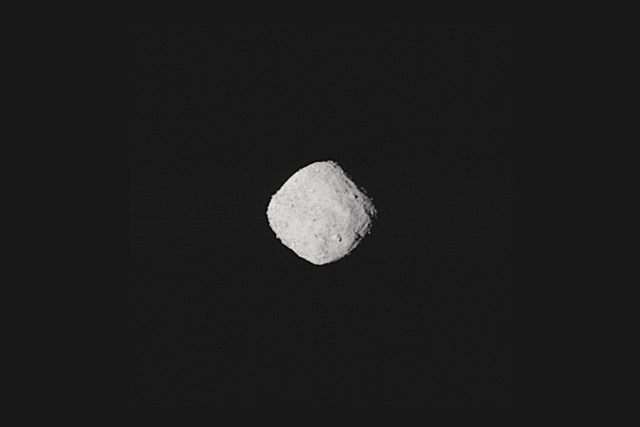
This “super-resolution” view of asteroid Bennu was created using eight images obtained by NASA’s OSIRIS-REx spacecraft on Oct. 29, 2018. NASA/Goddard/University of Arizona

The first images of the Bennu asteroid, target of the OSIRIS-REx spacecraft mission, have been shared by NASA. The craft, fully titled the “Origins Spectral Interpretation Resource Identification Security – Regolith Explorer” (OSIRIS-REx), set out on September 8 2016 and is currently around a month out from its destination. It will collect a sample from the Bennu asteroid and bring it back to Earth for scientists to study, in order to answer questions about the early solar system and to learn about both the hazards and the resources that exist in near-Earth space.

Recommended Videos

The Bennu asteroid was chosen for study for reasons both practical — because it is relatively close to the Earth and is large enough to spin slowly, making it easier to touch down on — and scientific — because the asteroid is very old, potentially even older than the solar system itself, and is well preserved. Scientists believe that it could be a kind of time capsule, showing conditions of the early solar system, and that it could even give clues about the origin of life.

Bennu is around 500m in diameter, making it a little larger than the height of the Empire State Building, and is believed to be a fragment of a catastrophic collision between two larger asteroids that occurred between 1 billion and 2 billion years ago. The asteroid is rich in carbon, which is critical for life-forming compounds on Earth, and it is thought to contain organic molecules like adenine, guanine, hypoxanthine, and more. Most importantly for the potential formation of life, there could also be water trapped in the minerals that make up the asteroid.

This set of 16 images shows the OSIRIS-REx spacecraft’s steady approach toward the asteroid Bennu during the last half of October 2018. NASA/Goddard/University of Arizona

The OSIRIS-REx craft is on course to touch down on Bennu’s surface in July 2020, when it will collect between 60 and 2,000 grams of dirt and rocks from the asteroid, depending on the conditions there. If the probe is successful in gathering 2,000 grams of material, it would be by far the largest sample collected from a space object since the Apollo Moon landing brought back moon rocks. The sample will be packed up safely into a capsule inside the craft and will be sent back to Earth, where it should be dropped into the west desert of Utah in 2023.

The sixteen images of Bennu released this week show the OSIRIS-REx craft approaching the asteroid at the rate of one image per day, starting at 27,340 miles out from Bennu and ending at just 200 miles out.

Georgina Torbet
Georgina has been the space writer at Digital Trends space writer for six years, covering human space exploration, planetary…
Artemis II crew preps for lunar orbit – and Orion’s cosmic commode
'It's the one place we can go during the mission where we can actually feel like we’re alone.'
The Orion spacecraft's toilet.

Four astronauts are about to embark on a historic voyage that will take them around the moon in a spacecraft about the size of a large camper van.

During the Artemis II mission, NASA astronauts Reid Wiseman, Victor Glover, and Christina Koch, and the Canadian Space Agency’s Jeremy Hansen, will spend 10 days inside the Orion capsule after being blasted to space by the SLS rocket from the Kennedy Space Center in Florida, hopefully next week.

Read more
It’s here! NASA reveals full livestream schedule for crewed moon mission
The coverage starts on Friday.
NASA's SLS lunar rocket on the launchpad at the Kennedy Space Center, with the moon shining brightly in the background.

The excitement is building with NASA now just a few days away from sending four astronauts on a voyage around the moon.

On Wednesday, the space agency shared its schedule for coverage of the final buildup and main event, including a Q&A with the astronauts this Friday, blast off on Wednesday, April 1, and regular updates as the crew make their way to the moon.

Read more
Peek inside NASA’s Mars habitat where humans train for life on the red planet
Four volunteers are staying in isolation for more than a year.
A scene inside NASA's Mars simulation habitat.

NASA has offered a sneak peek inside its Mars simulation habitat where four volunteers have now spent 150 days isolated from the outside world.

By living within the confines of the 1,700-square-foot Mars Dune Alpha habitat at the Johnson Space Center in Houston, Ross Elder, Ellen Ellis, Matthew Montgomery, and James Spicer are helping NASA to better prepare for long-duration missions that will take humans into deep space.

Read more