  1. Home
  2. Space
  3. Emerging Tech
  4. News

InSight lander successfully places its seismometer onto the surface of Mars

Add as a preferred source on Google

Another update from the surface of Mars, as NASA’s InSight lander has successfully deployed its first instrument onto the planet’s surface. This week the lander placed its copper-colored seismometer onto the ground in front of it, from where the instrument can gather data about vibrations deep within the planet.

Placing the seismometer, formally known as the Seismic Experiment for Interior Structure (SEIS), was a delicate operation because it needed to be positioned just right, on level ground and avoiding any large rocks or other potential hazards. The NASA team made use of a model in the JPL test bed to make sure that the commands that they sent to the lander would result in the correct movements to place the instrument. They also used images gathered by the lander’s Instrument Deployment Camera to check the surface was clear of obstructions before the instrument was lifted off the lander body and placed onto the ground.

Recommended Videos

Another issue was that the lander is sitting in a sand-filled hollow that is at a slight angle, and the seismometer needs to be placed on level ground. The ground on which it currently sits is at a very slight angle of two to three degrees, but the team is confident that they can level it within the next few days.
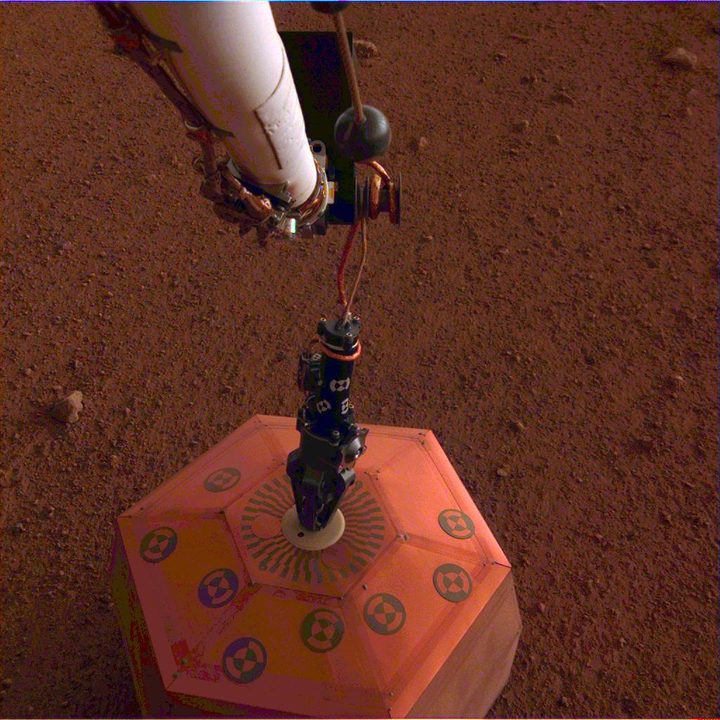
NASA’s InSight lander placing its seismometer on Mars NASA/JPL-Caltech

The seismometer is InSight’s most important instrument, being required for three quarters of the mission’s science objectives. Its function is to listen for vibrations from within the ground of Mars, which are known as marsquakes. When a marsquake occurs, it acts like a flashbulb, allowing scientists to see the planet’s interior by looking at the way that the seismic waves pass through the different layers of the planet. With this information, the scientists can make determinations about the size of the layers inside the planet and the materials that they may be composed of.

Philippe Lognonné, principal investigator of SEIS, described the instrument as like an audio-capturing device — appropriate given that it captured the sounds of Martian winds recently. “Having the seismometer on the ground is like holding a phone up to your ear,” he said. “We’re thrilled that we’re now in the best position to listen to all the seismic waves from below Mars’ surface and from its deep interior.”

Georgina Torbet
Georgina has been the space writer at Digital Trends space writer for six years, covering human space exploration, planetary…
Artemis II crew preps for lunar orbit – and Orion’s cosmic commode
'It's the one place we can go during the mission where we can actually feel like we’re alone.'
The Orion spacecraft's toilet.

Four astronauts are about to embark on a historic voyage that will take them around the moon in a spacecraft about the size of a large camper van.

During the Artemis II mission, NASA astronauts Reid Wiseman, Victor Glover, and Christina Koch, and the Canadian Space Agency’s Jeremy Hansen, will spend 10 days inside the Orion capsule after being blasted to space by the SLS rocket from the Kennedy Space Center in Florida, hopefully next week.

Read more
It’s here! NASA reveals full livestream schedule for crewed moon mission
The coverage starts on Friday.
NASA's SLS lunar rocket on the launchpad at the Kennedy Space Center, with the moon shining brightly in the background.

The excitement is building with NASA now just a few days away from sending four astronauts on a voyage around the moon.

On Wednesday, the space agency shared its schedule for coverage of the final buildup and main event, including a Q&A with the astronauts this Friday, blast off on Wednesday, April 1, and regular updates as the crew make their way to the moon.

Read more
Peek inside NASA’s Mars habitat where humans train for life on the red planet
Four volunteers are staying in isolation for more than a year.
A scene inside NASA's Mars simulation habitat.

NASA has offered a sneak peek inside its Mars simulation habitat where four volunteers have now spent 150 days isolated from the outside world.

By living within the confines of the 1,700-square-foot Mars Dune Alpha habitat at the Johnson Space Center in Houston, Ross Elder, Ellen Ellis, Matthew Montgomery, and James Spicer are helping NASA to better prepare for long-duration missions that will take humans into deep space.

Read more