  1. Home
  2. Space
  3. Emerging Tech
  4. News

Hope it doesn’t melt! Rocket to ISS carries vital supplies — including ice cream

Add as a preferred source on Google

A rocket has launched over Virginia’s eastern shore and is carrying supplies to the International Space Station (ISS). The Antares rocket, a launch system developed by Orbital Sciences Corporation and used successfully by NASA in the past, took to the skies to carry a Cygnus spacecraft named the S.S. John Young on the first stage of its journey to the ISS.
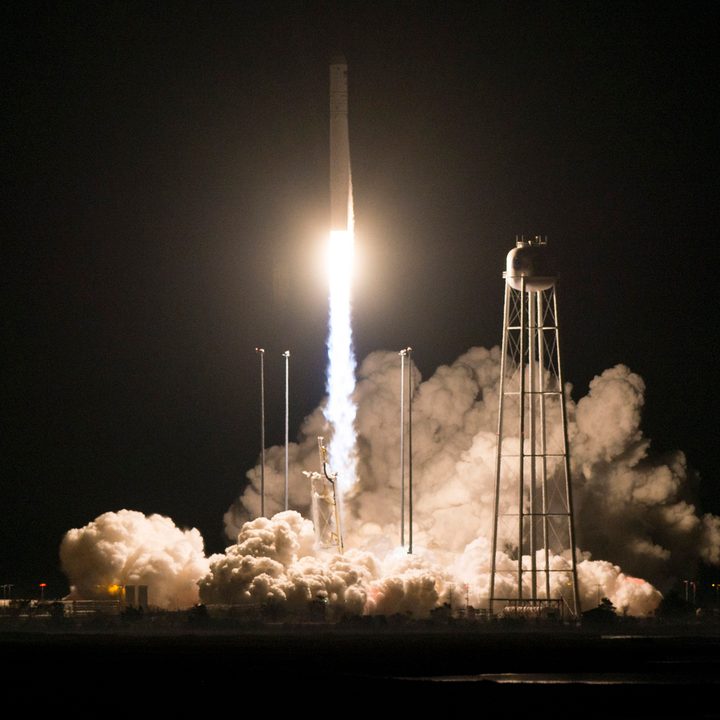
NASA/Joel Kowsky

Inside the spacecraft are essential supplies for the ISS itself and the crew onboard, such as scientific equipment and food. Around 7,400 lbs. (3,400 kilograms) of supplies were packed into the craft, including a few special treats for the astronauts like fresh fruit and ice cream. The other cargo includes vehicle hardware, computer resources, and spacewalk equipment.

Recommended Videos

The launch had to be delayed for two days due to poor weather, but it was able to go ahead on November 17 once skies cleared. Now the craft will fly through space over the weekend and should arrive at the ISS on Monday at 5:20 a.m. EST. Once it comes near to the space station, the craft will be captured with a robotic arm controlled by the astronauts, allowing it to be reeled in and its cargo collected.

Joel Montalbano, NASA’s deputy station program manager, described the launch as “outstanding” and praised the team at private company Northrop Grumman which built the rocket. He also discussed the challenges faced by the ISS as there are currently only three astronauts on board instead of the expected five. In October the launch of a Soyuz spacecraft was aborted due to a deformed sensor and the American and Russian crew were forced to perform a dramatic emergency landing. This meant that the extra crew members were not able to make it to the ISS.

But the smaller crew on the ISS has apparently been operating without issue, and has been able to keep up with scheduled maintenance and research activities. “The crew members on board have picked it up and they’ve been really working hard and picking up the things that had to get done,” Montalbano said. “Any science or research that was time-critical is being done, and we’re reprioritizing other activities.”

Georgina Torbet
Georgina has been the space writer at Digital Trends space writer for six years, covering human space exploration, planetary…
Artemis II crew preps for lunar orbit – and Orion’s cosmic commode
'It's the one place we can go during the mission where we can actually feel like we’re alone.'
The Orion spacecraft's toilet.

Four astronauts are about to embark on a historic voyage that will take them around the moon in a spacecraft about the size of a large camper van.

During the Artemis II mission, NASA astronauts Reid Wiseman, Victor Glover, and Christina Koch, and the Canadian Space Agency’s Jeremy Hansen, will spend 10 days inside the Orion capsule after being blasted to space by the SLS rocket from the Kennedy Space Center in Florida, hopefully next week.

Read more
It’s here! NASA reveals full livestream schedule for crewed moon mission
The coverage starts on Friday.
NASA's SLS lunar rocket on the launchpad at the Kennedy Space Center, with the moon shining brightly in the background.

The excitement is building with NASA now just a few days away from sending four astronauts on a voyage around the moon.

On Wednesday, the space agency shared its schedule for coverage of the final buildup and main event, including a Q&A with the astronauts this Friday, blast off on Wednesday, April 1, and regular updates as the crew make their way to the moon.

Read more
Peek inside NASA’s Mars habitat where humans train for life on the red planet
Four volunteers are staying in isolation for more than a year.
A scene inside NASA's Mars simulation habitat.

NASA has offered a sneak peek inside its Mars simulation habitat where four volunteers have now spent 150 days isolated from the outside world.

By living within the confines of the 1,700-square-foot Mars Dune Alpha habitat at the Johnson Space Center in Houston, Ross Elder, Ellen Ellis, Matthew Montgomery, and James Spicer are helping NASA to better prepare for long-duration missions that will take humans into deep space.

Read more