  1. Home
  2. Space
  3. Emerging Tech
  4. News

Parker Solar Probe captures first image from within the atmosphere of the sun

Add as a preferred source on Google

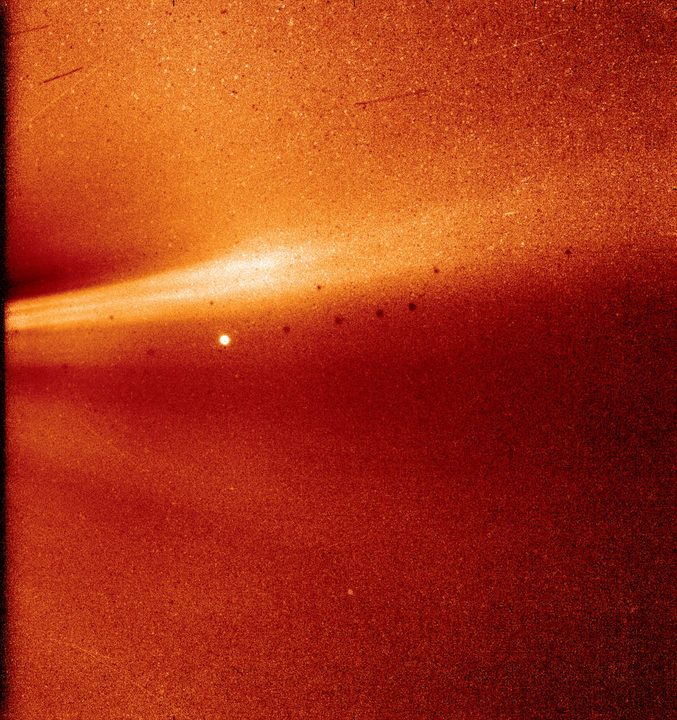
NASA has shared a first image from inside the atmosphere of the sun, taken by the Parker Solar Probe. Last month the probe made the closest ever approach to a star, gathering data which scientists have been working on and have released to the public this week.

The probe skimmed past the surface of the sun on a solar encounter phase which ran from October 31 to November 11, reaching a record-breaking speed of 213,200 miles per hour. Coming within 15 million miles of the sun’s surface, the probe may encounter extreme temperatures of up to 2,500°F on its heat shield, which is turned towards the sun to protect the instruments inside.

Recommended Videos

The probe captured this stunning image from within the sun’s atmosphere, showing a coronal streamer — a structure of solar material that lies over regions of the sun where there is increased solar activity. You can see Mercury as the bright dot near the center of the image, while the darker spots nearby are a result of background correction. This image was taken a mere 16.9 million miles from the surface of the sun:
NASA/Naval Research Laboratory/Parker Solar Probe

The mission is just beginning for the Parker Solar Probe — it will complete a total of 24 orbits around the sun over its seven year mission. During the mission the probe will encounter the planet Venus seven times, using a gravity assist maneuver to slow the speed of the probe so that it can get closer to the sun and gather more data. At its closest, the probe should pass within just 3.8 million miles of the sun. The observations gathered from within the corona of the sun will be used to examine questions like why it is that the temperature in the sun’s atmosphere can be so much higher than the temperature on the sun’s surface.

Nour Raouafi, a scientist from the Parker Solar Probe project at the Johns Hopkins University Applied Physics Lab, said that there were a lot of unknowns when working with a probe venturing into extreme conditions: “We don’t know what to expect so close to the sun until we get the data, and we’ll probably see some new phenomena,” he said. “Parker is an exploration mission — the potential for new discoveries is huge.”

Georgina Torbet
Georgina has been the space writer at Digital Trends space writer for six years, covering human space exploration, planetary…
Artemis II crew preps for lunar orbit – and Orion’s cosmic commode
'It's the one place we can go during the mission where we can actually feel like we’re alone.'
The Orion spacecraft's toilet.

Four astronauts are about to embark on a historic voyage that will take them around the moon in a spacecraft about the size of a large camper van.

During the Artemis II mission, NASA astronauts Reid Wiseman, Victor Glover, and Christina Koch, and the Canadian Space Agency’s Jeremy Hansen, will spend 10 days inside the Orion capsule after being blasted to space by the SLS rocket from the Kennedy Space Center in Florida, hopefully next week.

Read more
It’s here! NASA reveals full livestream schedule for crewed moon mission
The coverage starts on Friday.
NASA's SLS lunar rocket on the launchpad at the Kennedy Space Center, with the moon shining brightly in the background.

The excitement is building with NASA now just a few days away from sending four astronauts on a voyage around the moon.

On Wednesday, the space agency shared its schedule for coverage of the final buildup and main event, including a Q&A with the astronauts this Friday, blast off on Wednesday, April 1, and regular updates as the crew make their way to the moon.

Read more
Peek inside NASA’s Mars habitat where humans train for life on the red planet
Four volunteers are staying in isolation for more than a year.
A scene inside NASA's Mars simulation habitat.

NASA has offered a sneak peek inside its Mars simulation habitat where four volunteers have now spent 150 days isolated from the outside world.

By living within the confines of the 1,700-square-foot Mars Dune Alpha habitat at the Johnson Space Center in Houston, Ross Elder, Ellen Ellis, Matthew Montgomery, and James Spicer are helping NASA to better prepare for long-duration missions that will take humans into deep space.

Read more