  1. Home
  2. Space
  3. Emerging Tech
  4. News

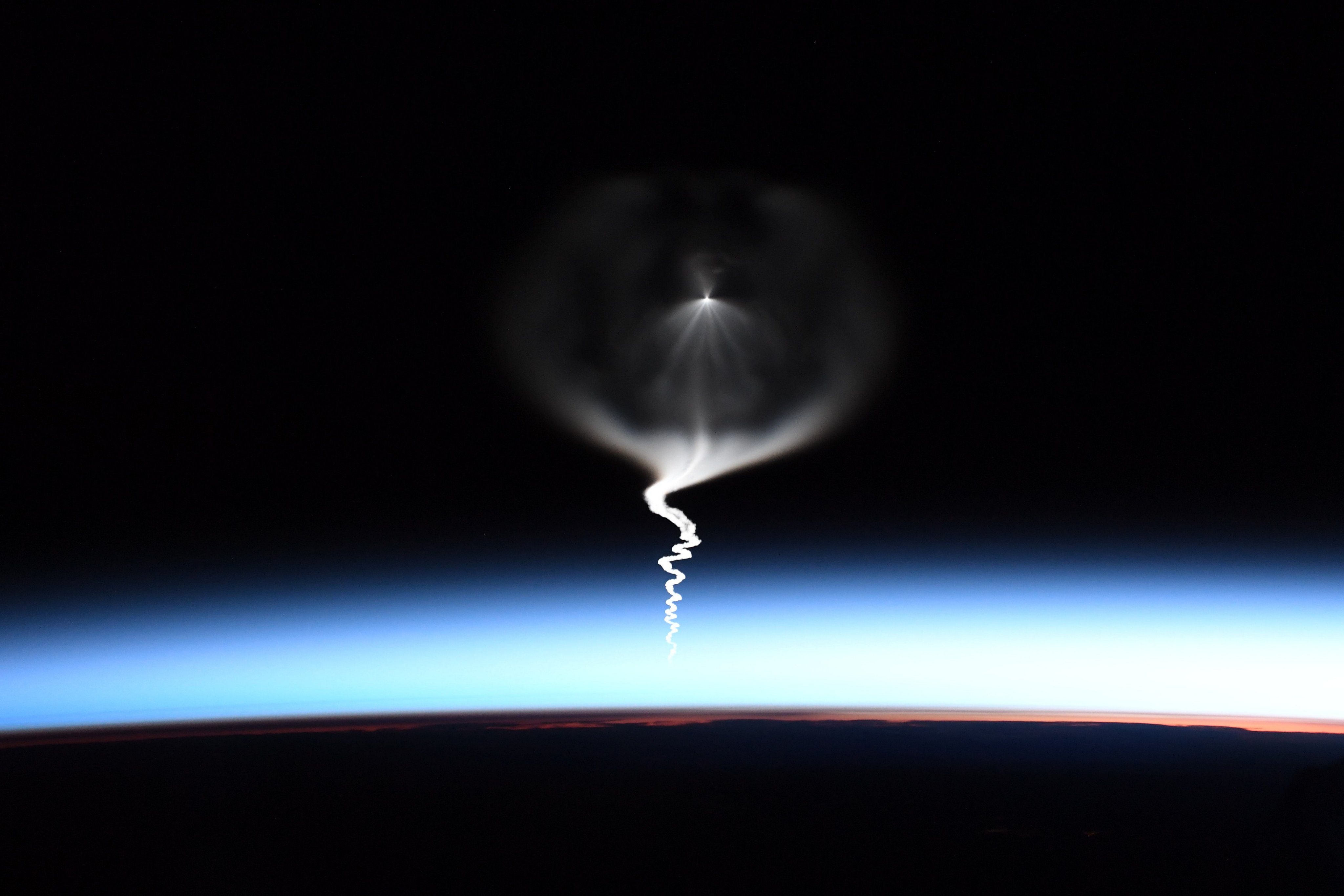
Stunning image shows astronaut’s-eye view of rocket approaching the ISS

Add as a preferred source on Google

The approach of Soyuz 61, as seen from the International Space Station. Christina H Koch

This week a new group of astronauts launched from the Baikonur Cosmodrome in Kazakhstan headed for the International Space Station. The three new ISS crew members, Jessica Meir of NASA, Oleg Skripochka of Roscosmos, and Hazza Ali Almansoori of the Emirati Space Agency docked with the station several hours later, temporarily taking the population of the station to nine people. That marks the largest crew aboard the ISS since 2015, but members of previous Expedition team 60 will be returning to Earth in around a week.

Recommended Videos

While the transferring of astronauts to and from the ISS is fairly standard for space agencies these days, there was something special about this mission. Astronaut Christina Koch was looking forward to being joined by her best friend and fellow NASA astronaut Jessica Meir, so she decided to capture an image of the incoming craft from her perspective on board the ISS. The result is the stunning photo above, showing the ghostly trails from the first stage and the cloud of vapor around the craft.

The astronauts traveled aboard a Soyuz MS-15 spacecraft, docking at the station’s Zvezda service module six hours after launch. The crew will stay aboard the ISS for at least six months and will be working on scientific projects in varied fields including biology, physical sciences, and the development of new technologies. They will also perform upgrades to the stations including installing new lithium-ion batteries which collect power from the station’s solar panels, part of an ongoing project to update the ISS’s power system.

Further work planned includes the upgrade and repair of the Alpha Magnetic Spectrometer, the most advanced magnetic spectrometer in space which is used for particle physics experiments. The tool is used to search for dark matter and antimatter, as well as measuring cosmic rays. It cost a staggering $2 billion to install, but a problem with the cooling system has prevented the ISS crew from taking full advantage of it. As it is located outside of the space station, in order to fix the problem the crew will take a series of spacewalks to perform the highly complex repairs.

Georgina Torbet
Georgina has been the space writer at Digital Trends space writer for six years, covering human space exploration, planetary…
Artemis II crew preps for lunar orbit – and Orion’s cosmic commode
'It's the one place we can go during the mission where we can actually feel like we’re alone.'
The Orion spacecraft's toilet.

Four astronauts are about to embark on a historic voyage that will take them around the moon in a spacecraft about the size of a large camper van.

During the Artemis II mission, NASA astronauts Reid Wiseman, Victor Glover, and Christina Koch, and the Canadian Space Agency’s Jeremy Hansen, will spend 10 days inside the Orion capsule after being blasted to space by the SLS rocket from the Kennedy Space Center in Florida, hopefully next week.

Read more
It’s here! NASA reveals full livestream schedule for crewed moon mission
The coverage starts on Friday.
NASA's SLS lunar rocket on the launchpad at the Kennedy Space Center, with the moon shining brightly in the background.

The excitement is building with NASA now just a few days away from sending four astronauts on a voyage around the moon.

On Wednesday, the space agency shared its schedule for coverage of the final buildup and main event, including a Q&A with the astronauts this Friday, blast off on Wednesday, April 1, and regular updates as the crew make their way to the moon.

Read more
Peek inside NASA’s Mars habitat where humans train for life on the red planet
Four volunteers are staying in isolation for more than a year.
A scene inside NASA's Mars simulation habitat.

NASA has offered a sneak peek inside its Mars simulation habitat where four volunteers have now spent 150 days isolated from the outside world.

By living within the confines of the 1,700-square-foot Mars Dune Alpha habitat at the Johnson Space Center in Houston, Ross Elder, Ellen Ellis, Matthew Montgomery, and James Spicer are helping NASA to better prepare for long-duration missions that will take humans into deep space.

Read more