  1. Home
  2. Space
  3. Emerging Tech
  4. Legacy Archives

SpaceX unveils Dragon V2 spacecraft, complete with 3D-printed engines

Add as a preferred source on Google

SpaceX founder and CEO Elon Musk has unveiled the Dragon V2, a spacecraft he hopes will one day take astronauts to and from the International Space Station (ISS).

At a special event at the company’s Hawthorne, California factory on Thursday, Musk took the wraps off an updated version of the existing Dragon spacecraft, which up to now has made four trips to the ISS, delivering vital supplies for crew members.

Recommended Videos

While the Dragon craft has never taken humans into space, the V2 capsule, which is set to become part of a new generation of spacecraft when it goes into service, can carry up to seven astronauts “for several days.”

Musk promises the new spacecraft, which could go into service as early as 2016, will have far superior landing capabilities to its predecessor, able to put down “anywhere on land with the accuracy of a helicopter.”

The Dragon’s parachutes will remain with the V2, but will only deploy if there’s a problem with the engines or propulsion system prior to landing.
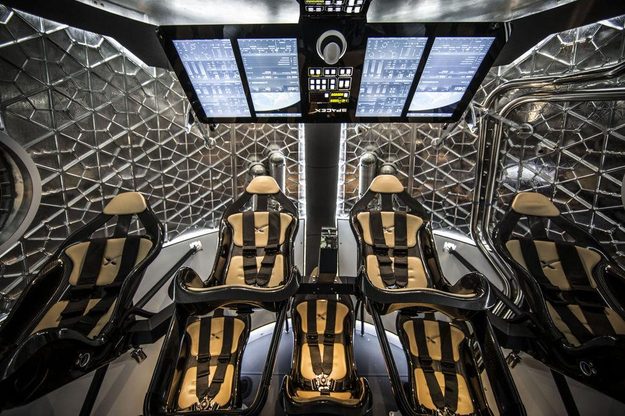
spacex dragon v2 interior
Image used with permission by copyright holder

It can also dock with the space station autonomously, without the aid of the ISS’s arm, an improvement over the Dragon that Musk described as a “significant upgrade.”

The V2’s design allows for rapid reuse of the spacecraft, something the SpaceX boss said was vital for revolutionizing access to space.

“So long as we continue to throw away rockets and spacecraft, we’ll never have true access to space; it’ll always be incredibly expensive,” Musk said.

The presentation gave attendees an up-close look at some of the V2’s components, including its new SuperDraco engines. Whereas each of the Dragon’s Draco engines produces about 100 pounds of thrust, a SuperDraco engine is capable of producing 16,000 pounds of thrust, “hence the ‘super,’” Musk quipped. In addition, the SuperDraco will be the first “fully printed” engine, making it the first such engine to see flight.

The SpaceX team believes its latest spacecraft design is another step forward to bringing down the cost of space flight as it vies for NASA development funds and contracts.

You can check out Musk’s 15-minute presentation below.

Trevor Mogg
Contributing Editor
Not so many moons ago, Trevor moved from one tea-loving island nation that drives on the left (Britain) to another (Japan)…
Artemis II crew preps for lunar orbit – and Orion’s cosmic commode
'It's the one place we can go during the mission where we can actually feel like we’re alone.'
The Orion spacecraft's toilet.

Four astronauts are about to embark on a historic voyage that will take them around the moon in a spacecraft about the size of a large camper van.

During the Artemis II mission, NASA astronauts Reid Wiseman, Victor Glover, and Christina Koch, and the Canadian Space Agency’s Jeremy Hansen, will spend 10 days inside the Orion capsule after being blasted to space by the SLS rocket from the Kennedy Space Center in Florida, hopefully next week.

Read more
It’s here! NASA reveals full livestream schedule for crewed moon mission
The coverage starts on Friday.
NASA's SLS lunar rocket on the launchpad at the Kennedy Space Center, with the moon shining brightly in the background.

The excitement is building with NASA now just a few days away from sending four astronauts on a voyage around the moon.

On Wednesday, the space agency shared its schedule for coverage of the final buildup and main event, including a Q&A with the astronauts this Friday, blast off on Wednesday, April 1, and regular updates as the crew make their way to the moon.

Read more
Peek inside NASA’s Mars habitat where humans train for life on the red planet
Four volunteers are staying in isolation for more than a year.
A scene inside NASA's Mars simulation habitat.

NASA has offered a sneak peek inside its Mars simulation habitat where four volunteers have now spent 150 days isolated from the outside world.

By living within the confines of the 1,700-square-foot Mars Dune Alpha habitat at the Johnson Space Center in Houston, Ross Elder, Ellen Ellis, Matthew Montgomery, and James Spicer are helping NASA to better prepare for long-duration missions that will take humans into deep space.

Read more